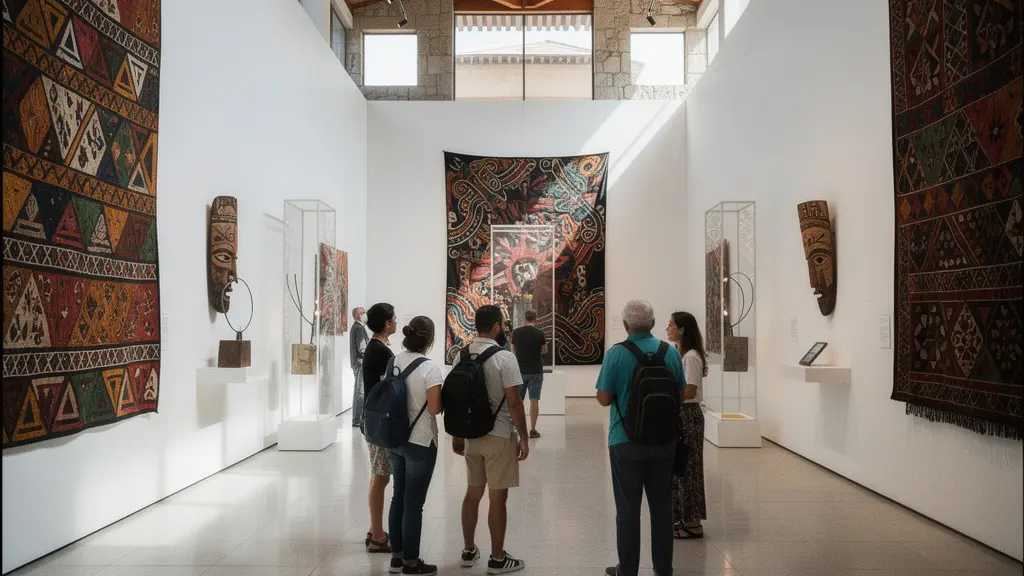
The deepest connection to a new culture isn’t found in a guidebook, but in learning to read the visual language of its art.
- Authentic understanding comes from decoding an object’s context, not just admiring its form.
- Distinguishing between tourist-facing craft and authentic local art is a critical skill for any thoughtful traveler.
Recommendation: Start by looking for the story behind one object—its materials, its creator, and its original purpose—to unlock a richer, more meaningful travel experience.
For the traveler yearning for a connection deeper than a landmark selfie, the local art scene often feels like the most direct path to a culture’s soul. We flock to museums, wander through street art alleys, and browse artisan markets, hoping to glimpse something authentic. Yet, we often leave with beautiful photos but only a surface-level understanding. The common advice—to “visit galleries” or “buy local”—misses the most crucial step: learning how to see.
The real journey begins when we stop treating art as a passive spectacle and start engaging with it as an active dialogue. It requires moving past the initial aesthetic impression to ask more profound questions. Why is this object shaped this way? What story do its materials tell? Who was it made for, and what role did it play in daily or spiritual life? This is the work of a cultural explorer, not just a tourist.
This guide is built on a simple but transformative premise: to truly understand a culture through its art, you must learn to decode its unique cultural grammar. It’s about recognizing that the very distinction between “art” and “craft,” the symbols embedded in a pattern, or an object’s journey from a sacred ritual to a museum display are all chapters in a nation’s story. We will move beyond simply looking at art and begin to understand its language, unlocking a far more profound and personal connection to the places we visit.
In the sections that follow, we will explore the practical methods for reading this visual language, from understanding spiritual art to ethically collecting artifacts, providing you with a new lens through which to see the world.
Summary: Beyond Souvenirs: How to Read a Culture Through Its Local Art
- Why Does Visual Art Replace Text in Many Spiritual Traditions?
- Craft or Fine Art: How Different Cultures Draw the Line Differently?
- How Did Colonialism Create Hybrid Art Forms in The Americas?
- The “Exoticism” Trap That Blinds Tourists to Real Cultural Meanings
- When to Visit to See Ephemeral Art Traditions Like Sand Mandalas?
- How to Pair African Sculptures With Asian Ink Wash Paintings Harmoniously?
- Universal Museum vs. Source Community: Who Should Own Heritage?
- How to Collect African Masks Respectfully and Authentically?
Why Does Visual Art Replace Text in Many Spiritual Traditions?
In many cultures, the most profound spiritual truths are not written in books but are carved, painted, and woven into visual art. This isn’t due to a lack of literacy, but a recognition that some experiences transcend the limits of language. The spiritual realm often deals with concepts that are ineffable—too vast or subtle to be captured by words. A comprehensive 2024 bibliometric study examining 2544 pieces of academic literature highlights the extensive and complex relationship between religion and visual representation. This body of research confirms that art serves as a crucial bridge between the material and the divine.
Visual art becomes a vessel for the sacred, offering a direct, intuitive pathway to understanding that bypasses intellectual processing. A symbol, a color, or a specific geometric pattern can convey complex cosmological ideas or emotional states instantly. For the practitioner, interacting with a sacred object—whether it’s a Hindu murti, a Christian icon, or a Buddhist thangka—is not merely looking at a picture; it’s an act of communion. The art is a focal point for meditation, a reminder of divine attributes, and a conduit for spiritual energy. It makes the abstract tangible and the distant present.
This challenge of expressing the inexpressible is something mystics and artists have in common. As scholar Carlos Miguel Gómez-Rincón notes, the spiritual journey often leads to a reality that cannot be fully explained. He observes:
Mystics do not remain silent after having dwelled in the divine reality which cannot be expressed in words or captured in concepts. Rather, they face the hassle of communicating what they have experienced, and thus share the task of the artist.
– Carlos Miguel Gómez-Rincón, Journal for the Study of Spirituality
For the traveler, this means approaching spiritual art not as a set of illustrations to a story you haven’t read, but as the story itself. It invites us to quiet our analytical mind and instead feel the harmony, tension, or tranquility the piece evokes. Understanding this function is the first step in reading a culture’s deepest beliefs.
Craft or Fine Art: How Different Cultures Draw the Line Differently?
As a traveler, you might instinctively categorize objects: a painting in a gallery is “fine art,” while a beautifully woven basket in a market is “craft.” This distinction, however, is a distinctly Western cultural construct. It prioritizes individual expression and purely aesthetic contemplation over communal tradition and utility. To truly understand local art, we must dismantle this ingrained hierarchy and embrace the concept of functional beauty.
In many non-Western traditions, particularly in Eastern and many indigenous cultures, no such line exists. An object’s worth is not diminished by its usefulness; rather, its beauty is often enhanced by it. A water pot, a ceremonial robe, or a carved stool are not merely decorative. Their form has been perfected over generations to serve a purpose, and their aesthetic elements are deeply integrated with that function. The anonymous mastery of a weaver who knows the precise tension for a basket’s handle is valued as highly as the signature brushstroke of a painter. This approach celebrates art as an integral part of life, not separate from it.
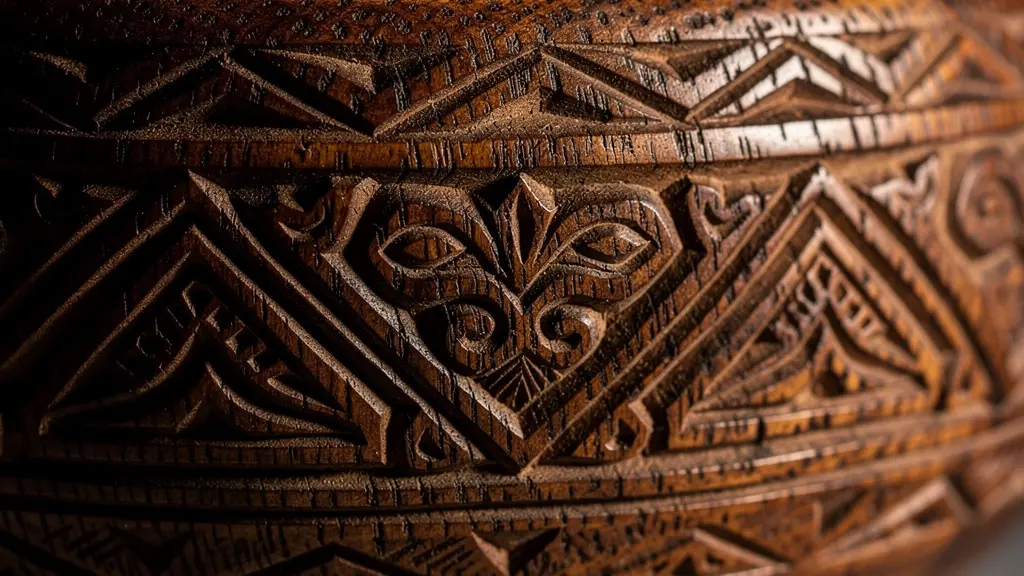
The intricately carved Yoruba bowl shown here is a perfect example. In a Western gallery, it might be displayed as a sculpture, an object of “fine art.” In its original context, it is an object of daily or ritualistic use, a piece of “craft.” The truth is that it is both. Its deep patterns hold symbolic meaning while its form serves a function. Seeing it only as a sculpture is to miss half its story—to ignore its object biography and the hands it was meant to serve.
How Did Colonialism Create Hybrid Art Forms in The Americas?
The art of the Americas is a vivid, and often painful, testament to the collision of cultures. When European colonial powers arrived, they brought with them their own artistic and religious traditions, which they imposed upon indigenous populations. But culture is not a monolith that can be simply replaced. Instead, a process of syncretism occurred, where indigenous beliefs and iconographies were subtly woven into the new, dominant forms of colonial art. This created powerful hybrid art forms that communicated on multiple levels: one for the colonizer, and another, hidden in plain sight, for the colonized.
For indigenous artists, integrating their own symbols into Christian art was a brilliant act of cultural resistance and survival. It allowed them to preserve their cosmology and identity under the watchful eye of the colonial authorities. A statue of a Catholic saint might be carved from a type of wood sacred to a native deity. The vibrant floral patterns adorning a church wall might contain hidden references to local medicinal plants or creation stories. This layering of meaning is a core element of the region’s cultural grammar.
As a traveler, learning to spot these hidden symbols transforms a visit to a colonial-era church or museum from a passive viewing into an active treasure hunt. It allows you to witness a centuries-old dialogue and appreciate the resilience and ingenuity of indigenous cultures. The following checklist provides a starting point for identifying these subtle yet powerful integrations.
Action Plan: Identifying Hidden Indigenous Symbols in Colonial Art
- Examine iconography: Look for attributes of native deities secretly embedded within the traditional iconography of Christian saints.
- Analyze landscapes: Pay attention to the shape of mountains in the background of paintings, especially in the cloak designs of the Virgin Mary, which often echo sacred peaks (Apus).
- Investigate backgrounds: Scrutinize background landscapes and decorative elements for references to indigenous cosmology, such as the three-tiered Andean worldview.
- Observe facial features: Notice when religious figures are depicted with distinctly non-European or indigenous facial features, a clear marker of local adaptation.
- Search for patterns: Look for pre-Columbian symbols, such as the Andean cross (Chakana) or animal motifs, integrated into decorative borders and architectural details.
By using this framework, you begin to see beyond the surface narrative and connect with the deeper, more complex history of the object and the people who made it.
The “Exoticism” Trap That Blinds Tourists to Real Cultural Meanings
One of the greatest obstacles to genuine cultural understanding is the “exoticism trap.” This is the tendency for travelers to seek out and reward art that conforms to a romanticized, often outdated, stereotype of a culture. We look for the “tribal,” the “ancient,” and the “primitive,” and in doing so, we can become blind to the living, breathing, contemporary reality of a place. This creates a market for “tourist art”—objects mass-produced to look “ethnic” but stripped of any real cultural significance.
This kind of contextual blindness prevents us from engaging with authentic local artists who may be blending traditional techniques with modern themes, reflecting the true, evolving state of their culture. It reduces a complex society to a caricature, a souvenir to be purchased. Authentic local art, in contrast, speaks an “aesthetic dialect” specific to its community. Its symbols are used with intention, its materials are chosen for their significance, and its form is dictated by tradition and personal vision, not by what will fit in a suitcase.
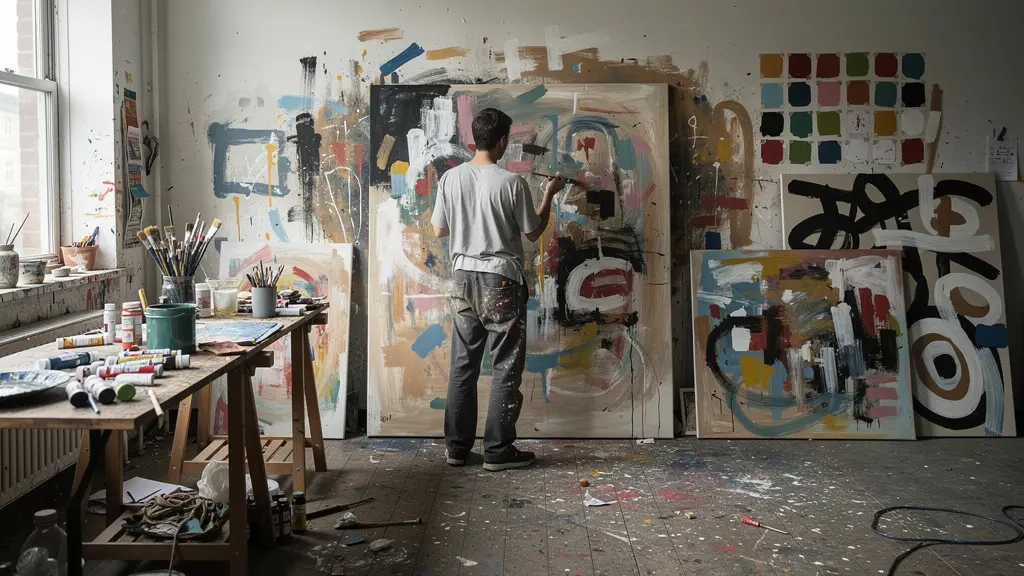
Learning to distinguish between these two categories is crucial. The following table, based on common distinctions noted by art historians, offers a guide to help you identify markers of authenticity versus mass-market production. As analysis from art historical resources shows, paying attention to details like size, materials, and stylistic specificity can reveal an object’s true purpose.
| Tourist Art | Authentic Local Art |
|---|---|
| Portable sizes for travel | Size appropriate to local use |
| Exaggerated ‘tribal’ aesthetics | Subtle, culturally specific symbolism |
| Sacred symbols used decoratively | Appropriate cultural context for symbols |
| Mass production techniques | Traditional methods and materials |
| Generic ‘ethnic’ style | Regional and community-specific styles |
By seeking out art that reflects the culture as it is today, not as we imagine it to be, we not only acquire more meaningful objects but also become more responsible and respectful visitors.
When to Visit to See Ephemeral Art Traditions Like Sand Mandalas?
Not all art is made to last. Some of the world’s most profound artistic traditions are ephemeral, created with the full intention of being destroyed. Tibetan sand mandalas, Indian kolam floor drawings, and festival processions are not about creating a permanent object but about sanctifying a moment in time. For the traveler, witnessing these traditions requires a shift in perspective: the focus is on the process of creation, not the final product.
The timing of your visit is everything. These traditions are tied to specific religious festivals, lunar cycles, or community events. Research is key. Look for calendars of cultural events for your destination, such as the Losar (Tibetan New Year) for mandalas or Pongal in Southern India for kolam. Attending these events offers more than a visual spectacle; it is an immersion into a community’s spiritual life. You are not a spectator in a gallery but a participant in a living ritual.
The act of witnessing both the meticulous creation and the eventual destruction is central to the tradition’s meaning. It is a powerful lesson in impermanence, a core tenet of many Eastern philosophies. The value is not in possessing the art, but in experiencing the focus, devotion, and collective energy that bring it into being. As one reflection on the intersection of art and spirituality notes:
When the moments of creativity and inspiration emerge, those moments of connection with the divine source, it is not the ego that creates reality. Instead, one allows, leaving the ego aside, the manifestation of another form of reality. The act of witnessing the creation and destruction is often an integral part of the tradition’s purpose.
– Experience from a Laboratory of Art and Spirituality, as noted in the Union Seminary Quarterly Review
To engage with ephemeral art is to learn to appreciate the beauty of the temporary. It teaches that the most valuable things we can bring home from our travels are not objects, but memories and a deeper understanding of the diverse ways humans make meaning.
How to Pair African Sculptures With Asian Ink Wash Paintings Harmoniously?
At first glance, pairing a three-dimensional, powerful African sculpture with a minimalist, serene Asian ink wash painting might seem like an impossible design challenge. Their visual languages are worlds apart. One is about solid form, raw material, and potent presence; the other is about empty space, fluid lines, and capturing an essence. To combine them harmoniously, we must move beyond their surface aesthetics and geographic origins.
The secret lies not in matching colors or styles, but in connecting them through a shared feeling or underlying principle. Are both pieces centered on a concept of ancestral reverence? Do they both explore the relationship between humanity and nature? Perhaps the sculpture’s strong vertical lines can echo the calligraphic stroke of a bamboo stalk in the painting. The goal is to create a dialogue between the pieces, allowing their contrasting energies to complement rather than compete with each other. This is about curating an experience, not just decorating a room.
This approach asks us to fundamentally rethink our relationship with the art we collect. They are not just static objects to be displayed, but active agents that shape the feeling of a space and trigger responses within us. Artist and theorist Roy Ascott captured this idea perfectly:
Stop thinking about art works as objects, and start thinking about them as triggers for experiences.
– Roy Ascott
By focusing on the experience you want to create—be it contemplation, energy, or a sense of history—you can find the conceptual thread that ties disparate works together. An African mask celebrating the harvest can resonate with an ink wash painting of a lone fisherman, both speaking to a fundamental reliance on nature. In this way, your collection becomes more than a display of your travels; it becomes a personal map of the universal human experiences you’ve connected with along the way.
Key Takeaways
- True cultural understanding through art requires moving beyond aesthetics to decode an object’s context, function, and history.
- The Western distinction between “fine art” and “craft” often doesn’t apply in other cultures, where functional beauty is paramount.
- Engaging with art ethically means avoiding the “exoticism trap,” supporting contemporary artists, and understanding the complex history of ownership and repatriation.
Universal Museum vs. Source Community: Who Should Own Heritage?
As you stand in a world-class museum in London, Paris, or New York, admiring artifacts from across the globe, a critical question may arise: How did they get here? This question opens up one of the most contentious and important debates in the art world today—the issue of repatriation. For centuries, colonial powers, archaeologists, and collectors removed vast quantities of cultural heritage from their places of origin. The scale is staggering; according to a 2018 French government report, as much as 90% of Africa’s cultural heritage is located in Western museums.
The argument for keeping these objects in “universal museums” is that they are part of a shared global heritage, made accessible to a wide international audience and preserved with state-of-the-art technology. Proponents argue that these institutions can tell a broader story of human history by placing different cultures in dialogue with one another. They may also question whether source countries have the resources to adequately care for the returned objects.
However, for source communities, these are not just objects; they are integral parts of their identity, history, and spiritual life. A mask or sculpture is not merely an artifact to be studied; it is an ancestor, a legal document, or a ritual vessel that loses its meaning when removed from its context. For them, repatriation is a matter of restorative justice, a healing of historical wounds, and a reclamation of their narrative. This perspective challenges the very definition of a museum, as articulated by Professor Dan Hicks:
Let us re-imagine and reinstate the anthropological, archaeological and world culture museum as a site of conscience, of transitional and restorative justice, and of cultural memory. The museum as process, not an end-point.
– Dan Hicks, The Brutish Museums
As a thoughtful traveler, being aware of this debate profoundly changes your museum experience. It encourages you to read the object’s label not just for its date and material, but for its “provenance”—the history of its ownership. Understanding an object’s full biography, including the often-violent story of its acquisition, is essential to engaging with it honestly.
How to Collect African Masks Respectfully and Authentically?
Bringing a piece of art home is a powerful way to keep the memory of a journey alive. When it comes to culturally significant items like African masks, however, collecting carries a heavy responsibility. The line between appreciation and appropriation is thin, and the market is fraught with fakes, stolen items, and objects stripped of their context. Collecting respectfully requires diligence, humility, and a focus on ethical sourcing above all else.
The most important step is to understand the difference between a mask made for a ceremony and one made for the market. A ritual mask is a sacred object, often considered a living entity within its community. These masks should never have left their communities, and acquiring one is often participating in cultural theft. In contrast, many talented artists create masks specifically for sale, using traditional skills to produce beautiful works that are meant to be shared with the outside world. Supporting these artists is the most ethical way to collect. To navigate this complex landscape, here are answers to some of the most common questions from thoughtful collectors.
Should I be collecting sacred African masks at all?
Consider your motivations first. If it’s for decoration or investment rather than genuine cultural appreciation and preservation, reconsider. Sacred masks that were spiritually active should never have left their communities. Your collection should honor the culture, not simply extract its aesthetic.
How can I tell if a mask was made for market versus ritual use?
Ritual masks often show signs of use, such as wear patterns on the inside where it would touch a face, a patina from handling, or residues from ceremonial substances. Market pieces, by contrast, are typically pristine. Always ask the seller about the mask’s provenance—its history—and the artist’s original intention. An honest dealer or artist will be happy to share this story.
What’s the most ethical way to acquire African masks?
The best practice is to buy directly from artists or community-run cooperatives whenever possible. This ensures the maker is compensated fairly and that you are acquiring a piece that was intended for you to own. If buying from a dealer, choose one who is transparent about their sourcing and can provide detailed provenance for each piece, demonstrating a clear and ethical chain of ownership.
By approaching art with curiosity, respect, and a willingness to learn its language, you transform from a passive tourist into an active and engaged cultural explorer, building bridges of understanding with every object you encounter.
Frequently Asked Questions about How to Use Local Art to Understand a New Culture Before Traveling?
Should I be collecting sacred African masks at all?
Consider your motivations first. If it’s for decoration or investment rather than genuine cultural appreciation and preservation, reconsider. Sacred masks that were spiritually active should never have left their communities.
How can I tell if a mask was made for market versus ritual use?
Ritual masks often show signs of use (wear patterns, patina from handling, residues from ceremonies), while market pieces are typically pristine. Ask about the mask’s provenance and the artist’s intention when creating it.
What’s the most ethical way to acquire African masks?
Buy directly from artists or community-run cooperatives rather than anonymous dealers. This ensures authenticity, fair compensation, and that you’re acquiring pieces intended for sale rather than stolen cultural patrimony.