Blog
Art shapes how we think, feel, and understand the world around us. From the neural pathways activated when viewing a painting to the financial mechanisms governing the contemporary art market, the realm of visual culture touches nearly every aspect of modern life. Whether you’re drawn to art for personal enrichment, professional development, or economic opportunity, understanding its multifaceted nature provides essential tools for navigating an increasingly visual society.
This exploration examines the core dimensions of artistic engagement: the psychological foundations of appreciation, the practical realities of creation and education, the economic structures supporting the market, and the cultural literacy required to decode visual meaning. Each dimension reveals how art functions not as isolated aesthetic experience, but as an integrated system connecting mind, culture, and commerce.
Why Visual Art Matters for Mind and Well-being
The relationship between art and human cognition runs deeper than simple pleasure. When you engage with visual works, neural mechanisms in multiple brain regions activate simultaneously, creating connections between emotional processing centers and areas responsible for complex reasoning. This explains why a single painting can simultaneously move you emotionally while prompting intellectual reflection.
Research consistently demonstrates measurable cognitive benefits from regular artistic engagement. The distinction between passive observation and active creation proves particularly significant. While viewing art in galleries activates visual processing and interpretive thinking, physically creating art engages motor skills, spatial reasoning, and problem-solving capacities. Think of it like the difference between reading about swimming and actually entering the water—both valuable, but fundamentally different experiences.
Integrating art into daily routines doesn’t require dramatic lifestyle changes. Consider these practical approaches:
- Dedicate a consistent viewing time, even if just ten minutes, to study a single artwork closely rather than scrolling through dozens
- Maintain a sketchbook for quick observational drawings during breaks, focusing on immediate surroundings
- Create physical space in your environment specifically for creative work, signaling to your mind that this area serves a dedicated purpose
- Rotate displayed artworks seasonally to prevent visual habituation and maintain fresh engagement
The risk of creative stagnation emerges when artistic engagement becomes mechanical rather than exploratory. Environmental factors play a crucial role—lighting quality, accessible materials, and freedom from interruption all influence creative output. Optimizing these conditions transforms art from occasional hobby into sustainable practice.
Art as Financial Asset: Market Dynamics and Investment
Beyond aesthetic and psychological value, art functions as a legitimate asset class within diversified investment portfolios. High-net-worth individuals increasingly allocate capital to visual works, drawn by both appreciation potential and the tangible pleasure of ownership. However, the art market operates according to rules quite different from traditional securities.
The financial stability of art as investment varies considerably by category, artist recognition, and provenance. Unlike stocks with quarterly earnings reports, artwork valuation depends on factors including exhibition history, critical reception, comparable sales, and shifting collector tastes. Primary market acquisitions—purchasing directly from artists or their representing galleries—offer different risk-reward profiles than secondary market purchases at auction.
Navigating Acquisition Decisions
The choice between original works and limited editions fundamentally affects both investment potential and acquisition cost. Original paintings or sculptures carry unique status but require substantially higher capital. Limited edition prints, particularly with small edition sizes and artist involvement in production, offer entry points while maintaining scarcity value. Edition size matters critically—an edition of 10 holds different market position than one of 500.
Authentication and Market Timing
Authentication pitfalls represent the gravest financial risk in art acquisition. Without proper provenance documentation, expert authentication, and condition reports, even visually appealing works may prove worthless or fraudulent. Common mistakes include:
- Purchasing solely based on stylistic similarity without documented attribution
- Accepting verbal authentication claims without written certification from recognized authorities
- Failing to verify chain of ownership through gallery records or previous sale documentation
- Overlooking condition issues that dramatically affect value, such as previous restoration or environmental damage
Market timing in art requires different thinking than equity markets. Optimal acquisition moments often occur during periods of broader economic uncertainty when discretionary spending declines, while sale timing depends on artist career trajectories, institutional interest, and collector demand cycles.
Visual Literacy in the Digital Age
We consume more images daily than any previous generation in human history, yet visual literacy—the ability to critically analyze and interpret visual information—remains underdeveloped in most people. This gap creates vulnerability to manipulation and limits our capacity to fully engage with visual culture.
Understanding the psychology of image consumption reveals how visual information bypasses rational processing. Images trigger emotional responses faster than text, making them powerful vehicles for both artistic expression and persuasive messaging. Propaganda techniques developed over centuries continue operating in contemporary contexts, from political campaigns to commercial advertising and social media influence.
The evolution of the selfie exemplifies broader shifts in visual culture. What began as casual self-documentation has evolved into sophisticated personal branding, where visual identity becomes carefully constructed performance. Optimizing personal visual branding requires understanding composition, lighting, and the cultural codes embedded in poses, settings, and styling choices.
The danger of visual illiteracy manifests in inability to recognize manipulated images, decode symbolic meaning, or distinguish between documentary and constructed imagery. Developing media literacy through systematic art analysis—learning to ask what you’re seeing, how it’s constructed, and what purposes it serves—builds critical capacities applicable far beyond museum walls.
The Craft of Subtlety: Negative Space and Delicate Techniques
In a visual environment characterized by noise and constant stimulation, subtle artistic approaches offer powerful alternatives. Negative space—the areas around and between subjects—often communicates as powerfully as rendered forms themselves. Mastering this principle means understanding that what you choose not to show shapes meaning as significantly as what you depict.
Traditional techniques emphasizing restraint and precision carry particular relevance for artists seeking distinctive voices. Botanical art demands scientific accuracy combined with aesthetic sensitivity, where millimeter-level precision in leaf structure or petal arrangement distinguishes professional work from casual rendering. Similarly, silverpoint—drawing with metal wire on prepared surfaces—produces extraordinarily delicate lines impossible to erase, requiring complete commitment to each mark.
The critical challenge lies in distinguishing between « weak » and « delicate » work. Delicate execution demonstrates control, intention, and understanding of subtle tonal relationships. Weak work simply lacks confidence or technical skill. This distinction becomes clear when considering viewing distance—delicate works reveal increasing complexity upon closer inspection, while weak works simply appear unfinished or tentative at any distance.
Traditional Art Education: Methods and Challenges
The rigor of traditional art education continues sparking debate among artists and educators. Classical training methods, particularly cast drawing from plaster sculptures, develop observational accuracy and technical facility through repetitive practice. This methodology assumes that mastering fundamental skills provides necessary foundation for later creative expression.
Cast drawing specifically teaches students to perceive and render three-dimensional form, understand light behavior on surfaces, and develop patience for sustained observation. The process involves:
- Initial massing of basic proportions and placement within composition
- Establishing primary shadow patterns to define form
- Progressive refinement of halftones and transitions
- Final adjustment of darkest accents and lightest highlights
Critique culture within academic settings builds resilience essential for professional practice. Learning to receive, process, and selectively apply criticism without defensive reactions or loss of artistic direction represents crucial professional development. However, the trap of derivative style—producing work that replicates instructors’ approaches rather than developing personal voice—remains a persistent risk.
Evaluating educational investment requires considering portfolio return on investment and career timing. Different paths—formal degree programs, atelier training, workshop intensives, or self-directed study—offer distinct advantages depending on individual circumstances, learning preferences, and professional objectives.
The Human Form: Ethics, Anatomy, and Expression
Despite shifting artistic trends, the human form maintains enduring relevance for artists across traditions and styles. The body serves simultaneously as familiar subject requiring no explanation and infinitely complex form demanding lifetime study to master. Understanding human anatomy provides foundation for both realistic rendering and informed abstraction.
The ethics of depicting the nude remains genuinely complex, intersecting questions of consent, objectification, artistic tradition, and cultural norms. Contemporary practice requires thoughtful consideration of power dynamics, representation politics, and viewer contexts that historical artists rarely addressed. Working with live models demands professionalism, clear communication about boundaries and usage rights, and awareness that artistic freedom carries responsibilities.
Body language and gesture communicate narrative content independent of facial expression or setting. A slight weight shift, hand position, or shoulder angle conveys psychological states and relational dynamics. Artists who develop sensitivity to these subtle cues gain powerful storytelling tools applicable across representational and abstract approaches.
Common proportion errors typically stem from drawing remembered concepts rather than observed reality. Human heads aren’t actually as large relative to bodies as beginners consistently draw them. Eyes sit at the midpoint of the head, not in the upper third as often depicted. Sequencing a life drawing session strategically—gesture studies building to sustained poses—helps artists capture both energetic essence and structural accuracy.
Building a Sustainable Art Career
Navigating the modern art career landscape requires balancing creative production with professional visibility, financial sustainability with artistic integrity. The tension between social media engagement and studio time represents one of the most challenging aspects of contemporary practice. Digital presence proves essential for most artists’ careers, yet the constant content demands can consume time and mental energy needed for actual creation.
Strategic approaches to this balance include batching social media content during specific sessions rather than constant posting, focusing on platforms where your target audience actually engages, and recognizing that quality of connection matters more than follower count. Consider treating digital presence as part of professional practice requiring dedicated time, not as distraction from « real » work.
Grant writing represents another essential skill rarely taught in studio courses. Successful applications require articulating artistic vision in accessible language, demonstrating project feasibility, establishing clear budgets, and aligning proposals with funding priorities. The process demands different thinking than creative work but provides crucial financial support for ambitious projects.
Opportunities and Risks
Art fair participation offers concentrated exposure to collectors, curators, and fellow artists, but requires significant financial investment and energy expenditure. Evaluating whether specific fairs align with your career stage and artistic approach prevents costly misallocations of limited resources.
The burnout risk in art careers stems from economic precarity, isolation, constant self-promotion demands, and the psychological weight of repeatedly facing rejection. Building sustainability requires establishing boundaries, developing multiple revenue streams, maintaining connections outside art world contexts, and recognizing that career trajectories rarely follow linear paths.
Timing gallery approaches strategically—when you have cohesive body of work, clear artistic direction, and understanding of specific gallery programs—increases success likelihood compared to premature outreach. Research galleries thoroughly, attend their exhibitions, and develop genuine relationships rather than treating gallerists as mere sales channels.
Contemporary Practice: Appropriation and Cultural Dialogue
Contemporary art increasingly engages historical precedents through appropriation, recontextualization, and remix. Artists sample from canonical works, vernacular imagery, and mass media to create new meanings and challenge established narratives. This practice raises fundamental questions about originality, authorship, and the boundaries of legitimate cultural borrowing.
The distinction between irony and homage proves crucial but often ambiguous. Ironic appropriation maintains critical distance, using historical references to question or subvert their original meanings. Homage approaches sources with respect, seeking to honor or extend their legacy. Both strategies carry artistic validity, but audience reception varies dramatically based on cultural context and interpretive frameworks.
Copyright boundaries in appropriation art remain legally uncertain and culturally contested. Fair use doctrine provides some protection for transformative works, but determining what constitutes sufficient transformation often requires litigation. Artists working with appropriated imagery must balance creative freedom with legal risk and ethical considerations about compensating or crediting source creators.
The danger of nostalgia in contemporary practice emerges when historical reference becomes mere aesthetic styling rather than meaningful engagement. Simply adopting vintage visual languages without critical purpose or contemporary relevance produces work that feels derivative rather than innovative. Effective recontextualization of the canon requires understanding why historical works mattered in their original contexts and what new insights emerge from current reconsideration.
Ultimately, developing sophisticated visual literacy—whether as creator or viewer—empowers you to participate fully in visual culture rather than passively consuming it. This literacy connects all dimensions explored here: the cognitive processes underlying appreciation, the technical skills enabling creation, the market structures supporting professional practice, and the critical frameworks for interpreting meaning.

From Status Symbol to Soul: How Da Vinci Taught Us to See Psychology in a Portrait
Leonardo da Vinci’s true genius wasn’t just artistic technique; it was a revolutionary form of psychological engineering that turned portraits from static records into living dialogues. He used blurred edges (sfumato) not for haze, but to make our brains perceive…
Lire la suite
How Do Contemporary Artists « Steal » From History Without Plagiarizing?
Appropriating art history is not about avoiding theft, but mastering the legal and artistic tools of transformation to create new, valuable work. Legal frameworks like Fair Use and the Public Domain are permissive toolkits, not just restrictions. The key difference…
Lire la suite
How to Build a Sustainable Art Career Without Gallery Representation?
Building a sustainable art career isn’t about waiting for a gallery to discover you; it’s about becoming the CEO of your own brand and mastering the art of the direct-to-collector relationship. The modern artist’s primary asset isn’t just their portfolio,…
Lire la suite
Why Does Figurative Art Remain Popular Despite the Rise of Abstraction?
The enduring popularity of figurative art isn’t about its simple relatability, but its profound power as a tool to investigate and construct human identity. It allows artists to explore complex narratives and emotions through the body’s silent language of gesture…
Lire la suite
Classical Training vs. Conceptual Freedom: Is an Atelier Education Still Relevant for Today’s Artist?
Contrary to popular belief, the choice between atelier and university isn’t about skill versus concept; it’s a strategic decision about how you want to structure your creative brain and which professional ecosystem you want to join. Rigorous, classical training isn’t…
Lire la suite
Why Minimalist Compositions Capture Attention in a Cluttered World?
Contrary to the belief that loud work gets noticed, true power lies in quiet intentionality. This guide reveals that minimalist art commands attention not through emptiness, but by engaging the viewer’s mind, making every mark a deliberate commitment and every…
Lire la suite
How to Decode Visual Manipulation in Media Using Art History Skills?
True media literacy isn’t about spotting technical flaws; it’s about understanding the timeless ‘visual grammar’ used to direct your emotions and beliefs. Power has always used the same visual codes, from Egyptian reliefs to modern political ads. What you see…
Lire la suite
How to Strategically Build a Fine Art Portfolio With a $50,000 Budget
Building a fine art portfolio is not an emotional pursuit but a calculated financial strategy; success at the $50,000 level hinges on mitigating risk and optimizing for ROI, not personal taste. Blue-chip art offers stability and proven returns, acting as…
Lire la suite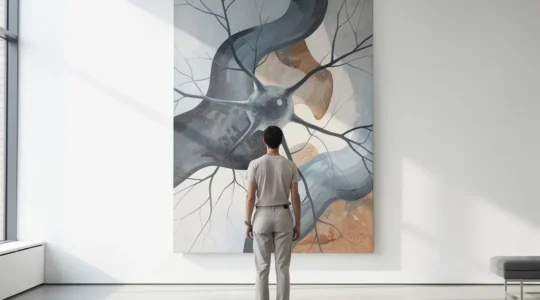
Why Engaging With Art for 20 Minutes a Day Boosts Problem-Solving Skills?
Engaging with art boosts problem-solving not by simple inspiration, but by training your brain to switch between focused and unfocused states, activating a key neural network for insight. Abstract and impressionist art are particularly effective as they force your brain…
Lire la suite