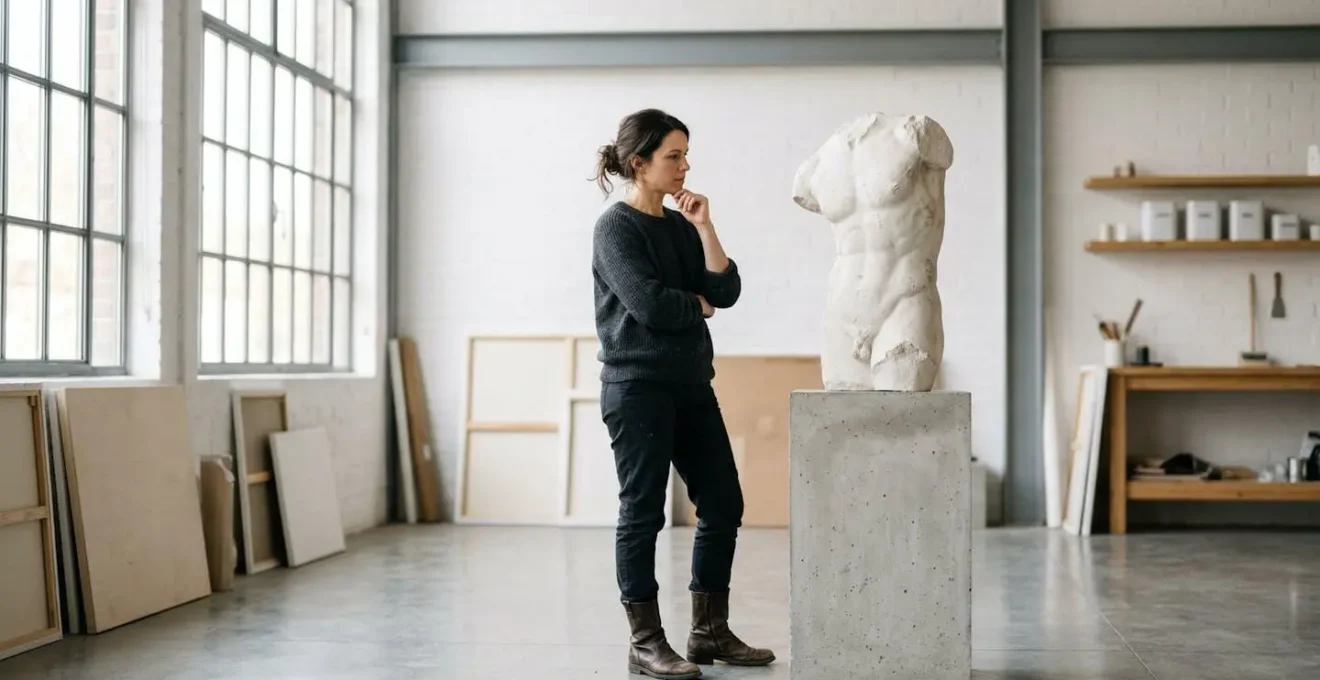
Contrary to popular belief, the choice between atelier and university isn’t about skill versus concept; it’s a strategic decision about how you want to structure your creative brain and which professional ecosystem you want to join.
- Rigorous, classical training isn’t just about technique; it builds a neurological “cognitive scaffolding” for visual problem-solving.
- University programs and ateliers are gateways to different, often non-overlapping, career networks of critics, collectors, and gallerists.
Recommendation: Choose the educational path that builds the specific creative mindset and professional network that aligns with your ultimate career goals, whether that’s gallery representation, academic tenure, or private commissions.
The question looms large for every aspiring artist: should you enroll in a university MFA program, steeped in critical theory and conceptual development, or dedicate yourself to a skill-based atelier, mastering the techniques of the Old Masters? It’s a debate that often gets simplified into a false dichotomy: the thinking artist versus the technical artist. Many articles will tell you it “depends on your goals” or that “a portfolio is what really matters,” but this advice overlooks the fundamental impact of your educational choice.
The reality is more profound. Your training doesn’t just give you a set of skills or a line on your CV; it actively shapes the neural pathways you use to see and create. It determines the professional ecosystem—the specific network of curators, gallerists, collectors, and peers—you will enter. This decision is less about what you learn and more about engineering a specific type of creative mind and career trajectory.
This isn’t about declaring one path superior. It’s about understanding that these are two different operating systems for a creative career. One path builds a deep, intuitive understanding of form and material—what we can call cognitive scaffolding. The other cultivates a sharp, critical framework for navigating the intellectual currents of the contemporary art world. The “right” choice depends on which system you believe will best serve your unique artistic vision.
This article will dissect the core components of this decision, moving beyond the surface-level debate. We will explore the neurological basis of classical training, the psychological resilience needed for critiques, the process of finding your voice after rigorous instruction, and the practical realities of how each path leads to different career outcomes, from gallery representation to academic positions.
Summary: Classical Training vs. Conceptual Freedom: Is an Atelier Education Still Relevant for Today’s Artist?
- Why Spend 6 Months Drawing a Plaster Ear Before Touching Color?
- How to Survive a Brutal Art School Critique Without Losing Confidence?
- The “Atelier Look” Trap: How to Find Your Voice After Rigorous Training?
- University Degree vs. Atelier Portfolio: Which Gets You Gallery Representation?
- Gap Year or Straight to School: When Is the Best Time to Train?
- Why Do Academies Force Students to Copy Old Masters for Years?
- Master or Apprentice: Who Actually Painted the Backgrounds?
- Why Does Figurative Art Remain Popular Despite the Rise of Abstraction?
Why Spend 6 Months Drawing a Plaster Ear Before Touching Color?
The infamous plaster cast drawing assignment is a rite of passage in classical training, often seen by outsiders as a tedious and outdated exercise. Why spend half a year on a single, colorless object when the contemporary art world is bursting with vibrant expression? The answer lies not in tradition for tradition’s sake, but in cognitive science. This process is a deliberate method of building a strong cognitive scaffold for visual understanding.
By removing color, the student is forced to confront the fundamental pillars of visual reality: form, value (light and shadow), and proportion. You are not just copying an ear; you are learning to deconstruct a complex three-dimensional object into a series of tonal relationships. It’s a focused, methodical training of the eye and hand to work in unison, to see the world not as a collection of things, but as an arrangement of light and form. This intense focus on monochrome values builds a deep, almost intuitive, library of visual information in the brain.
This isn’t just artistic theory; it’s backed by science. Recent neuroscience research demonstrates that this type of observational drawing training measurably enhances the brain’s connectivity. It strengthens the pathways between the occipital cortex (which processes visual information) and the parietal cortex (which handles spatial awareness and navigation). In essence, you are physically rewiring your brain to see and interpret the three-dimensional world with greater accuracy and sensitivity. This foundational structure makes handling the much more complex and relative variable of color a far more manageable task later on.
How to Survive a Brutal Art School Critique Without Losing Confidence?
The group critique, or “crit,” is a cornerstone of both university and atelier education, but it can be a psychologically taxing experience. The silence in the room feels heavy as all eyes turn to your work, and a panel of instructors and peers begins to dissect what you’ve poured hours of your life into. For many students, a harsh critique can feel like a personal attack, leading to a spiral of self-doubt that can cripple creative momentum. The pressure is significant, and it takes a toll. In fact, research has found that students studying fine arts report higher rates of mental distress than their peers in other majors, with the critique culture often cited as a contributing factor.
Surviving—and thriving—in this environment requires separating the feedback from your sense of self-worth. A critique is not a judgment on you as a person; it is a data-gathering session about your work at a specific point in time. The key is to develop a system for processing this data objectively, turning potentially painful comments into actionable steps. This requires building a mental filter that separates useful technical advice from subjective personal taste.
Adopting a mindset of detached professionalism is crucial. You are not your work. Your work is a series of problems you are trying to solve in public. The critique is a collaborative, if sometimes blunt, part of that problem-solving process. Learning to listen without defensiveness, ask clarifying questions, and identify recurring themes in the feedback are skills as important as mastering perspective or color theory. A resilient artist is one who can extract the valuable lessons from a tough critique without letting it erode their core confidence.
Your Action Plan: Framework for Processing Critique Feedback
- Apply the 24-Hour Rule: Avoid immediate emotional reactions. Allow at least a day for the comments to settle before you decide what is and isn’t valid. This prevents you from making rash changes based on a momentary feeling of defensiveness or despair.
- Create a Feedback Ledger: Document all comments in a notebook, dividing them into two columns. One column for objective, technical observations (e.g., “The composition is weighted too heavily to the left,” “The values in the shadow are muddy”). The other for subjective, stylistic opinions (e.g., “I don’t find this subject matter interesting,” “This feels too sentimental”).
- Extract Actionable Items: From the “objective” column, identify specific, concrete suggestions you can implement. Focus on feedback that offers a clear path to improvement, like “Try a study with a more limited palette” or “Re-check the anatomy of the hands.” Filter out vague or purely negative comments that offer no solution.
- Analyze the Critique Source: Contextualize the feedback by considering the instructor’s own work, their known aesthetic preferences, and the overarching philosophy of the institution. An instructor with a background in abstract expressionism will have a different perspective than a classical realist. Their feedback is a valuable point of view, not an absolute truth.
The “Atelier Look” Trap: How to Find Your Voice After Rigorous Training?
A common fear among students considering an atelier is the “atelier look”—the concern that years of methodical, prescribed training will produce a generation of artists whose work is technically proficient but stylistically indistinguishable. It’s a valid worry: if everyone learns the same system for drawing and painting, how can an individual voice emerge? The fear is that the system will overwrite, rather than empower, personal expression. This is the paradox of rigorous training: its structure is designed to liberate, but it can feel restrictive.
However, this perspective often misunderstands the purpose of technique. Skill is not the enemy of creativity; it is the language of it. As artist and instructor Charles Miano notes, “Skill empowers an artist. Expertise in traditional drawing and painting carries authority and can liberate an artist’s creativity.” A robust technical foundation gives you the freedom to make deliberate choices, rather than being limited by what you are able to execute. It’s the difference between having a full vocabulary to write a poem and only knowing a handful of words.
Finding your voice is not about abandoning your training, but about learning to deconstruct it. It’s a process of taking the established rules and deciding which to follow, which to bend, and which to break in service of your unique vision. As an analysis of post-atelier artists shows, true style emerges from how an artist chooses to interpret and edit visual information. Just as everyone learns the same alphabet but develops a unique handwriting, trained artists apply their skills with a distinct signature. Consider a historical example: Michelangelo and Raphael worked in similar environments with the same patrons and themes, yet their styles are instantly recognizable and profoundly different. Their shared training was the foundation upon which their individual genius was built, not the cage that contained it.
University Degree vs. Atelier Portfolio: Which Gets You Gallery Representation?
For many artists, the ultimate goal is gallery representation. This raises a critical, career-defining question: what do gallerists actually look for? Is it the conceptual rigor and critical discourse of a university MFA, or the stunning technical mastery of an atelier-honed portfolio? The answer is not one or the other, but that each path prepares you for—and gives you access to—different segments of the art market. It’s about engineering the right ecosystem for your work.
A university MFA program is designed to plug you into the institutional art world. The emphasis on art history, critical theory, and writing artist statements prepares you to communicate with curators, critics, and academics. Your network will be built around these figures, and the degree itself is often a non-negotiable prerequisite for securing a tenure-track university teaching position. While the portfolio is important, it is often evaluated on its conceptual strength and its place within contemporary art discourse. An MFA is a powerful key for unlocking doors in the academic and museum worlds.
Atelier training, by contrast, is laser-focused on creating a portfolio that demonstrates undeniable visual impact and technical skill. This path is geared more towards the private gallery market, especially within the realist and figurative sectors, as well as private commissions and high-end illustration. The network here is comprised of working artists, private collectors, and gallerists who prioritize craftsmanship. In this arena, the work must speak for itself, often with less need for a dense theoretical text to justify its existence.
The following table, based on an analysis of different art education pathways, breaks down these distinct career trajectories.
| Criteria | University MFA Program | Atelier Training |
|---|---|---|
| Primary Focus | Conceptual development, critical theory, art history context | Technical mastery, observational skills, classical techniques |
| Networking Ecosystem | Access to critics, curators, institutional networks, academic tenure track | Tight community of realist painters, private collectors, working artists |
| Portfolio Strength | Stronger conceptual arc and intellectual narrative | Stronger technical demonstration and visual impact |
| Essential For | University teaching positions (tenure-track), museum curatorial work | Gallery representation (realist market), private commissions, illustration careers |
Gap Year or Straight to School: When Is the Best Time to Train?
The pressure to jump straight from high school into a demanding art program can be immense. But is it always the wisest move? The idea of a “gap year” is often dismissed as a costly delay, a year of lost progress. However, when viewed through the lens of learning science, a gap year—if used productively—can be a powerful tool for solidifying commitment and maximizing the value of a future education. The key lies in a concept known as “desirable difficulties.”
The theory of desirable difficulties posits that learning is deeper and more durable when it requires considerable effort. Easy learning is often superficial and quickly forgotten. A gap year can introduce this productive struggle. By stepping away from the structured environment of education, you are forced to be self-directed. You have to actively fight for time to make art, seek out resources on your own, and confront whether this is a path you are truly passionate about without external validation. This period of self-initiated effort and problem-solving can make your eventual return to formal training far more potent.
This principle is supported by extensive research on memory and learning. For example, studies on retrieval practice—the act of actively recalling information rather than passively reviewing it—show its profound effect on long-term retention. One landmark study found that retrieval practice can improve long-term recall by as much as 50% compared to simply re-studying material. A gap year can function as a large-scale retrieval practice for your artistic motivation. By having to “retrieve” your desire to create day after day, you are strengthening the neural and psychological foundations of your commitment, ensuring that when you do invest in a rigorous program, you arrive with the focus and maturity to fully absorb its lessons.
Why Do Academies Force Students to Copy Old Masters for Years?
Copying the work of Old Masters is another foundational practice of academic art training that can seem perplexing to the modern student. It can feel like an exercise in forgery rather than a path to originality. Why not just learn the principles and apply them to your own ideas? The reason for this long-standing tradition is that a masterwork is a complete, perfectly resolved lesson in composition, value, anatomy, and narrative, all in one package. It is a time-tested solution to a complex visual problem.
When you copy a masterwork, you are not just mimicking a surface; you are retracing the thoughts of a master. You are forced to confront the thousands of decisions—large and small—that went into its creation. How did Rembrandt turn the form of a face with just a few brushstrokes? How did Degas create such a powerful sense of movement with his composition? By physically recreating the work, you begin to internalize these strategies. It’s like a musician learning a complex piece by Mozart; they aren’t just playing notes, they are absorbing the principles of harmony and structure embedded within the music.
This process is a direct and efficient way to build a visual vocabulary and develop a deeper understanding of aesthetics. It’s a dialogue with history that bypasses verbal theory and goes straight to hands-on learning. As an exhaustive longitudinal analysis published in *Psychology of Aesthetics, Creativity, and the Arts* has shown, this type of representational drawing training has a direct and measurable relationship with the development of visuospatial skill. By copying the masters, you are essentially downloading centuries of refined solutions for depicting the world, creating a rich mental library from which your own original ideas can eventually draw.
Master or Apprentice: Who Actually Painted the Backgrounds?
The romantic image of the solitary artist creating a masterpiece in isolation is largely a modern myth. Historically, from the Renaissance workshops to the 19th-century academies, art-making was often a collaborative effort. The master artist was the visionary and the brand, but much of the labor—from grinding pigments to painting drapery or backgrounds—was carried out by a team of apprentices and assistants. This workshop model was not seen as a compromise of artistic integrity, but as a practical and efficient system for producing high-quality work at scale.
This tradition is far from dead; it has simply evolved. Many of today’s most successful contemporary artists operate in a very similar fashion. Figures like Jeff Koons, Damien Hirst, and Takashi Murakami run large, factory-like studios where teams of highly skilled assistants execute their vision. The artist’s primary role shifts from manual laborer to creative director, overseeing quality control and ensuring the final product aligns with their conceptual goals. The “artist’s voice” remains the guiding force, even if their hand is not the only one that touched the canvas.
This collaborative model raises important questions about authorship and preservation, which are actively being addressed by organizations like VoCA (Voices in Contemporary Art). Their research focuses on how to maintain the integrity of an artwork’s concept for future conservation, even when it’s the product of many hands. As VoCA states in its mission, “The artist’s voice is primary in developing preservation strategies and their participation is essential for future conservation and presentation of their work.” This affirms that authorship resides in the concept and the vision, not merely in the physical act of painting. Understanding this historical and contemporary reality demystifies the creative process and provides a more realistic view of what a professional art career can look like.
Key Takeaways
- The choice between university and atelier is less about ‘skill vs. concept’ and more about intentionally building a specific ‘cognitive scaffolding’ and ‘career ecosystem’.
- Classical training methods, like cast drawing and master copies, are not just about tradition; they are scientifically-backed techniques for rewiring the brain’s visual processing abilities.
- Finding an authentic artistic voice after rigorous training is not about rejecting the rules, but about strategically deconstructing them to serve a personal vision.
Why Does Figurative Art Remain Popular Despite the Rise of Abstraction?
In a world where conceptual art and pure abstraction often dominate critical discourse, figurative art—art that depicts a recognizable subject—maintains a powerful and enduring hold on the popular imagination. While trends come and go, the human impulse to see ourselves and our world reflected in art remains a constant. This popularity is not a sign of a lack of sophistication, but rather a testament to the deep, hard-wired human need for narrative, connection, and relatability.
Figurative art speaks a universal language. It leverages our innate ability to recognize faces, read body language, and project ourselves into a scene. An abstract painting might require a lengthy wall text to explain its meaning, but a portrait or a landscape offers an immediate point of entry. It taps into our shared experiences of joy, sorrow, beauty, and mortality. This direct line to human emotion is what allows figurative work to resonate so broadly, connecting with viewers in a way that is both visceral and immediate.
This doesn’t diminish the value of abstraction, but it does explain why figuration has not only survived but thrived. For many artists, the challenge is not to abandon representation, but to imbue it with a contemporary sensibility. They use the familiar language of the figure to explore complex modern themes, blending classical technique with a modern point of view. This enduring appeal ensures a consistent market for skilled figurative artists and demonstrates that the oldest form of artistic expression continues to be one of the most vital.
Ultimately, the path you choose should equip you with the tools not just to make art, but to build a sustainable and fulfilling career. Whether through the conceptual frameworks of a university or the technical mastery of an atelier, the goal is to find the system that best empowers your unique voice. To put these ideas into practice, the next logical step is to begin an honest self-assessment of your artistic goals and learning style.