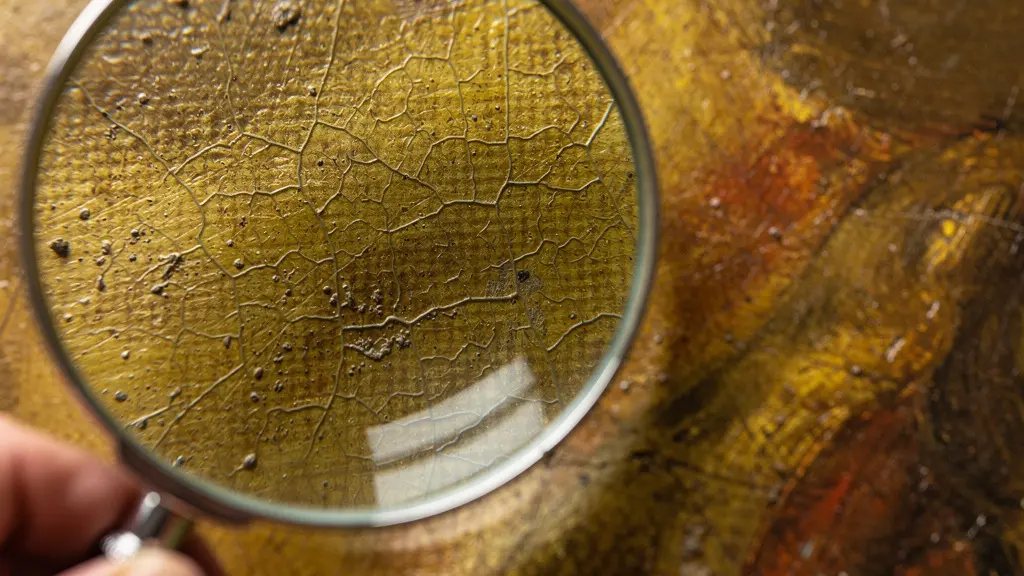
The biggest mistake in dating an unsigned painting isn’t misjudging the style; it’s ignoring the physical story the object itself is telling.
- Repairs, damage, and material decay are not just flaws—they are historical timestamps that can be more revealing than brushstrokes.
- Understanding an artist’s workshop practices and the common “School of” trap is crucial for avoiding costly attribution errors.
Recommendation: Start your investigation by examining the back of the canvas and its wounds; the most valuable clues are often hidden there, not on the front.
It’s the thrill every antique hunter lives for: unearthing a dusty, forgotten painting at a flea market or estate sale. It has no signature, no paperwork, but there’s something about it—a flash of brilliance in the brushwork, a haunting quality in the subject’s eyes. The immediate question is, “What is this?” Most people instinctively try to categorize the style. Is it Baroque? Is it Neoclassical? This is the conventional approach, but it’s also where many treasure hunts go cold.
The truth is, relying on style alone is like trying to solve a mystery with only one clue. The real secrets of an unsigned work aren’t just in its aesthetic. They are embedded in its very substance: the weave of the canvas, the type of wood on the stretcher, the cracks in the varnish, and even the scars from past damages and repairs. These are not imperfections; they are the painting’s biography, written over centuries.
But what if the key to unlocking a painting’s age and origin wasn’t just about identifying a movement, but about learning to read this physical history? This guide is built on that premise. We will move beyond simple stylistic guesswork and dive into the forensic techniques used by experts. You’ll learn how a lack of paperwork can drastically alter value, why scientific dating has its limits, and how to spot the subtle clues that separate a master’s work from a follower’s copy. This isn’t just about art history; it’s about becoming an art detective.
This article provides a complete framework for your investigation. Each section tackles a critical piece of the puzzle, from decoding the physical object to understanding market traps and opportunities, giving you a structured method for evaluating your next potential masterpiece.
Summary: Dating the Undiscovered: How to Read the Visual Clues of an Unsigned Painting?
- Why a Gap in Paperwork Can Devalue an 18th Century Work by 60%?
- Carbon Dating vs. Stylistic Analysis: Which Is More Reliable for Buyers?
- How to Spot “Transitional” Works That Bridge Two Major Art Movements?
- The “School of” Trap That Catches Novice Antique Buyers
- How to Organize a Private Collection to Tell a Coherent Historical Story?
- Edo Period or Meiji Reprint: Which Is Worth the Investment?
- How to Stabilize a Canvas With Severe Tears and Water Damage?
- Which Historical Art Period Is Currently Undervalued by the Market?
Why a Gap in Paperwork Can Devalue an 18th Century Work by 60%?
You’ve found a stunning 18th-century portrait, the technique is masterful, but the history is a blank slate. In the art world, this is a red flag the size of a gallery wall. The chain of ownership, known as provenance, is an artwork’s pedigree. It proves authenticity, establishes historical significance, and reassures buyers that the piece isn’t a forgery, a copy, or looted art. A clean, unbroken provenance can be more valuable than the painting itself. When it’s missing, the market gets nervous, and prices plummet.
While a 60% figure might seem extreme, it reflects a fundamental market principle. Even at the highest levels, gaps in ownership history are financially devastating. For instance, recent auction house data reveals a potential 45.5% decrease in sales for major works with questionable provenance. For the amateur collector, this principle is even more critical. Without paperwork, you are buying a story, not a verifiable asset. The risk falls entirely on you, and the potential for a glorious discovery is matched by the potential for a costly mistake. The burden of proof shifts from the seller to the buyer, who must then embark on the difficult task of rebuilding that lost history.
But don’t despair—a gap in provenance is a challenge, not a dead end. For the dedicated treasure hunter, it’s an opportunity to conduct a real investigation. Rebuilding a lost history is a meticulous process of cross-referencing clues found on the object itself with historical records. It requires patience and detective work, but successfully linking a painting to a past auction, exhibition, or collection can dramatically restore its value and turn a speculative find into a certified treasure.
Your Action Plan: Rebuilding Lost Provenance
- Search the Getty Provenance Index for historical auction records from the artwork’s estimated period.
- Cross-reference canvas stamps and stretcher bar marks with supplier databases to identify the origin and date of the materials.
- Investigate genealogical records of previous owners through family estate archives if any names are found.
- Check museum exhibition catalogs and gallery records from the relevant time period for mentions or images.
- Examine the back of the painting meticulously for exhibition labels, gallery stamps, or inventory numbers.
Carbon Dating vs. Stylistic Analysis: Which Is More Reliable for Buyers?
When trying to date an artwork, it’s tempting to look for a single, definitive test. Many people believe Carbon-14 dating is that magic bullet—a scientific guarantee of age. The reality is far more complex. Carbon dating is a powerful tool, but it comes with significant limitations that every buyer must understand. It can only date organic materials, like the wooden panel or the linen canvas, not the inorganic pigments of the paint itself. This creates a major loophole for forgers, who can use an old piece of wood or canvas to create a “new” old master.
This is where stylistic analysis—the classic method of connoisseurship—remains indispensable. It involves a deep knowledge of art history, including an artist’s brushwork, compositional tendencies, color palette, and preferred subjects. An expert can often spot anachronisms that a scientific test might miss, such as a 19th-century style of brushwork on a canvas that carbon-dates to the 17th century. The weakness of stylistic analysis, however, is its subjectivity. It relies entirely on the expert’s eye and experience, leaving room for error and disagreement.
The smartest approach for a buyer is not to choose one method over the other, but to see them as complementary parts of a larger investigation. Stylistic analysis is your first-pass tool: it’s non-invasive, relatively low-cost, and can quickly raise or dismiss red flags. If the style seems plausible for the suspected period, scientific methods can then be used to either corroborate or challenge that hypothesis. Think of it as building a legal case: stylistic analysis provides the circumstantial evidence, while scientific tests provide the forensic proof.
This table breaks down the most common authentication methods, highlighting their strengths and weaknesses to help you build your treasure hunter’s toolkit. As you can see from a comparison of art authentication techniques, no single method is foolproof.
| Method | Cost Range | Accuracy | Limitations | Best Use Case |
|---|---|---|---|---|
| Carbon-14 Dating | $500-$2,000 | ±40 years | Only dates organic support (canvas/wood), not paint layer | Panel paintings, suspected forgeries on old supports |
| Stylistic Analysis | $200-$1,000 | Variable based on expertise | Subjective, requires extensive comparative knowledge | Initial assessment, non-invasive authentication |
| Dendrochronology | $1,000-$3,000 | Exact year possible | Only works on panel paintings with visible tree rings | Northern European panel paintings |
| Pigment Analysis | $300-$1,500 | High for anachronisms | Requires micro-samples | Detecting modern pigments in supposed old masters |
How to Spot “Transitional” Works That Bridge Two Major Art Movements?
Some of the most exciting and historically significant finds are not perfect textbook examples of a single art movement, but are instead “transitional” works. These are pieces created by artists at the cusp of change, capturing the moment one style began to morph into another. Think of the shift from the rigid order of Neoclassicism to the emotional drama of Romanticism. A transitional painting might feature a classical composition but be infused with a new, Romantic intensity in its color and light. Spotting these works requires a nuanced eye, as they break the standard rules.
The key is to look for what experts call “stylistic cohabitation”. This is where you see elements from two different periods existing on the same canvas. A work may retain the formal structure of a Neoclassical history painting but experiment with the looser brushwork and dramatic subject matter that would come to define Romanticism. These pieces often show an artist wrestling with new ideas. Under infrared examination, they may reveal numerous pentimenti—ghostly images of earlier versions that the artist painted over—showing their process of deliberation and discovery. Finding a work with these mixed signals can be a sign of a truly important find.
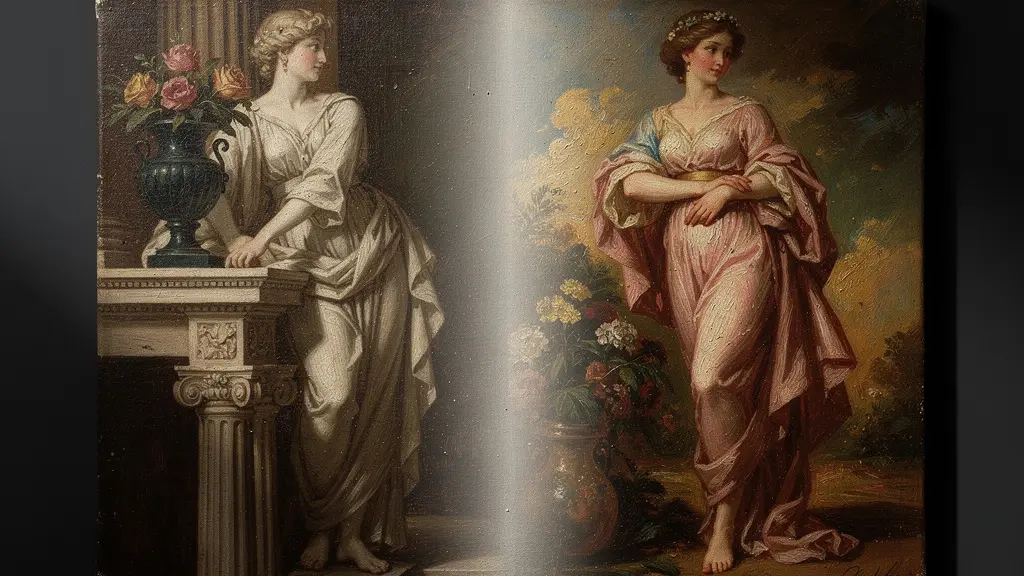
As this visual suggests, the transition is not an abrupt switch but a gradual blending of old and new. These works are often undervalued because they don’t fit neatly into a single category, making them a prime target for the savvy collector. As noted by leading authenticators, this combination of old and new is the hallmark of a genuine transitional piece. In their landmark study, Art Certification Experts explained the phenomenon perfectly:
Forensic analysis reveals that true transitional pieces show a ‘first appearance’ of new stylistic elements alongside the ‘persistent echo’ of the previous movement.
– Art Certification Experts, Authentication and Evaluation Methods Study
The “School of” Trap That Catches Novice Antique Buyers
You’re at an auction, and a beautiful painting is listed as “School of Rembrandt.” Your heart leaps—a chance to own something connected to the great master for a fraction of the price! This is the “School of” trap, one of the most common and costly pitfalls for novice buyers. Attribution terminology is a minefield, and misunderstanding it can lead to massive overpayment. “School of” does not mean it came from Rembrandt’s workshop. It means it was painted by an unknown artist who was working in the master’s style, often years or even decades after he died.
The value difference is staggering. A work “Attributed to” an artist suggests it is likely by their hand, but conclusive proof is missing; it might retain 30-50% of a fully authenticated work’s value. A piece from the “Circle of” the artist means it was created by a known associate or contemporary, but not the master himself. A “Studio of” or “Workshop of” piece was likely created in the master’s studio by an assistant, possibly with the master’s supervision. But a “School of” painting has the most distant connection and, consequently, the lowest value, often fetching 70-90% less than an authenticated piece.
So how do you avoid the trap? First, you must internalize these definitions. Second, you must become a skeptic. Question the attribution. Look for signs of mechanical copying rather than creative energy. The brushwork in a “School of” piece is often more hesitant or generalized than a master’s confident hand. Compare the work to known, authenticated pieces by the artist. Is the quality of the pigments consistent? Does the composition feel as dynamic? Asking these tough questions and demanding a detailed condition report can protect you from paying a master’s price for a follower’s tribute.
How to Organize a Private Collection to Tell a Coherent Historical Story?
For the amateur collector and treasure hunter, the goal isn’t necessarily to acquire a room full of masterpieces. It’s to build a collection that has meaning and tells a story. Organizing your finds is an art in itself, transforming a random assortment of paintings into a coherent and personal museum. The most powerful collections are not defined by their monetary value, but by the narrative they weave. So, how do you find that narrative when your collection consists of disparate flea market finds?
Forget trying to build a comprehensive history of art. Instead, look for the “mini-narratives” hidden within your collection. You could group paintings thematically: perhaps you have a fondness for anonymous portraits, seascapes from different eras, or still lifes that feature books. Arranging them together allows for fascinating comparisons. Another approach is to organize by technique or period. You might create a wall that shows the evolution of portraiture from the late 19th to the mid-20th century, even if the artists are unknown. This transforms your collection from “old paintings” into “a study of changing social expressions.”
The most personal method is to build a story around your own journey as a collector. Document each find: where you bought it, what drew you to it, and what you’ve discovered about it since. Your collection becomes a diary of your adventures and your developing eye. An unsigned landscape is no longer just a pretty picture; it’s “the painting I found in a dusty barn in Vermont that taught me to spot 19th-century canvas.” This approach gives every piece significance, regardless of its attribution. It ensures your collection reflects not just art history, but your own physical history as a seeker of hidden beauty.
Edo Period or Meiji Reprint: Which Is Worth the Investment?
Japanese woodblock prints (ukiyo-e) are an alluring field for collectors, but it’s a market filled with subtleties where originality is everything. The most critical distinction to master is identifying a print from the Edo period (1603-1868)—the golden age of artists like Hokusai and Hiroshige—versus a later reprint from the Meiji period (1868-1912). While both can be beautiful, their investment potential is worlds apart. The reason is simple: scarcity and quality. Edo prints are the “first editions,” made under the artist’s supervision with delicate techniques.
Meiji reprints were often mass-produced for a burgeoning tourist market. The original woodblocks, worn down from use, produced thicker, less refined lines. Furthermore, the subtle, plant-based dyes of the Edo period were replaced with harsh, bright aniline dyes imported from the West. The result is a print that can look superficially similar but lacks the delicacy and soul of an original. From an investment perspective, there’s no contest; market analysis shows that first-edition Edo prints retain 3-5x the value of their Meiji counterparts, with appreciation rates that are significantly higher.
For the treasure hunter, spotting the difference is a crucial skill. It requires close examination of the print’s physical characteristics. You must become a detective of paper, color, and line. The table below provides a quick visual guide to the key features that separate a high-value Edo original from a more common Meiji reprint. Mastering these details can mean the difference between acquiring a rapidly appreciating asset and a decorative piece.
| Feature | Edo Period (1603-1868) | Meiji Reprint (1868-1912) |
|---|---|---|
| Key Block Lines | Fine, delicate, shows minimal wear | Thicker, less refined due to block wear |
| Color Palette | Subtle vegetable dyes, muted tones | Harsh aniline dyes, brighter colors |
| Paper Quality | Handmade washi, irregular texture | Machine-made, uniform surface |
| Censor Seals | Period-specific seals present | Different or absent seals |
| Investment Return | 15-20% annual appreciation | 5-8% annual appreciation |
How to Stabilize a Canvas With Severe Tears and Water Damage?
Discovering a painting with tears, flaking paint, or dark water stains can feel heartbreaking. The initial impulse might be to see it as a lost cause. But for an art detective, damage is not just a flaw—it’s data. The way a painting has been damaged and, more importantly, repaired over its life provides an invaluable “physical history” that can help date the work. Before you even think about stabilization, you must first learn to read these wounds. A professional conservator is essential for any actual repair, but your initial assessment can uncover crucial clues.
Forensic conservation has shown that different eras used distinct repair methods. An 18th-century tear might be stitched with period-specific thread, while a 19th-century repair could involve a wax-resin patch. As a forensic analysis by CIRAM laboratory demonstrates, these interventions act as historical timestamps. Examining the back of the canvas can reveal layers of repairs, each telling a story about a different chapter in the painting’s life. Similarly, modern retouching to cover damage is often easily detectable. A simple UV blacklight will cause modern paints to fluoresce differently, often appearing as dark, inert patches against the glow of the original, older varnish.
Once you have “read” the damage, stabilization becomes the priority to prevent further loss. For severe tears, the immediate goal is to prevent stress on the surrounding canvas. You can place the painting face-up on a clean, flat surface to relax the canvas. Small, loose paint flakes should be carefully collected in a labeled envelope. Do not attempt to glue them back on! For water damage, the key is slow, controlled drying away from direct heat or sunlight to prevent warping. These are temporary, first-aid measures. Any significant damage requires a consultation with a professional conservator who can perform reversible, archivally-sound repairs that preserve both the artwork and its valuable history of scars.
Key Takeaways
- An artwork’s physical condition is not just damage; it’s a historical record. Scars, repairs, and material decay are valuable dating clues.
- Solid provenance (chain of ownership) is often more critical to a painting’s value than its aesthetic quality. Rebuilding it is a key task.
- Attribution terms like “School of” or “Circle of” are not interchangeable. Understanding them is crucial to avoid major financial mistakes.
Which Historical Art Period Is Currently Undervalued by the Market?
The ultimate treasure hunt is finding a diamond in the rough: an artwork from a period that the market has overlooked but is poised for a resurgence. While major names like Picasso or Monet are priced out of reach for most, entire schools and movements remain undervalued. Currently, the market is showing renewed interest in artists who were skilled and historically important but not the “superstars” of their time. These are often the second-tier members of major movements or artists from regional schools who are just now getting their due.
One prime example is the Barbizon School. While top-tier works by masters like Millet or Rousseau command high prices, paintings by their talented but less famous contemporaries have been largely ignored until recently. As a sign of this shift, recent Bank of America art market data shows that second-tier Barbizon School paintings increased 17% in 2024 alone. Similar trends are emerging for the wider circle of the Ashcan School and early Symbolist painters. These areas represent a sweet spot for collectors: the art is of high quality and historical importance, but prices have not yet caught up to the renewed academic and institutional interest.
So how can you spot the *next* undervalued period? The secret is to watch the leading indicators. Market upswings are almost always preceded by a rise in academic interest. Look for an increase in dissertations, specialized museum exhibitions, and academic journal articles focused on a particular artist or school. According to market analysis, these academic trends typically precede a market value increase by 18 to 24 months. By paying attention to what scholars are rediscovering, you can anticipate where the market is headed and acquire works just before they enter the spotlight. This is the most strategic form of treasure hunting—using knowledge to get ahead of the money.
Your next great discovery is waiting. Now, you have the tools to not just find it, but to understand its story. Start applying these forensic techniques on your own collection and see what secrets you can uncover.
Frequently Asked Questions on How to Estimate the Date of an Unsigned Painting Using Visual Clues?
What exactly does ‘Attributed to’ mean versus ‘School of’?
‘Attributed to’ suggests the work is likely by the named artist but lacks conclusive proof, while ‘School of’ indicates it was created by an unknown artist working in the master’s style, often decades later.
How much less is a ‘Circle of’ painting worth compared to an authenticated work?
Typically 70-90% less than an authenticated work by the master, though exceptional quality pieces from known associates can retain 40-50% of the master’s value.
Can scientific testing definitively prove a ‘Studio of’ attribution?
Scientific testing can confirm period-appropriate materials and techniques, but distinguishing between a master and a skilled assistant often requires connoisseurship combined with technical analysis.