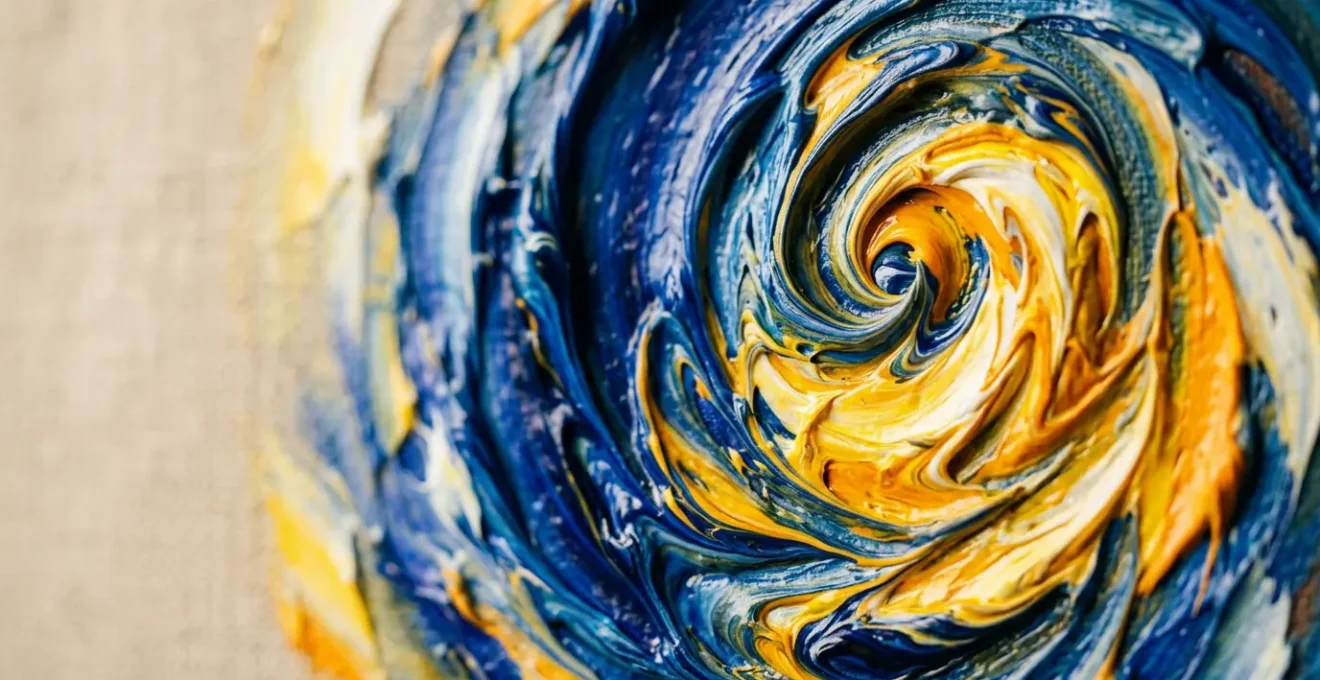
Beyond the myth of madness, The Starry Night reveals Van Gogh as a methodical observer who intuitively captured the fundamental laws of physics and perception in his brushstrokes.
- The painting’s iconic swirls perfectly match mathematical models of turbulent flow, a scientific concept not formalized until decades after his death.
- Far from being a simple fantasy, the scene is an engineered vision, a meticulously constructed composite of direct observation, memory, and sophisticated color science.
Recommendation: Look at the painting not just as an emotional outburst, but as a calculated experiment in capturing the universe’s dynamic energy.
For over a century, Vincent van Gogh’s The Starry Night has been enshrined in our collective imagination as the ultimate expression of the tortured artist. We look at the swirling, incandescent sky and see a direct line to a troubled mind, a beautiful but chaotic vision born from the isolation of an asylum cell. The conventional narrative tells us of a man overwhelmed by emotion, painting his inner turmoil onto the canvas. We are told the towering cypress tree is a symbol of death and the entire scene a fever dream, a departure from the reality he so desperately tried to capture in his earlier work.
But what if this common interpretation, while compelling, misses the most astonishing truth of the painting? What if we’ve been so focused on the artist’s biography that we’ve failed to see the scientist within him? The truth is that The Starry Night is not a chaotic fantasy. It is a work of profound observation and stunning scientific intuition. This is the work of a visual physicist, an artist who didn’t just feel the energy of the cosmos but understood its mechanics, translating the complex laws of light, color, and fluid dynamics into a visual language we could all comprehend. This is not the story of a mind losing its grip on reality, but of one grasping it on a level so deep it predated formal science.
This exploration will peel back the layers of myth to reveal the methodical genius behind the masterpiece. We will journey from the uncanny mathematical precision of his turbulent sky to the deliberate, almost architectural construction of his village, revealing an artist in full command of his craft. It’s a journey that challenges us to see Van Gogh not as a madman, but as a master observer of the universe’s hidden order.
Summary: The Hidden Physics of a Turbulent Mind
- Kolmogorov Scaling: How Does Van Gogh’s Sky Match Physics Equations?
- Why Is the Large Black Tree in the Foreground Often Misunderstood?
- Memory or Reality: Why Is the Church Spire Dutch Instead of French?
- The Studio Mistake: Did Van Gogh Paint Starry Night Outside or Inside?
- When Is the Best Time to See Starry Night Without a Crowd?
- Blue and Orange: How Did Complementary Colors Create Visual Tension?
- Why Does Red Look Brighter Next to Green Than Next to Orange?
- How Did Van Gogh Turn a Cypress Tree Into a Symbol of Death?
Kolmogorov Scaling: How Does Van Gogh’s Sky Match Physics Equations?
Perhaps the most breathtaking discovery about The Starry Night lies not in art history, but in physics. The swirling patterns of light and color that define the painting’s sky are not random expressions of emotion; they are an almost perfect depiction of a deeply complex natural phenomenon: turbulent flow. This is the same chaotic yet structured motion seen in swirling water, smoke plumes, and the formation of clouds. It’s a field of physics that would not be mathematically described until the 1940s by Russian mathematician Andrey Kolmogorov.
What’s truly astonishing is how precisely Van Gogh’s work aligns with these principles. A 2024 analysis confirmed what physicists had long suspected: when the luminance of the painting’s whirls is analyzed, the power spectrum follows a characteristic -5/3 Kolmogorov-like power-law. This means the way energy cascades from the large eddies to smaller ones in his painting mirrors the mathematical reality of how turbulent fluids behave. It’s as if he could see the underlying structure of the universe’s motion. As physicist Yongxiang Huang notes, this could stem from intense observation or an “innate sense of how to capture the dynamism of the sky.” Van Gogh didn’t just paint a swirling sky; he painted the physics of a swirling sky.
Why Is the Large Black Tree in the Foreground Often Misunderstood?
Let’s immediately address the most dominant, earthbound element in the painting: the towering cypress tree. For decades, it has been almost universally interpreted as a dark omen, a symbol of death and mourning reaching from the graveyard to the heavens. This interpretation fits neatly into the narrative of a depressed artist. Yet, this reading is a profound misunderstanding of Van Gogh’s relationship with these trees. To him, the cypress was not a symbol of death, but of eternity and resilience.
The evidence comes directly from the artist himself. In a letter to his brother Theo, written while working on this very series, he expressed his admiration for the cypress, stating he found it “beautiful as regards lines and proportions, like an Egyptian obelisk.” He saw it as a living, architectural element connecting earth and sky, a pillar of natural beauty. This perspective was powerfully highlighted in The Metropolitan Museum of Art’s 2023 exhibition, *Van Gogh’s Cypresses*. The show brought together dozens of his cypress works and presented new research challenging the traditional “death symbol” interpretation. It reframed the tree as a subject of aesthetic fascination and a symbol of the enduring life cycle, a flame of life reaching for the cosmos.
He found [the cypress] beautiful as regards lines and proportions, like an Egyptian obelisk.
– Vincent van Gogh, Letter to brother Theo, June 1889
By viewing the cypress through Van Gogh’s own eyes, we transform it from a morbid marker into a powerful symbol of vitality and aspiration, a bridge between the terrestrial world and the celestial dance above.
Memory or Reality: Why Is the Church Spire Dutch Instead of French?
While the sky is a study in natural forces and the cypress a symbol of life, the quiet village below is a testament to the power of memory. At first glance, the hamlet of Saint-Rémy appears to be a realistic depiction. However, a closer look reveals a startling incongruity: the church spire. The churches in Provence, France, where the asylum was located, typically have square, Romanesque bell towers. The slender, pointed spire in The Starry Night is distinctly Northern European, evoking the architecture of Van Gogh’s native Netherlands. This is no mistake; it is a deliberate act of composite realism.
As the Museum of Modern Art explains, the village is largely an invention, a landscape built from nostalgia. While in self-imposed exile in the south of France, Van Gogh’s mind returned home. Art historians largely agree that he constructed this scene from memories of the Dutch Brabant region where he grew up. He wasn’t painting the view from his window so much as he was projecting a memory onto it. He blended the present reality of the Alpilles mountains in the background with a deeply felt, reconstructed image of home.
The hamlet, on the other hand, is invented, and the church spire evokes van Gogh’s native land, the Netherlands. The painting, like its daytime companion, The Olive Trees, is rooted in imagination and memory.
– Museum of Modern Art, Official description of The Starry Night
This blending of past and present reveals a key aspect of his method. The painting is not a simple choice between reality and imagination, but a sophisticated fusion of both. It is an emotional landscape where the observed world becomes a canvas for the remembered one.
The Studio Mistake: Did Van Gogh Paint Starry Night Outside or Inside?
The romantic image of Van Gogh painting manically under the stars, a lone genius capturing the night *en plein air*, is powerful but inaccurate. The truth of the painting’s creation is more methodical and speaks volumes about his artistic process. While the view is indeed the one from his east-facing asylum window, hospital rules forbade patients from working in their rooms at night. The Starry Night was painted during the day, in a ground-floor studio he was granted.
So, was it purely from memory? Not exactly. This is where his systematic methodology comes into play. For weeks, Van Gogh obsessively observed the view from his window at all hours of the day and night and in all weather conditions. He created no fewer than twenty-one variations of this very view, many of them detailed sketches in ink or charcoal on paper. These sketches served as his data, his observational notes. The final oil painting was a synthesis, a grand composition executed in the studio but built upon a foundation of rigorous, direct observation.
Case Study: The Sketch-to-Canvas Process
Van Gogh’s process at Saint-Rémy was deliberate. He would make numerous observational sketches from his bedroom window, capturing the lines of the hills and the placement of the cypress. Later, in his studio, he would use these sketches as a reference, combining them with his memory of the night sky and his imaginative, emotional response. This allowed him to maintain factual accuracy in the landscape’s form while taking creative liberty with the color and energy of the sky, creating a work that is both observed and felt.
This understanding dismantles the “frenzied artist” myth and replaces it with the image of a dedicated craftsman. He was not just passively channeling a vision; he was actively engineering it, piece by piece, from observation, memory, and imagination.
When Is the Best Time to See Starry Night Without a Crowd?
After exploring the deep science and history within the canvas, nothing compares to experiencing its vibrant energy in person. Housed at the Museum of Modern Art (MoMA) in New York City, The Starry Night is one of the world’s most beloved and visited artworks. This means that seeing it often involves navigating a significant crowd, which can detract from the contemplative experience it deserves. Planning your visit strategically is key to finding a moment of quiet connection with the masterpiece.
The goal is to avoid peak tourist times. Weekends, holidays, and the summer months of June through August are predictably the busiest. The most effective strategy is to visit on a weekday, either right when the museum opens or in the late afternoon. An early morning visit allows you to be among the first to reach the fifth-floor gallery, while a late afternoon visit capitalizes on the departure of day-trip crowds. Purchasing timed-entry tickets online in advance is also a crucial step to minimize wait times and guarantee entry.
Your Action Plan: Viewing Starry Night with Minimal Crowds
- Visit on weekday mornings immediately when the museum opens (currently 10:30 AM on most days).
- Consider purchasing a MoMA membership for access to member-only hours and skip-the-line privileges.
- Avoid weekends, school vacation periods, and summer months (June-August) when tourist traffic peaks.
- Book timed-entry tickets in advance online to guarantee entry and reduce waiting time.
- Target late afternoon hours on weekdays (after 4 PM) when day-trip tourists have departed.
Blue and Orange: How Did Complementary Colors Create Visual Tension?
Van Gogh’s genius was not just in capturing motion, but also in manipulating emotion through color. In The Starry Night, he masterfully employs the principle of complementary colors to create a powerful visual vibration. The canvas is dominated by a deep, rich blue, but it is punctuated by brilliant bursts of yellow and orange in the moon and stars. Blue and orange/yellow are opposites on the color wheel, and when placed side-by-side, they intensify one another, creating a dynamic tension that makes the composition feel alive and electric.
This was a deliberate choice, rooted in the color theories of his time. He understood that this contrast would make the celestial bodies appear more luminous and the sky more profound. It’s not just a blue sky with yellow dots; it’s a carefully balanced ecosystem of color where each element amplifies the other. The rich blues suggest the infinite depth of the night, while the fiery oranges and yellows convey its living, pulsating energy. This corresponds with the true character of the night, where he used color to suggest powerful, layered emotions.
The technical brilliance of this choice is confirmed by modern science. Research by the Rochester Institute of Technology and MoMA has confirmed that Van Gogh used a specific palette to achieve this effect. According to the scientific pigment analysis of the painting, he used deep ultramarine and cobalt blue for the sky, contrasted with a rare Indian yellow combined with zinc yellow for the moon and stars. This wasn’t just a painter grabbing colors; this was a color scientist conducting an experiment in visual energy.
Key Takeaways
- Van Gogh’s swirling sky is not a fantasy but an accurate depiction of mathematical turbulence, a concept unknown to science at the time.
- The painting is a “composite reality,” meticulously engineered in a studio by blending direct observation (sketches) with powerful memories (the Dutch church).
- His use of complementary colors and simultaneous contrast was a deliberate scientific choice to manipulate the viewer’s perception and create a sense of pulsating light.
Why Does Red Look Brighter Next to Green Than Next to Orange?
The principle described in the title, known as simultaneous contrast, is a key to unlocking the vibrating energy of The Starry Night. This optical effect states that a color appears to change its hue and brightness depending on the color it’s placed next to. Van Gogh was a master of this perceptual mechanic. While the dominant pair is blue and orange, he weaves in other colors to heighten this effect. Look closely at the sky: it’s not a flat blue. There are light greens and subtle violets scattered throughout.
Van Gogh’s deliberate lack of blending is crucial here. He uses a “broken color” technique, placing distinct strokes of color next to each other. This forces our eyes to do the blending, and in doing so, it creates a flickering, vibrating effect. The yellow auras around the stars appear to pulse against the blues and greens of the sky. As art historians note, the stars become “pulsating shining orbs of light” precisely because of how Van Gogh manipulates our perception through color placement. He wrote to Theo that the “starry night is more alive and more richly colored than the day,” and he used every tool of color theory to prove it on the canvas.
Case Study: The Science of Pulsating Stars
Van Gogh’s technique creates an optical illusion. By surrounding a bright yellow star with a slightly darker yellow-green halo, which is then placed against a deep blue, he maximizes the simultaneous contrast at each border. The sharp transition from blue to yellow makes the yellow appear even brighter, creating a ‘glow.’ The slightly different hues of yellow and green in the aura then vibrate against each other, giving the star its signature pulsating quality. This is not just painting a star; it’s painting the experience of looking at a star.
This demonstrates a conscious application of optical science. He is not just depicting light; he is using color to replicate the physiological experience of seeing light in the darkness.
How Did Van Gogh Turn a Cypress Tree Into a Symbol of Death?
Given Van Gogh’s personal view of the cypress as a pillar of life and beauty, a fascinating question arises: how did it become so widely and persistently associated with death in the public imagination? The answer lies in a combination of traditional symbolism and the biographical lens through which his work is almost always viewed. In classical Mediterranean culture, the cypress tree has long held funerary associations, often planted in cemeteries as a symbol of mourning and eternal life after death.
When art critics and the public began to analyze Van Gogh’s work, especially after his tragic death, they latched onto this pre-existing symbolism. The dark, flame-like form of the tree in The Starry Night, combined with the knowledge that it was painted in an asylum by a man who would soon take his own life, created a powerful, almost irresistible narrative. The tree became an easy shorthand for his inner darkness. It’s an interpretation that serves the “tortured artist” myth perfectly, even if it contradicts the artist’s own stated feelings.
In van Gogh’s hands, however, they shed funerary associations and become living pillars of vitality. In ‘Cypresses,’ two trees dominate the vertical composition, their flame-like foliage swirling with energy.
– Classical Canvas, Complete analysis of Van Gogh’s Cypresses (1889)
So, in a sense, Van Gogh didn’t turn the cypress into a symbol of death; the narrative surrounding his life did. He painted a column of life, but we chose to see a monument to his demise. This reveals more about our need for tragic stories than it does about the artist’s original intent.
The next time you stand before a masterpiece, look beyond the surface story. Ask yourself: what hidden forces, what deliberate choices, what cosmic truths are waiting to be discovered? In doing so, you honor the true genius of the artist.