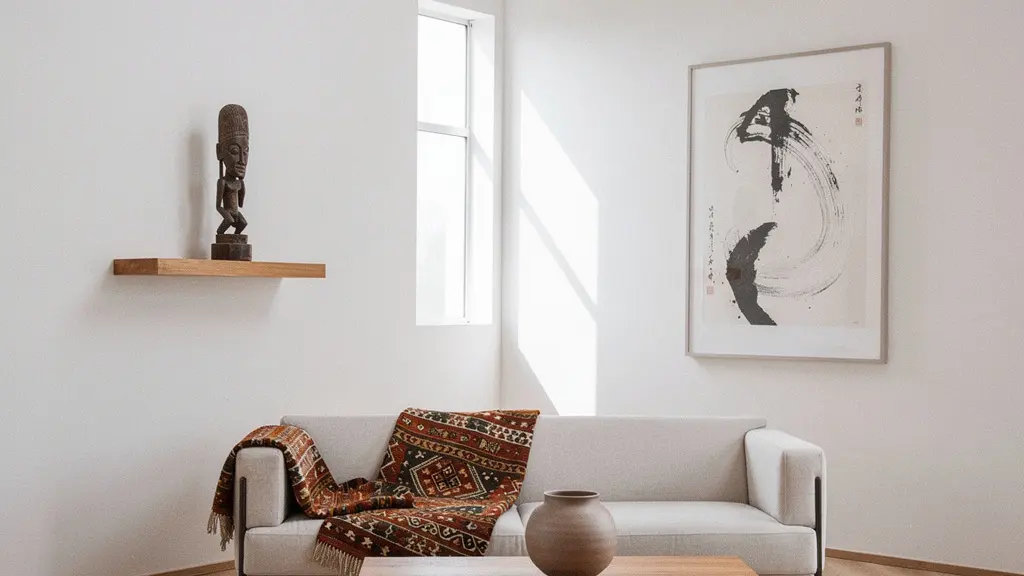
To create a sophisticated, globally-inspired home, you must shift from a mindset of ‘decorating’ to one of ‘curatorial conversation,’ where cultural integrity is paramount.
- Authenticity is achieved not by matching colors, but by understanding the context and history of each piece, whether it’s a gallery original or a market find.
- A harmonious space relies on creating an aesthetic dialogue between objects, using principles of visual weight, negative space, and thematic connection.
Recommendation: Begin by auditing your existing collection for its ethical provenance and cultural significance before adding any new pieces.
For the discerning homeowner, a house is more than a dwelling; it’s a reflection of a life lived with curiosity and intention. After traveling the world, the desire to integrate those rich experiences and beautiful objects into your personal space is natural. Yet, this ambition walks a fine line. The common approach—placing a few exotic items on a neutral backdrop—often falls short, risking a home that feels like a disjointed collection of souvenirs or, worse, a thoughtless pastiche. Many guides will advise you to simply pick a regional theme or add some woven textiles, but this rarely leads to the authentic, sophisticated look you crave.
The challenge lies in avoiding the pitfalls of kitsch and cultural appropriation while maintaining a clean, minimalist aesthetic. How do you honor the story of an African sculpture, the serenity of an Asian painting, and the raw texture of a South American textile in a single, cohesive vision? The answer is not found in conventional decorating rules. It requires a more profound approach, one that treats your home not as a display case, but as a stage for a living, breathing dialogue between cultures and forms.
The true key is to move beyond decoration and embrace the art of curation. This means understanding that the most important element is not the object itself, but the space and respect you create around it. It’s about fostering a curatorial conversation, where each piece is given the dignity of its context and allowed to speak to the others. This guide will walk you through the principles of this elevated approach, transforming your space from a collection of things into a testament to a world respectfully seen and beautifully integrated.
This article explores the nuanced strategies for creating a meaningful and aesthetically stunning interior. We will delve into the ethics of displaying cultural artifacts, the techniques for harmonious pairing, and the curatorial discipline required to maintain minimalist clarity.
Summary: The Art of Curating a Global Minimalist Interior
- Why Context Matters When Displaying Sacred Cultural Artifacts at Home?
- How to Pair African Sculptures With Asian Ink Wash Paintings Harmoniously?
- Gallery Original or Market Souvenir: Which Fits a Sophisticated Interior?
- The Maximalist Mistake That Turns Your Living Room Into a Cluttered Museum
- When to Rotate Your Art Collection to Refresh Your Home’s Energy?
- How to Arrange Your Office Art to Maximize Focus and Inspiration?
- Why Is Hanging a Ritual Mask on a Wall Controversial for Some?
- How to Use Local Art to Understand a New Culture Before Traveling?
Why Context Matters When Displaying Sacred Cultural Artifacts at Home?
Integrating cultural artifacts into your home transcends mere aesthetics; it is an act freighted with ethical responsibility. A sacred object is not simply a decorative form. It is a vessel of history, spirituality, and communal identity. To display it without understanding its original purpose is to strip it of its cultural integrity, reducing its significance to a mere exotic accent. This is the critical line between appreciation—honoring an object’s meaning—and appropriation, which can occur when objects are taken from a disempowered culture for purely decorative purposes.
The perception of this act is deeply tied to historical and social dynamics. In fact, research shows that cultural displays are more likely to be criticized when there’s a clear power imbalance between the borrower and the source culture. When an object made for a sacred ritual is used as a simple wall hanging, it can perpetuate a long history of colonial extraction where cultural treasures were removed from their communities and rebranded as “art.” Therefore, the first step in ethical curation is always research and introspection.
A positive model for this engagement emphasizes partnership and fair compensation. It’s about ensuring that the communities of origin benefit from the global interest in their craft. A powerful example of this principle in action is the Indego Africa model.
Case Study: Indego Africa’s Ethical Sourcing Model
Indego Africa partners directly with artisan women in Ghana and Rwanda to create handcrafted products for a global market. The artisans not only earn a significant portion of the profits but also receive training and education funded by the enterprise. This approach demonstrates how a business can foster genuine appreciation by creating economic empowerment and preserving artisanal traditions, ensuring that the act of purchasing and displaying these objects contributes directly to the well-being of their creators.
To navigate this complex terrain, every homeowner should act as a responsible custodian of the objects they choose to live with. This requires a conscious framework for evaluating each piece, not for its beauty alone, but for its story and ethical provenance.
Your 5-Point Ethical Curation Checklist
- Research Provenance: Investigate the object’s cultural and religious history using museum databases, academic sources, or reputable dealers. What was its original function?
- Verify Sourcing: Was the item purchased directly from the artisans, through a certified fair-trade organization, or from a dealer who can document its ethical acquisition?
- Assess Display Context: Does your intended display method (e.g., hanging a sacred mask on a living room wall) contradict its original, spiritual purpose?
- Examine Your Intent: Are you using the object with a genuine understanding of its meaning, or is it purely for its decorative or “exotic” appeal?
- Provide Context: If displaying a significant piece, consider creating appropriate context, such as a small, discreet plaque or a note in a digital home gallery explaining its cultural importance and origin.
How to Pair African Sculptures With Asian Ink Wash Paintings Harmoniously?
Creating harmony between art from disparate cultures is the pinnacle of personal curation. The secret to pairing, for instance, a bold, three-dimensional African sculpture with a minimalist Asian ink wash painting is not to find a common color, but to foster an aesthetic dialogue. This is a conversation of form, texture, philosophy, and spirit. Instead of forcing a match, a masterful interior allows each piece to retain its unique voice while contributing to a new, unified composition. The goal is a relationship built on complementary contrast, not superficial similarity.
This process begins by looking beyond the surface and identifying the deeper conceptual threads that connect the works. A West African figure carved from dark, dense wood speaks of earth, community, and ancestral spirits. A Japanese sumi-e landscape, with its vast negative space and fluid strokes, evokes concepts of impermanence and the Zen philosophy of finding profundity in simplicity. The dialogue emerges when these two worldviews are placed in conversation within the same visual field.
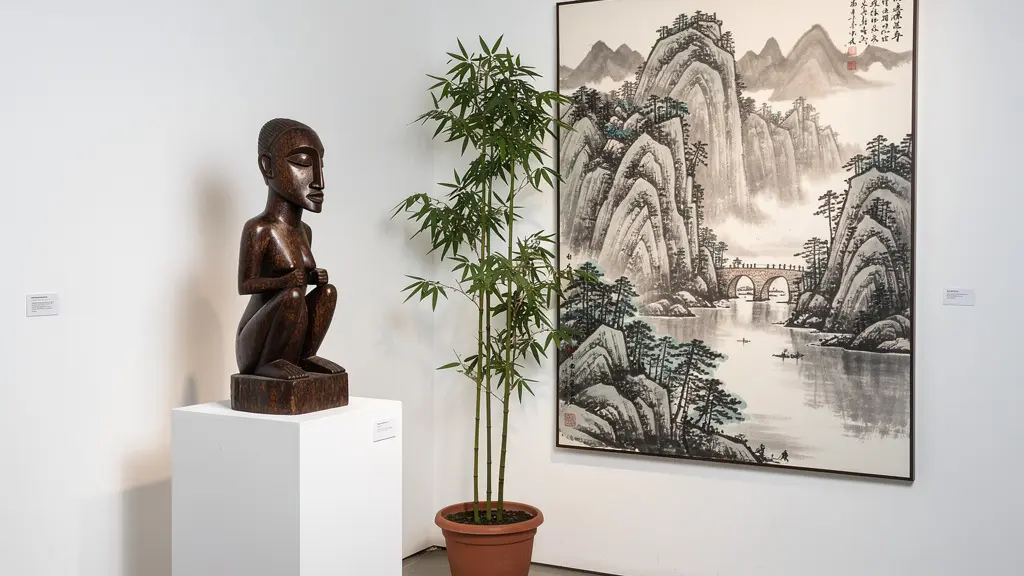
As seen in this thoughtful arrangement, the success of such a pairing relies on deliberate curatorial techniques. It’s about balancing visual weight, guiding the eye, and creating a sense of intentionality. To achieve this, you can employ several philosophical strategies:
- Connect Through Shared Themes: Link the animist, earth-bound spirit of the sculpture with the Zen celebration of nature in the ink wash painting. The shared theme is a deep reverence for the natural world, expressed in different artistic languages.
- Apply the Rule of Three: Create a visual triangle between the sculpture, the painting, and a third “bridging” element, such as a live plant or a carefully chosen piece of furniture. This guides the eye and creates a stable, yet dynamic, composition.
- Use Dynamic Asymmetry: Do not place both pieces dead center. Instead, balance the dense, heavy presence of the sculpture with the light, airy quality of the painting by strategically using the negative space on the wall around them.
- Introduce a Bridging Element: A simple, neutral element can unite the two pieces. A bamboo plant in an earthen pot, for example, references the material culture of both continents and softens the transition between the two distinct forms.
Gallery Original or Market Souvenir: Which Fits a Sophisticated Interior?
A common dilemma for collectors is the perceived hierarchy between a high-value gallery original and a humble market souvenir. In the context of a minimalist, globally-inspired home, this is a false dichotomy. Sophistication does not stem from an object’s price tag but from the quality of its story and the intentionality of its display. A multi-thousand-dollar painting can feel impersonal if chosen without connection, while a simple, hand-carved wooden spoon from a village market can exude immense power if it carries a personal narrative and is curated with respect.
The choice between a gallery piece and a souvenir is not about which is “better,” but about understanding the different types of value they bring to a space. A gallery original offers financial and historical authenticity, often backed by provenance and critical acclaim. A market souvenir offers emotional authenticity—a direct, tangible link to a place, a person, or a moment in time. A truly sophisticated interior makes room for both.
As the philosophy of modern luxury evolves, the emphasis shifts from overt displays of wealth to something far more personal and meaningful. This is beautifully captured by a core tenet of contemporary design:
The Story is the New Luxury. In a minimalist home, sophistication comes from curation and narrative.
– Interior Design Philosophy, Global Cultural Aesthetics in Modern Homes
This principle empowers the homeowner to act as a curator of their own life. The key is to treat every object, regardless of its origin, with the same level of curatorial respect. The following table breaks down how each type of object contributes to the overall design narrative.
| Aspect | Gallery Original | Market Souvenir |
|---|---|---|
| Financial Value | Investment piece, appreciates over time | Affordable, emotional value exceeds price |
| Authenticity Type | Financial authenticity with provenance | Emotional authenticity with personal story |
| Display Approach | Professional lighting, prominent placement | Museum-quality framing, story card display |
| Psychological Impact | Statement of taste and investment | Portal to personal memory and travel experience |
| Curation Strategy | Fewer pieces, gallery-style spacing | Grouped collections, thematic arrangements |
The Maximalist Mistake That Turns Your Living Room Into a Cluttered Museum
The greatest threat to a minimalist home filled with global treasures is not an abundance of objects, but a lack of curatorial intent. The “maximalist mistake” is the assumption that every surface must be filled, turning a living space into a static, cluttered museum where no single piece can truly be appreciated. The room becomes a cacophony of stories, with no room for the eye—or the soul—to rest. This is a fundamental misunderstanding of minimalism, which is not about emptiness, but about radical intentionality.
To avoid this, a designer thinks in terms of visual weight and negative space. A heavy, ornate object requires a significant amount of “empty” wall or surface area around it to breathe. This negative space is not wasted; it is an active design element that frames the object, directs attention, and creates a sense of calm and order. A collection becomes clutter when this crucial balance is ignored. The goal is to edit ruthlessly, so that what remains is powerful and resonant.
Instead of scattering your collection throughout a room, a more sophisticated approach is to adopt micro-curation strategies. This involves treating small areas of your home—a single bookshelf, a niche in the wall, or a console table—as miniature, rotating galleries. By grouping objects with discipline and a clear theme, you create powerful vignettes that draw the eye and tell a coherent story.
Here are several professional techniques to prevent your collection from becoming clutter:
- Create Themed Groupings: Organize small collections by a unifying principle, such as ceramic textures from different continents, objects within a specific color story (e.g., indigo blues), or pieces acquired during a single transformative journey.
- Implement Visual Pauses: This is the most critical rule. Deliberately leave surfaces and walls empty between your curated collections. These “pauses” are essential for allowing the art to be seen and for maintaining an overall sense of tranquility.
- Design a Modern “Cabinet of Curiosities”: Instead of an overloaded glass cabinet, use architectural features like built-in niches or minimalist floating shelves to display smaller, precious items. This integrates the display into the architecture of the home.
- Apply the “One In, One Out” Rule: To maintain equilibrium, commit to placing an existing item into storage for every new piece you introduce. This forces a continuous process of editing and re-evaluation.
When to Rotate Your Art Collection to Refresh Your Home’s Energy?
A truly dynamic interior is not static; it evolves with you and with the seasons. Thinking of your art collection as a living entity that needs to be refreshed is a hallmark of a sophisticated curatorial practice. Rotating your art is not just about preventing visual boredom; it’s a powerful tool to shift the energy of a space, rediscover forgotten treasures, and continue the ongoing curatorial conversation within your home. The question is not *if* you should rotate, but *when* and *how*.
One of the most intuitive approaches is to align your art rotation with the changing of the seasons. Just as you might swap heavy drapes for light linens, you can adjust your art to reflect the mood and light of the time of year. This creates a home that feels deeply connected to its environment and the natural rhythms of life.
Case Study: A Seasonal Curation Approach
A successful rotation strategy can completely transform a space’s atmosphere. For instance, during the colder, darker winter months, one might choose to display art with a sense of warmth and history. This could involve bringing out classical artwork in ornate, gilded frames and pairing it with luxurious fabrics like velvet and silk on upholstery. Intricate tapestries and mirrors can be used to reflect light and add a layer of timeless elegance. As spring arrives, these pieces can be swapped for lighter, more vibrant contemporary works and natural textiles, creating a home that feels responsive and alive.
Of course, a successful rotation strategy requires a practical and organized storage system. This doesn’t have to be a climate-controlled vault, but it should be a dedicated, well-organized space where pieces are protected and easily accessible. Thinking about storage as part of your design process is crucial for making rotation a joy rather than a chore.
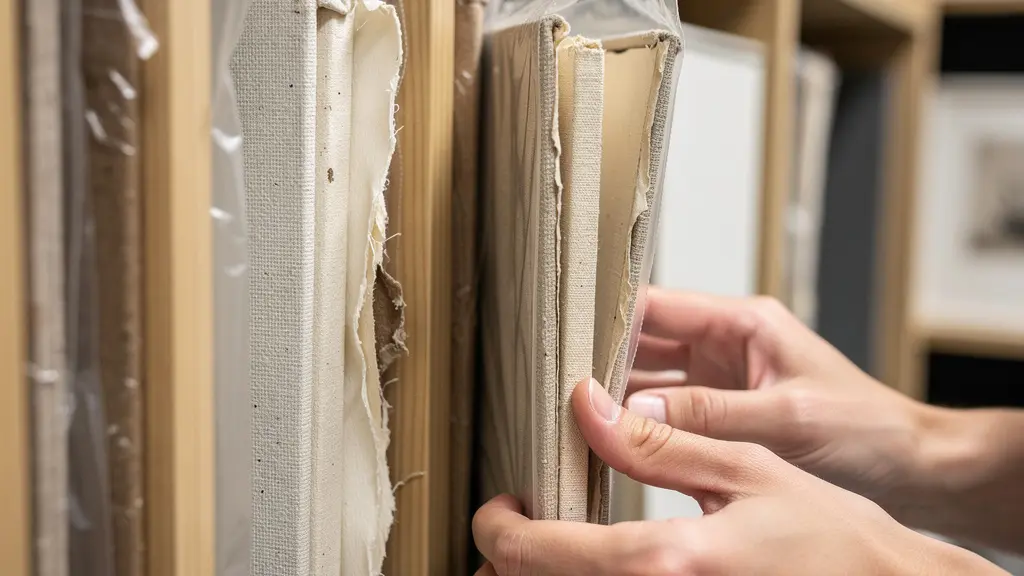
Ultimately, the timing of your rotation is personal. It can be tied to the seasons, triggered by the acquisition of a new piece, or simply inspired by a desire for change. The key is to see your walls not as permanent fixtures, but as a revolving gallery that tells the evolving story of your life.
How to Arrange Your Office Art to Maximize Focus and Inspiration?
The home office is a unique space where the demands for productivity and inspiration intersect. The art you choose for this environment is not merely decorative; it is a functional tool that can profoundly influence your mental state. By applying the same principles of curatorial conversation to your workspace, you can create zones that are intentionally designed to either calm the mind for deep focus or stimulate it for creative brainstorming.
The most effective strategy is to divide your office into distinct functional zones. The art within your direct line of sight should be different from the art in your peripheral vision or in the space you use for breaks. This zoning strategy allows you to tailor the psychological impact of your art to the task at hand. For instance, the wall behind your monitor is prime real estate for art that promotes tranquility and minimizes distraction, while a wall to the side can host more complex, thought-provoking pieces.
The selection of art for each zone should be deliberate, drawing on the inherent qualities of different cultural art forms to achieve a specific mental effect. The table below outlines a framework for this approach.
| Zone | Art Type | Cultural Example | Purpose |
|---|---|---|---|
| Focus Zone | Minimalist, Monochrome | Japanese Shodo calligraphy with simple harmony, like a single Kanji character for peace. | Reduce distraction |
| Inspiration Zone | Complex, Colorful | Vibrant African art with geometric designs that tell rich, narrative stories. | Spark creativity |
| Transition Area | Tactile, 3D | A smooth stone sculpture or a ceramic vessel placed by the door. | Mental state shift |
Beyond these primary zones, you can use art in more subtle ways to structure your workday. Placing a small, tactile object like a smooth stone sculpture by the door can serve as a mental transition trigger, helping you shift from “home” mode to “work” mode. You can even use a highly detailed artifact as a visual anchor for focus breaks, practicing a one-minute mindful gaze to reset your attention between demanding tasks.
Why Is Hanging a Ritual Mask on a Wall Controversial for Some?
The act of hanging a ritual mask on a wall as decoration lies at the very heart of the debate over cultural appropriation. For many indigenous communities, a mask is not an inanimate object or a piece of “art” in the Western sense. It is a sacred vessel, an active participant in ceremonies, and a conduit to the spiritual world. When it is removed from this living context—from the dance, the music, the community, and the ceremony it was created for—it is effectively “killed.” Its purpose is nullified, and it is transformed from a powerful ritual object into a silent, exotic trophy.
This decontextualization is seen by many as an act of profound disrespect, especially when the object comes from a culture that has historically been colonized or marginalized. It represents the continuation of a process where sacred items are extracted and repurposed for the aesthetic pleasure of a dominant culture. The voices from these communities are unequivocal in their stance against the unauthorized use and exploitation of their spiritual heritage.
We assert a posture of zero-tolerance for any ‘white man’s shaman’ who rises from within our own communities to ‘authorize’ the expropriation of our ceremonial ways by non-Indians; all such ‘plastic medicine men’ are enemies of the Lakota, Dakota, and Nakota people.
– Declaration of War Against Exploiters of Lakota Spirituality, Native American Rights Fund
The controversy is further complicated by the difficulty of navigating these issues with sensitivity. Well-intentioned efforts to avoid offense can sometimes lead to clumsy policies or censorship, highlighting the complexity of the debate. There are rarely easy answers, and what one person sees as respectful appreciation, another may see as harmful appropriation.
Case Study: The Challenge of Institutional Sensitivity
The complexities of this issue are illustrated by institutional struggles to create fair policies. For example, a 2016 decision by the University of East Anglia in the UK to prohibit sombreros at parties, out of a belief that they could offend Mexican students, was widely criticized by some as an overreach. This case shows how even when the intent is to be sensitive, the path is fraught with nuance, and there is often no broad consensus on what constitutes respectful cultural engagement versus appropriation.
For the conscientious homeowner, the takeaway is clear: when an object’s primary identity is spiritual or ritualistic, its place is likely not on your wall as decoration. The risk of causing unintended offense and participating in a legacy of cultural extraction is simply too high. True respect lies in acknowledging that some cultural treasures are not meant for domestic display.
Key Takeaways
- Ethical Curation is Paramount: Before displaying a cultural artifact, research its history and original purpose to ensure your display is respectful, not appropriative.
- Create Aesthetic Dialogue: Harmoniously blend diverse art forms by focusing on shared themes and principles of composition, such as visual weight and dynamic asymmetry, rather than matching colors.
- Narrative is the New Luxury: The sophistication of your interior comes from the stories you tell and the intentionality of your curation, whether the piece is a gallery original or a market souvenir.
How to Use Local Art to Understand a New Culture Before Traveling?
The ultimate expression of a globally-minded individual is not just to bring the world into their home, but to understand the world before they even step into it. Engaging with a country’s art scene before you travel is a profound act of respect and preparation. It transforms you from a passive tourist into an informed and engaged visitor. Art is a culture’s visual language; by learning to read it, you gain insight into the values, histories, and emotional landscapes of a place long before your plane touches down.
This pre-travel research goes far beyond flipping through a guidebook. It involves an active and curious immersion into both the traditional and contemporary artistic expressions of your destination. It’s about understanding the symbolic meaning of local motifs, learning about the time-honored craftsmanship behind traditional textiles, and following the work of contemporary artists who are shaping the cultural conversation today. This process builds a foundation of knowledge that enriches every interaction and observation you will have during your trip.
A structured research strategy can open doors to a much deeper and more authentic travel experience. Here is a practical framework for using art as your guide:
- Study the Visual Language: Research the meanings behind common symbols, motifs, and color palettes found in the region’s traditional art. This will give you a new lens through which to see everything from architecture to clothing.
- Follow Contemporary Artists: Use platforms like Instagram and Behance to discover and follow artists from the country you plan to visit. Their work provides a real-time window into current social issues, cultural trends, and modern identity.
- Map the Emotional Landscape: Observe how local artists depict their own environment, people, and history. Does the art convey a sense of pride, struggle, joy, or nostalgia? This emotional context is invaluable for understanding the local psyche.
- Plan Studio or Gallery Visits: Once you’ve identified artists or craft traditions that resonate with you, research local galleries or artisan cooperatives to visit. Contacting them in advance can sometimes lead to authentic opportunities for cultural exchange.
This proactive engagement is part of a larger, positive evolution in how we approach cross-cultural exchange. Indeed, cultural evolution research indicates that over the past 50 years, Western views have evolved to more deeply embrace ethnic diversity and multiculturalism. By doing this homework, you are not just planning a vacation; you are participating in this global shift toward more mindful and respectful interaction.
Begin this journey of discovery today. The next time you plan a trip, make art your first port of call, and unlock a richer, more meaningful connection to the world.