
True artistic value is not found in a brand name, but in a hierarchy of intentional, technical choices that mass production cannot replicate.
- Inferior materials and finishes lead to exponential restoration costs and value loss, betraying a lack of long-term vision.
- “Hand-finished” is a marketing term; true “hand-crafted” involves the maker’s hand at every stage, justifying a significant price premium through skill and time.
Recommendation: Use a forensic checklist to analyze brushwork, material integrity, and construction before any acquisition to separate masterful intent from industrial convenience.
For the discerning collector, the market presents a fundamental paradox. You stand before an object of beauty, its price tag suggesting immense value, yet a nagging question persists: are you paying for genuine skill or clever branding? The line between a masterfully crafted artifact and a well-marketed, mass-produced item has become dangerously blurred. Many are taught to look for “charming imperfections” as a sign of the handmade, a romantic but flawed notion that often excuses mediocrity.
This approach is inadequate. True craftsmanship is not about random flaws; it is about a hierarchy of intentional decisions, a deep conversation between the maker and their materials. It’s about an unwavering commitment to techniques that prioritize longevity and aesthetic integrity over speed and cost-effectiveness. A collector who cannot see this distinction is merely a consumer, vulnerable to the inflated pricing of the “gallery brand” trap and the hidden costs of poor material choices.
This guide abandons romanticism for a forensic framework. We will not be looking for charming flaws. We will be equipping you with a master evaluator’s eye, teaching you to deconstruct an object and read the story written in its construction, its finish, and its very substance. It is time to learn the difference between an object that is merely assembled and one that is truly born from skill.
This article provides a technical walkthrough for evaluating the core attributes of true craftsmanship. From analyzing the foundational materials to understanding the economic realities of artisanal work, each section offers a critical lens for your next acquisition.
Summary: A Forensic Guide to Identifying True Artisanal Value
- Why Cheap Materials in Modern Art Will Cost You Double in Restoration?
- How to Spot Flaws in Brushwork and Finishing Before You Buy?
- Hand-Finished vs. Hand-Crafted: Which Justifies a 30% Price Premium?
- The “Gallery Brand” Trap That Inflates Prices for Mediocre Work
- How to Clean Textured Art Surfaces Without Damaging the Patina?
- The “Botched Restoration” Error That Ruins Historical Value Forever
- Why Does It Take Four Artisans to Make One Woodblock Print?
- Why Does One Tube of Red Paint Cost $5 and Another $40?
Why Cheap Materials in Modern Art Will Cost You Double in Restoration?
The first indicator of an object’s integrity is its material honesty. Mass production prioritizes cost-efficiency, often employing materials that look good upon completion but are engineered for obsolescence. True craftsmanship, conversely, begins with materials chosen for their stability, longevity, and graceful aging. An artist who builds an object with inferior or unstable components demonstrates a fundamental disregard for its future—a hallmark of production-line thinking, not mastery.
Modern and contemporary art is particularly susceptible to this issue. The use of experimental acrylics, commercial plastics, and mixed-media assemblages can create an “inherent vice,” where the materials themselves are chemically incompatible or destined to degrade rapidly. This is not a charming quirk; it is a structural flaw. When you acquire such a piece, you are also acquiring an inevitable and costly restoration bill. Indeed, professional conservators estimate that restoration costs can reach $10,000 to $15,000 for larger paintings damaged by material failure.
Therefore, your evaluation must begin at this foundational level. Question the materials. A plywood substrate hidden beneath a veneer, a commercial-grade paint used in place of archival pigment, or an unstable adhesive are all red flags. A master artisan respects their materials and understands their properties over time. A manufacturer is concerned only with the object’s appearance at the point of sale. Choosing craftsmanship is choosing permanence over disposability.
How to Spot Flaws in Brushwork and Finishing Before You Buy?
The surface of an object is where the artist’s hand is most visible. It is the signature of their technique, and you must learn to read it with forensic precision. Forget the notion of “charming imperfections.” You are looking for intentionality and control. A shaky, uncertain line is a flaw. A confident, deliberate brushstroke, even if bold, is a sign of skill. Mass-produced items often feature sprayed-on, uniform finishes or printed textures that mimic handiwork but lack its soul.
To assess the finish, use raking light—shine a light source from a low angle across the surface. This technique will reveal every inconsistency, tool mark, and layer of finish. A mass-produced object will appear flat and lifeless, while a handcrafted piece will show a dynamic topography of subtle variations. Look for signs of hand-polishing, burnishing, or deliberate texturing. These are marks that a machine cannot replicate with the same organic quality.
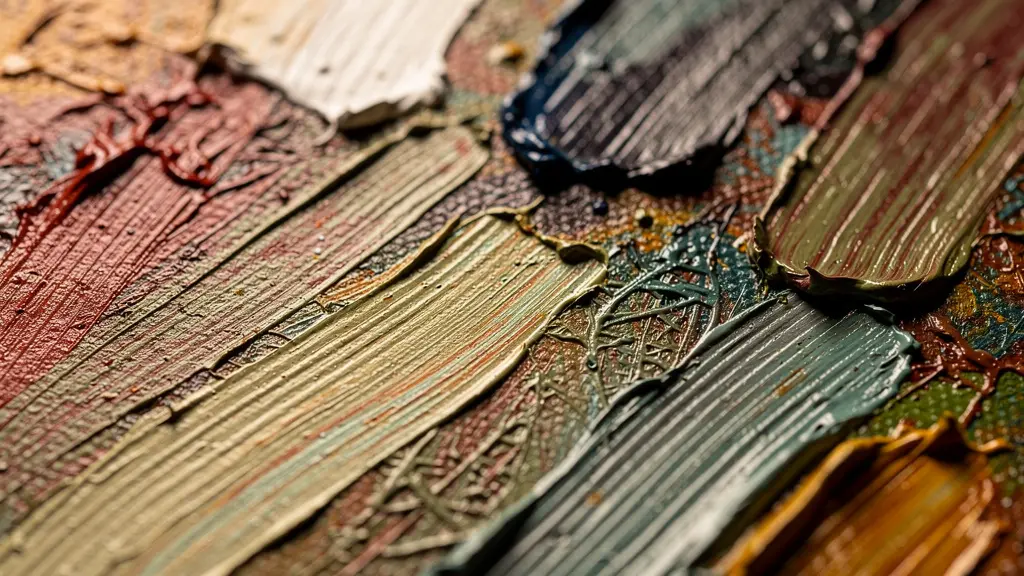
This macro view demonstrates what you must look for: the physical evidence of the brush. You can see the drag of the bristles, the subtle mixing of pigments on the canvas, and the varying thickness of the paint (impasto). These are not flaws; they are the verifiable record of a human process. A machine-printed image or a sprayed finish will lack this complex, tactile dimension. Your ability to discern this difference is paramount.
Action Plan: Forensic Surface Inspection
- Assess structural integrity: Before analyzing the surface, check for any areas where ornamentation is loose or frames are unstable. A solid foundation is a prerequisite for a lasting finish.
- Examine the varnish: Observe the condition of the final protective layer. Historic varnishes degrade and yellow over time, while a cheap, quickly applied varnish may show drips, cloudiness, or an unnatural plastic-like sheen.
- Conduct patch testing (for conservators): For a true professional analysis, each unique pigment requires a separate test to determine the correct and safe cleaning solution, revealing the complexity of the original materials.
- Identify unusual pigments: Look for the tell-tale signs of historic or high-quality pigments. The deep, vibrant blue of Lapis Lazuli or the rich, earthy tones of traditional ochres have a chromatic depth that synthetic equivalents struggle to match.
- Document the brushwork: Use your phone’s camera in macro mode with raking light. Compare different areas of the piece. Look for consistency in skill but variation in application—the hallmarks of a confident hand.
Hand-Finished vs. Hand-Crafted: Which Justifies a 30% Price Premium?
In the lexicon of marketing, words are often weaponized to mislead the buyer. “Hand-finished” and “hand-crafted” are prime examples. A “hand-finished” object is typically machine-made, with a final, often superficial, touch applied by a person—a quick sanding, a coat of varnish, or the attachment of a handle. It is a minimal human intervention designed to justify a higher price. “Hand-crafted,” by contrast, is a philosophy. It means the artisan’s hand and skill are integral to every stage of creation, from the initial shaping of the material to the final polish.
This distinction is not trivial; it represents a vast difference in labor, skill, and time, which must be reflected in the price. The global handmade market is not a niche cottage industry; the global handmade and crafts market reached a staggering $906 billion, a testament to the perceived and real value of artisanal work. An object that is 95% machine-made and 5% “finished” by hand cannot command the same value as one that is 100% conceived and executed by a skilled individual. You must learn to dissect the manufacturing process to determine where the value truly lies.
The following data illustrates the chasm in value between factory production and true craftsmanship. While these are everyday items, the principle applies directly to art objects: the labor and skill of the artisan command a premium that mass production cannot justify.
| Product Type | Factory-Made Price | Handcrafted Price | Price Difference |
|---|---|---|---|
| Silverware Set (20-24 pieces) | $20 | $426 | 2,130% |
| Dinner Plate | $3.50 | $40 | 1,143% |
| Pair of Jeans | Standard retail | 5.5 hours labor | Time-based premium |
The “Gallery Brand” Trap That Inflates Prices for Mediocre Work
A prestigious gallery, a slick catalogue, and a high price do not automatically equate to high-quality craftsmanship. This is the “Gallery Brand” trap: the practice of using marketing and reputation to inflate the price of work that, upon technical inspection, is mediocre. The gallery’s brand becomes a substitute for the object’s intrinsic value. As a collector, your job is to see through this facade. You must evaluate the object, not the label attached to it.
To avoid this trap, you must deconstruct the price. An artisan’s pricing is based on tangible factors: the cost of high-quality materials (bought in small, expensive quantities), the hours of skilled labor, and the overheads of their workshop. A maker with years of expertise rightfully charges for their developed skill. At a UK minimum wage, a simple handmade card that takes 30 minutes to create has a labor cost that already exceeds the retail price of many mass-market cards. This calculation—cost of materials + hours of labor x skill level + overhead—gives you the object’s baseline artisanal value.
When you see an object in a gallery, perform this mental calculation. Does the price seem to reflect these factors, with a reasonable margin for the gallery? Or does it seem arbitrarily high, buoyed by the gallery’s location and reputation? Often, the most technically brilliant work is found in smaller, specialist studios where the price is a direct reflection of the craft, not the brand. Your loyalty must be to the craftsmanship, not the gallery.
How to Clean Textured Art Surfaces Without Damaging the Patina?
The long-term care of an object is a direct extension of its initial evaluation. An object that is difficult or impossible to clean without causing damage is a poorly designed object. True craftsmanship considers maintenance from the outset. The “patina” of age—the gentle sheen and coloration that develops on a surface over time—is a desirable sign of history. However, dirt and grime are not patina, and their removal requires extreme care, especially on textured surfaces.
The first rule is absolute: do no harm. Generic, aggressive cleaning methods will strip the patina, abrade the surface, and irrevocably damage the piece. As professional conservators know, the cleaning method must be tailored to the specific material and era of the artwork. Cleaning an Old Master painting with its delicate glazes is a vastly different process from cleaning a modern acrylic or an Impressionist work with heavy impasto. A one-size-fits-all approach is a recipe for disaster.

For textured surfaces, the gentlest methods are imperative. Never use commercial cleaning sprays or wet cloths. Dust should be lifted, not pushed around. A soft, natural-bristle brush (like a sable watercolor brush) can be used to gently flick dust from crevices towards the nozzle of a low-suction vacuum cleaner held several inches away. For more ingrained dirt, specialized, pH-neutral conservation sponges or dry-cleaning granules may be used, but only after extensive research and preferably by a professional. The tools of conservation are precise and gentle for a reason; your tools must be too.
The “Botched Restoration” Error That Ruins Historical Value Forever
There is a value far greater than the initial purchase price: historical and artistic integrity. Nothing destroys this value more completely or permanently than a botched restoration. The attempt to “fix” or “improve” a piece by an amateur or unqualified individual is an act of vandalism that can erase centuries of history and skill in a matter of hours. The horrifying “restorations” of artworks that occasionally go viral are just the tip of the iceberg.
The financial consequences are catastrophic. While a professional conservation consultation may seem expensive, restoration mistakes can cause a 50-90% permanent value loss. An object that was worth $100,000 can become virtually worthless overnight. This is not a risk; it is a certainty when unqualified hands are involved. A professional conservator’s creed is to intervene as little as possible, using reversible techniques to stabilize the object. Their goal is preservation, not alteration. An amateur, driven by ego, often seeks to repaint, refinish, and “perfect” the piece, destroying its authenticity in the process.
Therefore, when acquiring an older piece, you must look for signs of previous restoration. Are there areas of mismatched color or unnatural gloss? Does a part of the painting or object look suspiciously “new” compared to the rest? These are indicators of past interventions that must be professionally assessed. A piece with honest wear and age is infinitely more valuable than one with a botched, irreversible restoration. Your role as a custodian is to preserve, not to reinvent.
Why Does It Take Four Artisans to Make One Woodblock Print?
The concept of “the lone artist” is often a romantic myth. Many of the highest forms of craftsmanship are, and always have been, collaborative. The Japanese ukiyo-e woodblock print is a perfect example. Its creation was not the work of a single person but a symphony of specialized skills: the artist (eshi) who drew the design, the carver (horishi) who painstakingly chiseled the woodblocks, the printer (surishi) who applied the inks, and the publisher (hanmoto) who financed and coordinated the entire venture.
This division of labor is not a sign of industrialization; it is the pinnacle of specialization. Each artisan dedicated their life to mastering a single, incredibly complex part of the process. To ask the carver to be a master printer would be to dilute their carving skill. This collaborative model, recognized by organizations like UNESCO as a vital part of intangible cultural heritage, ensures that knowledge is passed down and standards remain uncompromisingly high. This is the antithesis of the mass-production assembly line, where workers are interchangeable and perform low-skill, repetitive tasks.
In artisanal collaboration, each participant is a master in their own right, and the final object is a testament to their collective genius. When evaluating an object, you must ask: was this made by one person, or is it the product of a workshop of specialists? Neither is inherently superior, but understanding the model of production is key to appreciating the skills involved. A workshop of masters is not an assembly line. The broader artisan industry is a major economic force, estimated to support roughly 300 million jobs worldwide, many of which rely on these collaborative, skill-based systems.
Key Takeaways
- Material Integrity is Non-Negotiable: Cheap, unstable materials are a hallmark of mass production and lead to costly restoration and permanent value loss. True craftsmanship begins with materials chosen for longevity.
- Read the Surface Forensically: Use raking light to analyze brushwork and finishing. Look for the controlled, intentional marks of a human hand, not the sterile uniformity of a machine.
- Deconstruct the Price: Differentiate between “hand-finished” (marketing) and “hand-crafted” (skill). A fair price reflects material costs, labor hours, and the artisan’s expertise—not the gallery’s brand.
Why Does One Tube of Red Paint Cost $5 and Another $40?
We arrive at the most fundamental level: the raw material itself. To truly understand the value of a crafted object, you must understand the value of its components. The vast price difference between two tubes of red paint is not arbitrary. A $5 tube of student-grade paint is mostly filler, with a small amount of low-quality synthetic pigment. A $40 tube of professional-grade cadmium red is almost pure, finely-milled pigment, offering unparalleled lightfastness and chromatic intensity. The artist who chooses the $40 tube is not being extravagant; they are making a technical decision to ensure the quality and permanence of their work. This choice is invisible in the final piece to the untrained eye, but it is the very foundation of its quality.
This principle extends to every medium. The cost of a piece of wood is determined by its species, its age, the quality of its grain, and how it was dried. The price of a lump of clay depends on its purity and firing properties. An artisan’s pricing formula is a complex calculation that must account for these variables, as well as the inherent risks of the craft.
| Cost Component | Description | Impact on Price |
|---|---|---|
| Materials (COGS) | Raw materials cost | Base cost |
| Time/Labor | Hours spent creating | Hourly wage × time |
| Business Overhead | Workspace, utilities, customer service time | Markup multiplier |
| Risk Factors | Material volatility, waste, health risks | Additional markup |
| Administrative Time | Packaging, shipping, bookkeeping, communication | Covered by markup |
The “Risk Factors” are crucial and often overlooked. A ceramicist, for instance, must account for the pieces that will inevitably crack in the kiln. As Lily from Drifting Spirits notes on the Artisans Cooperative Blog:
Danger of different firing processes must be considered when pricing ceramics.
– Lily from Drifting Spirits, Artisans Cooperative Blog
This is the cost of experience and quality control. When you buy a handcrafted object, you are not just paying for the successful piece you hold in your hands; you are paying for the failures that were necessary to achieve that level of mastery.
Apply this forensic mindset to every potential acquisition. Question the materials, analyze the technique, deconstruct the price, and respect the craft. By doing so, you will ensure that your collection is not an assemblage of expensive objects, but a testament to genuine human skill and a true investment in art.
Frequently Asked Questions on How to Distinguish True Craftsmanship From Mass Production in Art Objects?
Why do restoration costs seem so high?
Restoration requires highly specialized approaches and trained artisans, which can make the perceived costs seem daunting. However, using an efficient, expert team to address damage from inferior materials or age actually preserves value. Proper pre-production studies can also provide accurate budgeting and often save money in the long run by preventing future issues.
What happens if unknown issues arise during restoration?
Unforeseen problems, such as hidden water damage or crumbling plaster, must be addressed immediately before any decorative work can continue. Failing to do so guarantees future failure and higher costs. Having the right, honest team on-site is vital to mitigate these urgencies and make realistic decisions about the budget and project scope.
How can pre-production studies save money on restoration?
The costs associated with initial research, historical investigation, and exploratory studies are an investment, not an expense. The more completely an object or interior is studied before work begins, the more accurate the production budgeting will be. These studies develop real, data-driven numbers for the total project cost, eliminating guesswork and preventing budget overruns from unexpected discoveries.