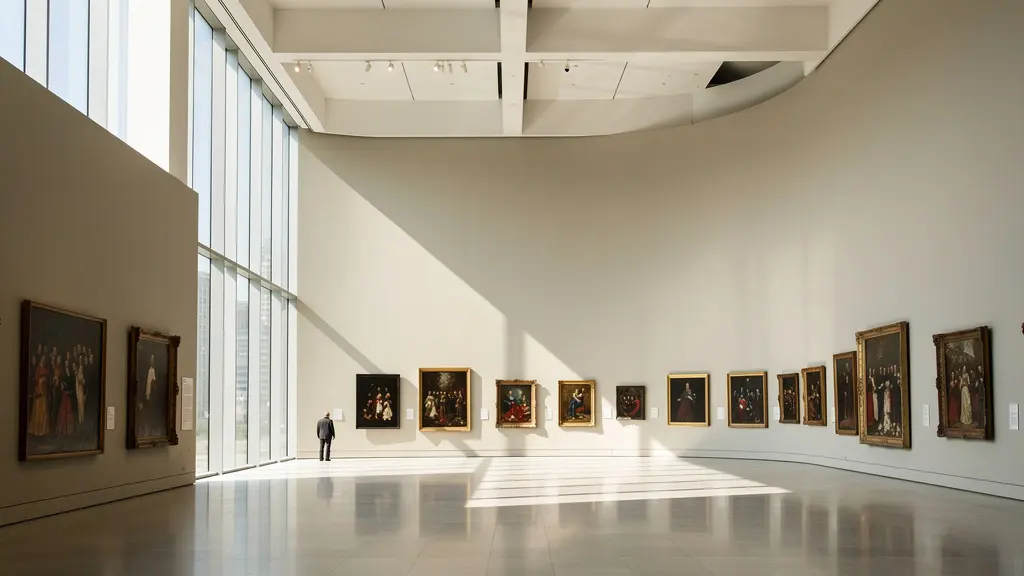
Contrary to popular belief, mastering the art history timeline isn’t about memorizing endless dates and names. The key is to stop treating art history as a list and start seeing it as a series of interconnected stories. This guide reframes memorization as a byproduct of understanding the ‘why’ behind each artistic shift, transforming your study from a chore into a compelling narrative investigation.
Many students approach art history with a sense of dread. The sheer volume of movements, artists, and dates can feel like an insurmountable mountain of facts to be memorized. The common advice—endless flashcards, dense chronological readings, rote repetition—often reinforces this feeling, turning a vibrant subject into a dry, academic exercise. You are told to memorize that the Renaissance valued harmony and the Baroque embraced drama, but rarely are you taught to see these as logical responses to the cultural and political climates of their time.
This approach misses the fundamental truth of the discipline. Art is not created in a vacuum; it is a conversation. Each movement is a reaction, a question, or an answer to what came before and what was happening in the world. The shift from Realism to Abstraction wasn’t a random decision; it was a necessary response to new scientific theories, psychological discoveries, and a changing global perspective. Understanding these connections is the secret to true retention.
But what if you could replace rote learning with a more intuitive, narrative-driven method? What if the key wasn’t memorizing more, but understanding better? This guide is built on that very principle. We will deconstruct the timeline into a series of logical cause-and-effect narratives. Instead of just learning facts, you will learn to think like an art historian, identifying the visual logic behind each period and connecting artworks to the grander story of human thought and experience. We will explore how to identify movements instantly, uncover the myths that distort our understanding, and use powerful visual techniques to make the timeline stick, not because you forced it to, but because it finally makes sense.
This article provides a structured method for transforming your approach to art history. The following sections break down complex concepts into manageable, interconnected ideas, equipping you with the tools to navigate the timeline with confidence.
Summary: How to Learn the Art History Timeline Through Narrative Understanding
- Why Did Art Shift Abruptly From Realism to Abstraction in the 20th Century?
- How to Identify Baroque vs. Renaissance Art in Under 10 Seconds?
- Classical Revival vs. Romanticism: Which Movement Resonates More Today?
- The Common Interpretation Error That Misleads 80% of History Students
- What Are the Best Visual Aids for Mastering Art Periods Quickly?
- The Myth of the “Sudden Rebirth” That Ignores Medieval Innovations
- Why Did Cubists Reject the Single Perspective Used for 500 Years?
- How to Estimate the Date of an Unsigned Painting Using Visual Clues?
Why Did Art Shift Abruptly From Realism to Abstraction in the 20th Century?
The turn of the 20th century didn’t just introduce new art; it detonated a bomb under the very definition of what art could be. For centuries, the goal was largely mimetic: to represent the world realistically. Suddenly, artists like Kandinsky, Malevich, and Mondrian abandoned representation entirely. This wasn’t an act of rebellion for its own sake; it was a logical response to a world that had been fundamentally broken apart and reassembled by new ideas. Understanding these conceptual anchors is the key to remembering this pivotal shift.
Three major forces compelled this move toward abstraction. First, the scientific revolution, including Einstein’s theories of relativity, shattered the notion of a single, stable reality. If time and space were relative, how could a single, fixed perspective in a painting claim to represent truth? Artists began to paint feelings and concepts over direct observations. Second, the rise of psychoanalysis under Freud and Jung turned the focus inward. The subconscious mind, with its dreams and non-linear logic, became a more compelling subject than the external world. Realism seemed inadequate for expressing these deep, internal states.
Finally, a surge of interest in non-Western art provided a new visual language. African and Oceanic sculptures, which prioritized expressive power over anatomical accuracy, showed artists like Picasso a way to break free from the constraints of European tradition. Art shifted to reflect its historical context, particularly as artists explored how new scientific theories impacted perception. Abstraction wasn’t an abandonment of reality but an attempt to depict a more complex, multi-layered, and internal one.
How to Identify Baroque vs. Renaissance Art in Under 10 Seconds?
Standing in a museum, it can be daunting to differentiate a Renaissance masterpiece from a Baroque one. They often share similar subjects—mythology, religion, portraiture. Yet, their entire philosophy and visual language are worlds apart. The secret isn’t to memorize lists of artists, but to learn the skill of diagnostic viewing: training your eye to spot the core emotional and compositional differences that define their respective “visual logic.” The Renaissance seeks harmony and stability; the Baroque craves drama and movement.
Think of the Renaissance as a held breath—a moment of perfect, serene stillness. Compositions are often built on stable, geometric shapes like triangles and pyramids. Figures are self-contained, their gazes inward, lost in contemplation. The lighting is even and clear, illuminating the scene with a divine sense of order. Everything feels balanced, calm, and eternal. It is the art of intellectual grace.
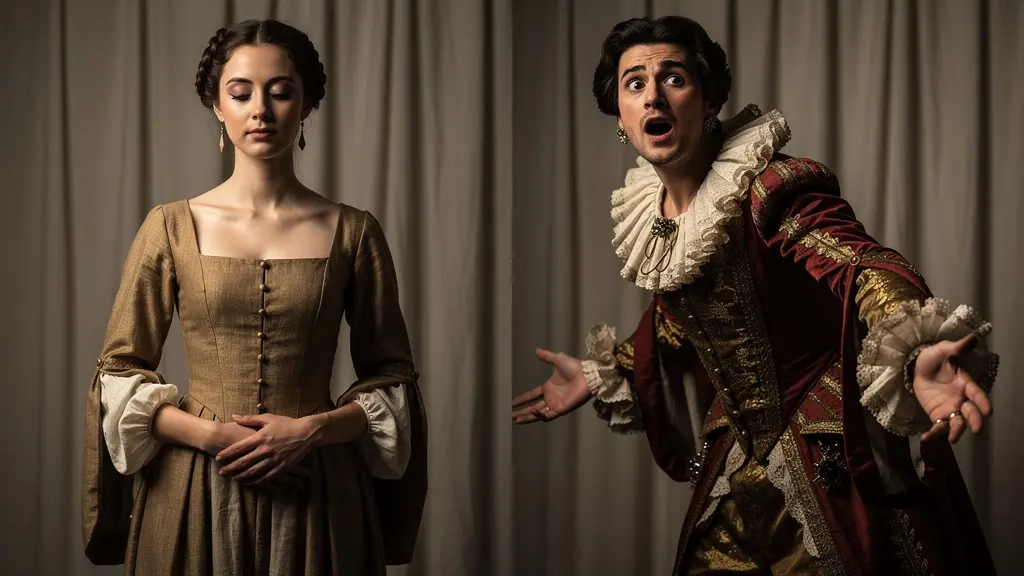
In contrast, the Baroque is the moment of exhalation—a whirlwind of action, emotion, and theatricality. Compositions are built on dynamic, sweeping diagonals that pull the viewer into the scene. Figures are caught mid-action, their bodies twisted, their faces displaying ecstatic rapture or intense suffering. Crucially, they often break the fourth wall, their gaze locking directly with yours. This dramatic effect is amplified by chiaroscuro, the use of extreme light and shadow, which acts like a spotlight on a stage.
This quick diagnostic table can serve as your mental checklist when confronting a work. By asking these five questions, you move beyond guessing and begin to analyze the work based on its fundamental principles.
| Visual Element | Renaissance | Baroque |
|---|---|---|
| Composition | Stable pyramid structure | Dynamic diagonal movement |
| Time Capture | Posed stillness, eternal moment | Dramatic action in progress |
| Emotional Register | Serene contemplation | Ecstatic rapture or intense drama |
| Figure Gaze | Inward or contained | Engaging viewer directly |
| Lighting | Even, balanced illumination | Theatrical chiaroscuro spotlights |
Classical Revival vs. Romanticism: Which Movement Resonates More Today?
The late 18th and early 19th centuries were defined by a tense philosophical duel between two opposing ideals: Neoclassicism (or Classical Revival) and Romanticism. This wasn’t just an aesthetic debate; it was a battle for the soul of the modern world, and its echoes are surprisingly loud today. For many, distinguishing these movements is a significant hurdle; educational data indicates that 78% of AP Art History students struggle with precisely this kind of differentiation. Understanding their core tenets clarifies not only the past but also our present cultural landscape.
Neoclassicism was a child of the Enlightenment. It championed reason, order, public virtue, and clarity. Looking back to the supposed moral purity of the Roman Republic, artists like Jacques-Louis David created works with crisp outlines, rational compositions, and sober colors. The message was paramount: art should instruct and ennoble the citizen. It is an art of the collective, of logic, and of civic duty.
Romanticism rose as a direct and passionate counter-argument. It celebrated individualism, emotion, the power of nature, and the sublime. Artists like Turner and Géricault rejected the cold rationality of Neoclassicism in favor of intense feeling and personal experience. Their works feature dramatic brushwork, turbulent compositions, and a focus on the awe-inspiring or terrifying power of the natural world. It is an art of the self, of intuition, and of untamed passion.
This historical conversation continues in our own time. As a response to cultural shifts, contemporary art often reflects these poles. The clean, grid-based aesthetic of modern minimalism and the structured order of a well-curated Instagram feed can be seen as heirs to Neoclassicism’s love for order. Conversely, the raw, unfiltered emotional expression of a personal blog or the chaotic energy of user-generated content on platforms like TikTok embodies the Romantic spirit of individual self-expression. Each ideal speaks to a different human need: the desire for structure and the longing for freedom.
The Common Interpretation Error That Misleads 80% of History Students
One of the most significant barriers to truly understanding art history is a cognitive trap known as the “Narrative of Progress.” This is the unconscious assumption that art history is a linear, upward march from “primitive” beginnings to the “perfect” realism of the Renaissance and beyond. This single error distorts our perception of entire epochs, leading us to dismiss or devalue art that doesn’t fit this flawed timeline. It causes us to ask the wrong questions, such as “Why couldn’t medieval artists paint realistically?” instead of the correct one: “What were medieval artists trying to achieve?”
This fallacy prevents students from appreciating the unique goals of different periods. For example, the purpose of a Byzantine mosaic was not to create a photorealistic depiction of a person; it was to convey the divine, transcendent, and eternal nature of a holy figure. The flat gold background, elongated forms, and large eyes weren’t mistakes or failures of skill. They were deliberate, highly sophisticated artistic choices designed to transport the viewer from the earthly realm to the spiritual one. Judging this work by the standards of Renaissance humanism is like criticizing a poem for not being a novel.
Similarly, this error can affect our reading of symbols. We might assume a symbol’s meaning is static across time. A skull in a 17th-century Dutch Vanitas painting is a clear *memento mori*, a reminder of mortality and the vanity of earthly pleasures. However, in contemporary art, a skull might signify rebellion, a subcultural affiliation, or even a purely decorative motif. Context is everything. To avoid this error, you must actively dismantle the idea of a single timeline of “improvement” and replace it with an understanding of multiple, parallel historical conversations, each with its own goals, values, and visual language.
What Are the Best Visual Aids for Mastering Art Periods Quickly?
The human brain is wired to remember images far better than abstract text. Yet, most students study art history by reading, not by looking. To move beyond rote learning, you must engage in active visual analysis. This means using techniques grounded in cognitive science to build stronger, more durable neural pathways. The goal is to make the visual characteristics of each movement so distinct in your mind that identification becomes second nature. In fact, research on memory techniques shows that visual aids combined with spaced repetition can improve information retention by up to 40%.
Forget passive scrolling through images. Instead, adopt these active learning strategies:
- Create Comparative Diptychs: Don’t just look at one painting. Place two artworks from different periods side-by-side on your screen. A Renaissance portrait next to a Baroque one, for instance. Force yourself to articulate the specific differences in lighting, composition, and emotional tone. This active comparison is far more powerful than studying them in isolation.
- Build Thematic Timelines: Instead of studying chronologically, trace a single subject through multiple eras. How was the “reclining nude” depicted by Titian (Renaissance), Goya (Romanticism), and Manet (Realism)? Following these narrative threads reveals how values and ideas about the body, class, and the viewer’s gaze have evolved.
- Use Interleaving Practice: Resist the urge to study in blocks (e.g., all of Impressionism in one day). Instead, mix it up. Study an Impressionist work, then a Cubist one, then a Baroque one. This “interleaving” feels harder, but it forces your brain to constantly retrieve and differentiate between different visual logics, leading to much stronger long-term memory.
- Apply Mental Reconstruction: After studying a key work for a few minutes, close your eyes and try to mentally rebuild it from scratch. Where is the main figure? What are they wearing? Where is the light source? This act of reconstruction solidifies the image in your visual memory.
These methods shift the focus from passive consumption to active engagement. They transform you from a spectator into an analyst, making the learning process more effective and, ultimately, more rewarding.
The Myth of the ‘Sudden Rebirth’ That Ignores Medieval Innovations
The very term “Renaissance,” meaning “rebirth,” perpetuates one of the most enduring myths in art history: that the Middle Ages were a long, dark, and ignorant period from which Europe was suddenly rescued by the rediscovery of classical knowledge. This narrative, crafted by Renaissance humanists themselves to elevate their own era, is a powerful but deeply misleading simplification. As one analysis notes, this was a deliberate branding exercise.
The term ‘Dark Ages’ was a biased label created by Renaissance humanists to aggrandize their own era.
– Art History Education Analysis, Bright Continent: African Art History Study Guide
Viewing the Middle Ages as merely a stagnant prelude to the Renaissance blinds us to a millennium of profound innovation and intellectual activity. The “rebirth” was not a sudden event but the flowering of seeds that were carefully cultivated throughout the medieval period. The technical advancements of the Renaissance would have been impossible without the groundwork laid by medieval artisans, thinkers, and engineers.
For instance, the luminous oil paintings of Jan van Eyck in the 15th century were not a sudden invention but the culmination of centuries of experimentation with oil-based glazes by Northern European artists. The intricate knowledge of advanced metallurgy required to create vibrant and stable pigments was a craft honed in medieval workshops. Furthermore, the breathtaking engineering of Gothic cathedrals, with their flying buttresses and ribbed vaults, demonstrates a mastery of physics and geometry that rivals any classical achievement. These structures were, in essence, stone skeletons designed to maximize interior light—a goal that directly foreshadows the Renaissance obsession with light and space. Art has always been an act of remembrance, and these medieval innovations were the essential foundation upon which the Renaissance was built.
Why Did Cubists Reject the Single Perspective Used for 500 Years?
For five hundred years, from the dawn of the Renaissance, Western art was governed by a single, powerful idea: linear perspective. This system, which uses mathematical principles to create a convincing illusion of three-dimensional space on a two-dimensional surface, was hailed as the pinnacle of realistic representation. So why, in the early 20th century, did artists like Picasso and Braque so radically reject it? The answer lies not in a desire to be different, but in a profound shift in how they experienced reality itself.
Cubism was an attempt to paint not what the eye sees in a single glance, but what the mind knows to be true. A face, for example, is not just a frontal view; we know it has a profile, a back, and countless angles in between. Linear perspective can only capture one of these viewpoints at a time. The Cubists saw this as a lie, an incomplete truth. Their solution was to fracture objects and reassemble them on the canvas, showing multiple viewpoints simultaneously. This is why a Cubist portrait might show a nose in profile on a face that is looking directly at you. It is a more complete, conceptual representation of the object as it exists in space and time.

This new way of seeing was heavily influenced by the modern world. Think of the new experience of motion offered by cars, trains, and especially cinema. A film shows an object from multiple angles, in motion, over a duration of time. Cubism can be understood as an attempt to capture this dynamic, cinematic experience on a static canvas. It is an art form that acknowledges the fourth dimension—time—and the fluid nature of perception. It grew out of the periods that came before, continuing a process of exploration to represent a new, more complex modern consciousness that the old rules of perspective could no longer contain.
Key Takeaways
- True memorization comes from understanding the ‘why’ behind artistic changes, not from rote learning of dates and names.
- Use active comparison (like placing Baroque and Renaissance art side-by-side) to train your eye for ‘diagnostic viewing’.
- Trace narrative threads (like a single theme across eras) to see art history as an ongoing conversation rather than a list of isolated facts.
How to Estimate the Date of an Unsigned Painting Using Visual Clues?
Imagine you encounter an old, unsigned painting. It feels European, but from when? The 15th century? The 18th? This is the work of the connoisseur: using a series of visual clues to narrow down the period, and often the location, of a work of art. This skill is not magic; it’s a systematic process of investigation, a form of visual detective work. By learning to recognize key indicators in materials, subject matter, and technique, you can develop a surprisingly accurate sense of an artwork’s place in the timeline.
The process begins with the most fundamental element: the physical object itself. The materials an artist used are often a dead giveaway. Was the painting done on a thick wood panel or on stretched canvas? This single clue can help you place the work before or after the 16th century, when canvas began to supplant wood as the preferred support. From there, you can move to the subject matter and the artist’s technique, looking for anachronisms or tell-tale stylistic choices that act as historical signposts.
This practical method, which combines material science with stylistic analysis, allows you to build a logical case for a painting’s origin. It’s the ultimate application of the principles we’ve discussed: using active, diagnostic viewing to decode the story embedded within the artwork itself.
Your Action Plan: The Connoisseur’s Triage Method
- Material Analysis: Determine if it’s wood panel (common before the 1600s) versus canvas (widespread post-1500s). The type of wood can also be a clue.
- Subject Classification: Is the subject primarily religious (dominant in Medieval-Baroque eras), secular/mythological (common from the Renaissance onward), or a genre scene of daily life (popularized by the 17th-century Dutch)?
- Technique Examination: Is the brushwork invisible, creating a smooth, enamel-like surface (a hallmark of Northern Renaissance artists like Van Eyck)? Or can you see thick, visible impasto (characteristic of artists from Titian and Rembrandt onward)?
- Anachronism Hunt: Search for technological or cultural clues within the painting. The presence of a fork, a printed book, specific styles of glassware, or a steam train in the background can definitively place the work after a certain date.
- Craquelure Pattern Analysis: Examine the network of fine cracks on the painting’s surface. A spider-web pattern often suggests an Italian work on a poplar panel, while a more rectangular, grid-like pattern can indicate a Dutch or Flemish work on an oak panel.
This step-by-step audit transforms a passive viewing into an active investigation. By layering these different forms of evidence, you can move from a vague impression to a well-reasoned hypothesis about a painting’s age.
Frequently Asked Questions on How to Memorize the Art History Timeline
What is the ‘Narrative of Progress’ error?
This is the mistaken assumption that art history is a linear path toward ‘better’ realism. In reality, different periods had entirely different goals. For example, Medieval art aimed to convey theological concepts, not to achieve the photorealism that became a goal during the Renaissance.
How does the ‘Patron vs Artist’ fallacy mislead students?
This fallacy involves projecting modern ideas of artistic self-expression onto historical works. It’s crucial to remember that for most of history, patrons—such as the church, a king, or wealthy merchants—were the ones who dictated the subject matter, the core message, and often even the style of the artwork.
Why is the ‘Static Symbol’ error problematic?
This error is assuming that symbols have fixed, universal meanings across all time periods. Context is critical. A skull in a 17th-century Dutch Vanitas painting is a clear symbol for *memento mori* (a reminder of death), whereas in a piece of contemporary art, it might signify rebellion or a subculture identity.