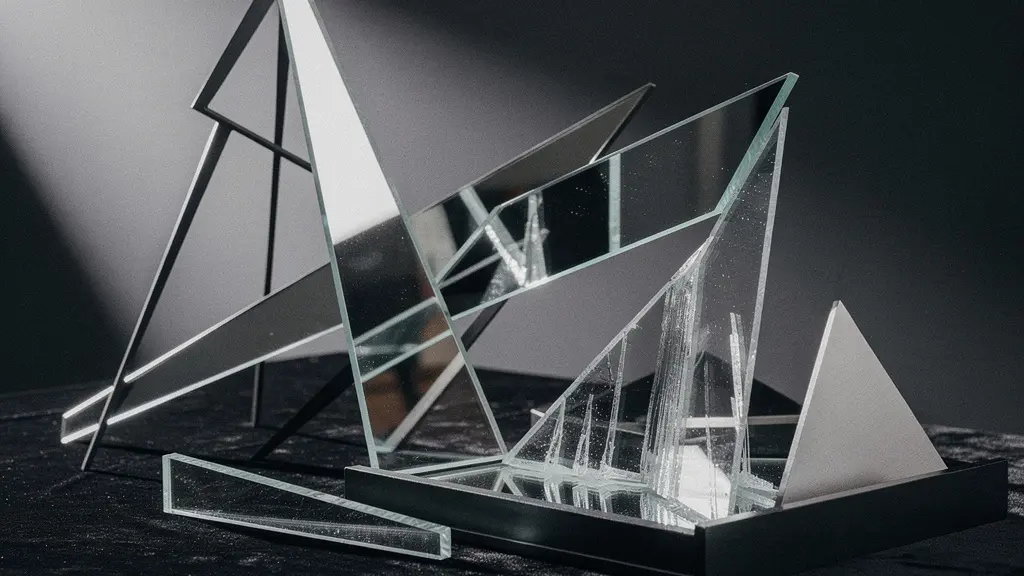
Standing before a Cubist painting can feel like you’re missing a crucial piece of the puzzle. The secret isn’t to memorize art history but to shift your perspective. This guide reframes the experience: instead of trying to find a single, ‘correct’ image, you’ll learn to act as a visual detective, enjoying the process of mentally reassembling a subject from the fragments the artist provides. It’s a skill that makes complex art accessible and deeply rewarding.
Have you ever stood in a museum, stared at a painting by Picasso or Braque, and felt a wave of confusion? You’re not alone. A quiet voice in your head might whisper, “I’m supposed to see something here, but I just don’t get it.” This feeling of intimidation is common when facing the fractured, geometric world of Cubism. For centuries, art was a clear window onto a recognizable world. Cubism shattered that window, and many of us feel lost among the shards.
The usual advice—to know about Analytical versus Synthetic phases or to recognize the influence of African art—is historically accurate but often unhelpful in the moment. It treats the painting like a textbook to be studied, not an experience to be felt. This can reinforce the idea that you need a special education to appreciate it. But what if the key wasn’t about knowing more, but about *looking differently*?
This is where our journey begins. We will explore Cubism not as a historical artifact, but as a new way of seeing. The goal is to transform you from a baffled spectator into an engaged visual detective. You will discover that the “chaos” of a Cubist canvas has an underlying logic, one that invites you to participate in the act of creation. By learning to decode its language, you’ll not only understand the painting but also activate a part of your brain that sees the world with fresh eyes.
This article provides a clear path through the complexities of the movement. We will explore why the artists broke with tradition, how their techniques evolved, and how their ideas spread far beyond the canvas. Most importantly, you will get a practical method for approaching any Cubist work with confidence and curiosity.
Summary: A Guide to Reading Cubist Canvases
- Why Did Cubists Reject the Single Perspective Used for 500 Years?
- Collage or Fracture: Which Phase of Cubism Changed Design Forever?
- How Did Cubist Forms Shape the Architecture of the 20th Century?
- The “My Kid Could Do That” Fallacy Regarding Cubist Composition
- In What Order Should You View a Cubist Canvas to Understand the Subject?
- Why Looking at Abstract Art Activates Your Brain Differently Than Realism?
- Why Is Hanging a Ritual Mask on a Wall Controversial for Some?
- How to Decode Visual Manipulation in Media Using Art History Skills?
Why Did Cubists Reject the Single Perspective Used for 500 Years?
For 500 years, since the Renaissance, Western art operated on a simple agreement: a painting was a window onto the world. Artists used linear perspective—a system of converging lines—to create a convincing illusion of three-dimensional space on a flat surface. This method presents a scene from a single, fixed viewpoint, as if seen through one eye at one specific moment. The Cubists, led by Pablo Picasso and Georges Braque, looked at this tradition and asked a revolutionary question: Is that really how we experience reality?
Think about how you perceive an object, like a coffee mug. You don’t see it from one static position. You see its handle as you reach for it, the roundness of its lip as you drink, and the circle of its base as you set it down. Your brain seamlessly stitches these multiple views into a single, complete concept: “mug.” The Cubists wanted to paint this mental concept, not just a single, fleeting optical snapshot. They rejected the single viewpoint because they felt it was a lie—a beautiful and convincing one, but a lie nonetheless.
Their goal was to represent the subject’s form more completely. They weren’t trying to be “abstract” for its own sake; they were chasing a deeper, more conceptual form of realism. By showing the front, side, and back of a subject all at once, they were painting its permanent structure and our total knowledge of it. This break was a radical shift from depicting what the eye sees to depicting what the mind knows, challenging the very definition of what a painting was supposed to do.
Collage or Fracture: Which Phase of Cubism Changed Design Forever?
Cubism wasn’t a single, static style; it evolved. Its two main phases, Analytical and Synthetic Cubism, represent two different approaches to deconstructing and reassembling reality. While the first was a radical intellectual exercise, it was the second that truly bled into the visual language of the 20th century, forever changing graphic design and advertising.
Analytical Cubism (c. 1910-1912) is the style most people picture when they think of “difficult” Cubism. Artists would “analyze” a subject by breaking it down into its geometric components and reassembling them on the canvas. The color palette was deliberately muted—mostly browns, grays, and ochres—to keep the focus on the complex analysis of form. The result is a dense web of overlapping, transparent planes that look fractured and complex.
Synthetic Cubism (c. 1912-1919), however, reversed this process. Instead of breaking things down, artists began building, or “synthesizing,” images from simple shapes, brighter colors, and, most importantly, real-world materials. This is where collage was born. Picasso and Braque began incorporating bits of newspaper, wallpaper, and other materials directly onto the canvas. This act of introducing “real” elements into the “fake” space of the painting was revolutionary and had a profound and lasting impact on design.
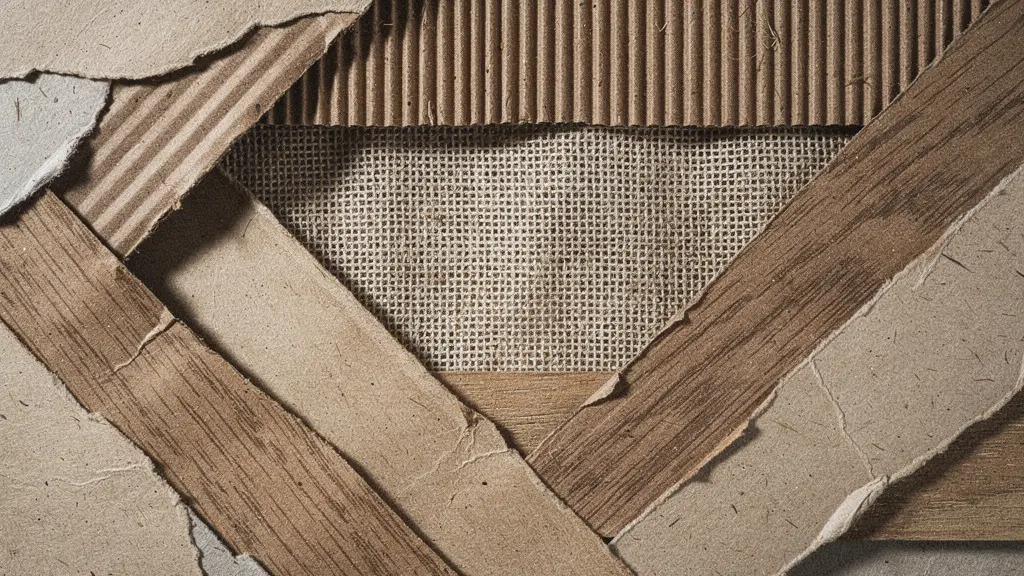
The introduction of collage and bold, flat shapes in Synthetic Cubism provided a new visual vocabulary. Graphic designers saw the power of combining typography, simple icons, and textured backgrounds. The idea of building an image from disparate elements became a cornerstone of modern advertising and visual communication, proving that this phase of Cubism was not just an art movement, but a design revolution.
The following table, based on an analysis of Cubism’s characteristics, highlights the key differences and their lasting impact.
| Phase | Period | Visual Characteristics | Design Legacy |
|---|---|---|---|
| Analytical Cubism | 1910-1912 | Monochromatic palette, fragmented forms, overlapping transparent planes | Intellectual breakthrough in deconstructing form |
| Synthetic Cubism | 1912-1919 | Brighter colors, collage elements, simpler shapes, real materials | Direct influence on graphic design, advertising, and Pop Art through material integration |
How Did Cubist Forms Shape the Architecture of the 20th Century?
The revolutionary ideas of Cubism were too powerful to be contained on a canvas. The movement’s principles of multiple viewpoints, geometric forms, and the interplay of planes soon found a new, three-dimensional expression: architecture. Architects saw in Cubism a way to break free from static, ornamental facades and create dynamic structures that engaged with the viewer in a new way.
The core Cubist idea of experiencing an object from multiple angles simultaneously was translated into buildings that revealed different faces and perspectives as you moved through them. Walls became planes, windows became geometric voids, and the entire structure could be seen as a large-scale Cubist sculpture. This approach rejected decorative elements in favor of clean lines and a focus on pure form, celebrating the building’s underlying geometric structure.
Nowhere is this influence more apparent than in the work of the Swiss-French architect Le Corbusier. He embraced the Cubist aesthetic to design houses that were radical in their simplicity and geometric clarity. His concept of the “architectural promenade” is a direct application of Cubist thinking to physical space.
Case Study: Le Corbusier’s Architectural Promenade as Physical Cubism
The adoption of the Cubist aesthetic by the Swiss architect Le Corbusier is reflected in the shapes of the houses he designed during the 1920s. His concept of the ‘architectural promenade’ manifests cubist principles by revealing different planes and intersecting views as one moves through the building. As a person walks through a space like the Villa Savoye, their path is carefully orchestrated. A ramp might cut through the structure, offering constantly shifting views of the interior and exterior. The experience is not static; it’s a journey through a composition of light, shadow, and form, creating a three-dimensional Cubist experience where the building is understood through movement and time.
This architectural philosophy, rooted in Cubist principles, laid the groundwork for much of modern architecture. It championed functionality, structural honesty, and a new, dynamic relationship between a building and its inhabitants, proving that a painting could indeed change the way we build and inhabit our world.
The “My Kid Could Do That” Fallacy Regarding Cubist Composition
It’s one of the most common refrains heard in a modern art museum: “My kid could do that.” This statement, often muttered in front of a Cubist work, stems from a misunderstanding of what is actually happening on the canvas. The apparent chaos of a Cubist painting is not the result of a lack of skill, but of its radical redefinition. The artists were not failing at realism; they were succeeding at a new, complex set of rules.
Before pioneering Cubism, Picasso was a child prodigy who had mastered realistic drawing and painting by his early teens. His choice to abandon traditional representation was a deliberate, intellectual one, not a consequence of inability. He had already proven he could paint like the old masters; he was now interested in inventing a new language for art. In fact, evidence of his incredible work ethic and technical skill is staggering; it’s a known fact that Pablo Picasso created more than 20,000 artworks in his life, a testament to a lifetime of dedicated practice that began with hyper-realistic works in his youth.
The composition of a Cubist painting is highly controlled. Far from being random scribbles, the works are built upon a rigorous and logical foundation. To the untrained eye, it might look like a mess, but to a visual detective, the clues of sophisticated decision-making are everywhere. Recognizing these elements is the key to dismantling the “my kid could do that” fallacy.
Here are some of the sophisticated compositional choices to look for:
- Controlled Line Weight: Cubists often used sharp, deliberate lines, sometimes created with rulers, to define planes with precision. This is a mark of control, not chaos.
- Intentional Color Palettes: The muted, monochromatic schemes of Analytical Cubism were a conscious choice to focus the viewer’s attention on form and structure, not an accident.
- Underlying Geometric Structure: Look for the hidden scaffolding of triangles, circles, and squares used systematically to represent features and create a stable composition.
- Overlapping Transparent Planes: Shapes overlap with calculated transparency to create a sense of depth while simultaneously emphasizing the flatness of the canvas—a complex visual paradox.
In What Order Should You View a Cubist Canvas to Understand the Subject?
This question gets to the heart of the confusion many viewers feel. We are accustomed to “reading” an image from left to right, or focusing on a central subject and moving outward. A Cubist painting defies this linear approach. Asking for a specific viewing order is like asking in what order you should experience a memory—it’s a fluid, non-linear process. The real answer is that there is no single correct order. Instead, the artist invites you to become an active participant in reassembling the image yourself.
The key is not to find a starting point, but to adopt a method. Rather than a linear path, think of it as a web of clues. Your job as a “visual detective” is to find an anchor point—any recognizable element—and then trace its connections to the other fragments. This process mimics how the artist created the work in the first place: by observing a subject from multiple viewpoints and weaving those observations together.
To help make this process more concrete, here is a practical algorithm for looking at any Cubist painting. This isn’t about finding the “right” answer but about engaging with the work in a structured, more rewarding way.
Your Action Plan: A 3-Step Algorithm for Viewing a Cubist Painting
- The Squint Test: First, step back from the painting and squint your eyes. This blurs the confusing details and allows you to see the overall composition, the balance of light and dark masses, and the dominant color scheme. It gives you the “big picture” before you dive into the fragments.
- The Anchor Hunt: Now, move closer and scan the canvas for a single, recognizable element. It could be the curve of a guitar, the numbers from a piece of newspaper, the shape of an eye, or the handle of a jug. This will be your anchor in the sea of shapes.
- The Reconstruction Web: From your anchor point, start tracing the lines and planes connected to it. See how the artist has broken and reassembled the object. Follow a curve and see where it leads. Notice how a patch of color on one side of the canvas might relate to a shape on the other. You are mentally rebuilding the subject from the artist’s clues.
Why Looking at Abstract Art Activates Your Brain Differently Than Realism?
If you’ve ever felt that looking at a Cubist painting requires more “work” than looking at a realistic landscape, you’re right. This feeling isn’t a sign of failure; it’s a sign that your brain is firing on all cylinders. Cognitive science gives us a fascinating explanation for why this happens. Our brains are fundamentally prediction machines. When we look at the world, we are constantly, and unconsciously, predicting what we are about to see.
A realistic painting of an apple confirms your brain’s predictions. You see a round, red shape with a stem, and your brain says, “Yes, that’s an apple, just as I expected.” The process is smooth, efficient, and requires little conscious effort. Abstract art, and Cubism in particular, does the opposite. It actively violates your brain’s predictions. You see fragments of an apple, a guitar, and a human face all jumbled together, and your brain’s predictive model short-circuits. It’s forced to switch from passive confirmation to active problem-solving.
This shift from automatic to effortful processing is precisely what makes looking at abstract art feel both challenging and rewarding. Your brain is trying to make sense of ambiguous information, searching for patterns, and creating new connections. This is a highly engaging state, one that can lead to “aha!” moments when you suddenly recognize a form or understand a relationship between shapes. As one art-focused cognitive researcher puts it:
Our brain constantly predicts what it’s going to see. Realism confirms these predictions. Abstract art violates them, forcing the brain into a more active, effortful state.
– Art cognitive research perspective, Understanding Visual Perception in Art
This ability to hold multiple, contradictory ideas “at a glance” is a hallmark of high-level creativity. It’s a mode of thinking that isn’t just for artists. The composer Mozart described a similar process in his own work, explaining that he could hear a long composition “all at once” in his imagination, not as a sequence of notes. Cubism offers us a visual training ground for this powerful cognitive skill.
Why Is Hanging a Ritual Mask on a Wall Controversial for Some?
The story of Cubism is inseparable from its controversial relationship with non-Western art. When Picasso painted his groundbreaking—and shocking—work, *Les Demoiselles d’Avignon*, in 1907, he was drawing heavily from artistic traditions far outside of Europe. The sharp, geometric features of two of the figures in the painting were directly inspired by African tribal masks he had seen in Parisian ethnographic museums. This act of appropriation is a central and complicated part of Cubism’s legacy.
From the artists’ perspective, these objects were a source of raw, expressive power. They saw in them a formal purity and an emotional directness that they felt Western art had lost. They were not interested in the masks’ original context, cultural significance, or ritual function. They were “discovered” as aesthetic objects, and their visual language was mined for a new European art movement. According to an overview of the Cubist movement by The Art Story, the shocking formal elements of the painting, derived from these sources, were a key part of its impact, and the work was widely considered “immoral” when first exhibited.
This is precisely where the controversy lies. For some, hanging a ritual mask on a museum wall, stripped of its original purpose, is an act of cultural violence. It transforms a living object, imbued with spiritual power and community meaning, into a sterile “artifact” for aesthetic contemplation. Picasso’s use of these forms, while artistically revolutionary, is seen by critics as a colonialist act—taking the cultural property of another people without understanding or respect for its original meaning, all in the service of Western avant-garde experimentation.
Therefore, when we look at a Cubist painting, we are looking at a complex historical document. It is both a testament to a radical artistic breakthrough and a reminder of a fraught history of cultural appropriation. Acknowledging this duality doesn’t diminish Cubism’s artistic importance, but it adds a necessary layer of critical understanding to our role as viewers.
Key Takeaways
- Cubism’s goal was not to be abstract, but to paint a more complete reality by showing an object from all sides at once.
- The key to understanding a Cubist work is to act like a “visual detective,” actively searching for clues and reassembling the subject in your mind.
- The skills used to decode a Cubist painting—questioning a single perspective and seeing how fragments form a narrative—are directly applicable to modern media literacy.
How to Decode Visual Manipulation in Media Using Art History Skills?
It may seem like a huge leap from a 100-year-old painting to your social media feed, but the mental tools you develop for looking at Cubism are surprisingly relevant for navigating today’s visually saturated world. Cubism teaches you to be a critical viewer. It trains you to question the single, authoritative perspective and to understand that any image is a construction, not a pure reflection of reality. This is the very foundation of media literacy.
Modern media—from news photos to advertisements and political memes—often presents a single, carefully framed viewpoint as the whole truth. An image is cropped, a video clip is edited, and a quote is taken out of context. These are all forms of fragmentation and reassembly, the same techniques used by Cubist artists, but often with the goal of manipulation rather than artistic exploration. By applying a “Cubist” mindset, you can become more adept at spotting these tactics.
Learning to see like a Cubist is learning to ask critical questions of any image you encounter. This practice is essential in an age of misinformation, where understanding how images are constructed and manipulated is a crucial skill for responsible digital citizenship. The analytical framework provided by art history gives us a powerful lens for the present moment, as outlined by a guide on applying Cubist analysis to film and media.
Here’s how you can apply a Cubist analysis to the media you consume:
- Question the single perspective: Ask yourself, “What viewpoints are missing from this image or video clip?”
- Identify fragmentation: Recognize when information is presented in selective pieces that are designed to create a biased or incomplete whole.
- Examine the frame: Always consider what might be happening just outside the camera’s view.
– Look for reassembly: Understand how selective editing can reconstruct reality to serve a specific narrative.
Now that you are equipped with this new way of seeing, the museum is no longer a place of confusion, but a playground for your mind. The next time you stand before a complex work of art, you’ll have the confidence to engage with it, ask questions, and build your own understanding. Start practicing your new skills as a visual detective today.