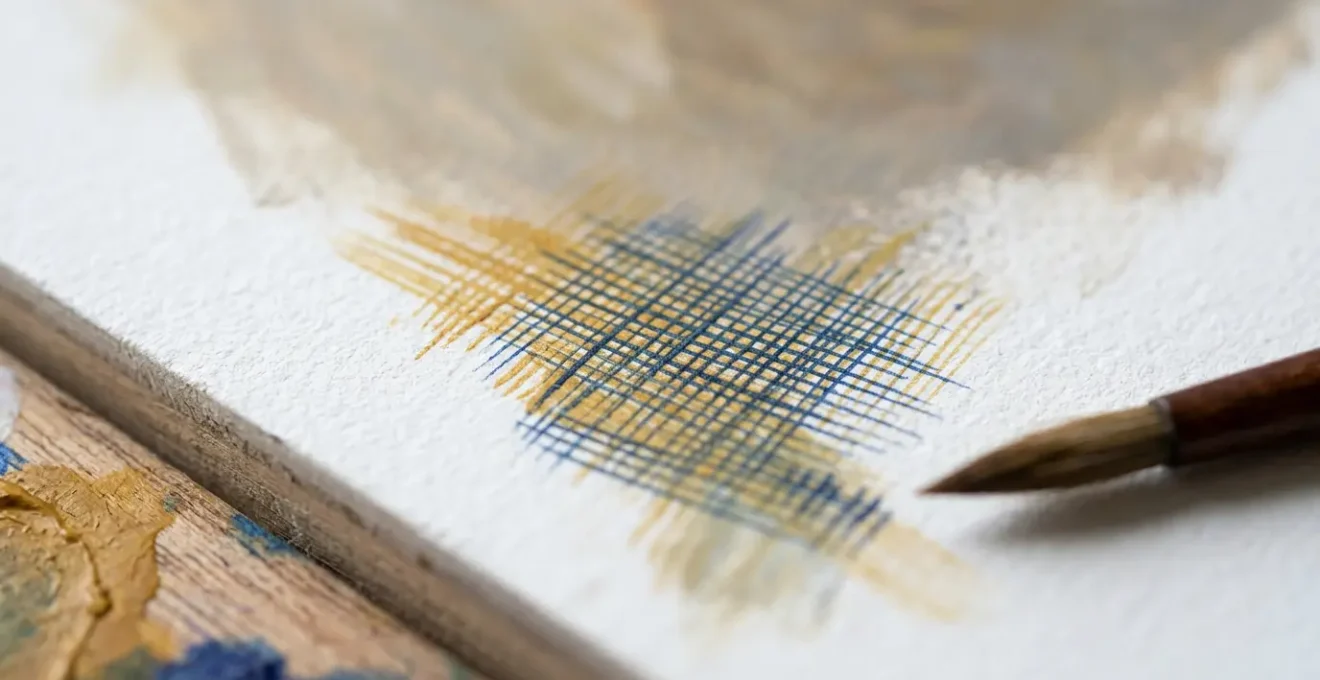
The unparalleled precision of egg tempera is not a feature, but a direct consequence of its demanding chemical nature, which forbids blending and forces the artist into a discipline of linear construction.
- Its rapid, irreversible drying time makes cross-hatching the only viable method for building form, creating an ‘optical architecture’ of color.
- The paint’s low refractive index and thin application allow light to reflect off the gesso ground, producing a unique internal luminosity.
Recommendation: To master tempera, cease fighting its limitations and instead embrace them as the structured path to achieving crisp, permanent, and luminous detail.
For the illustrator or fine artist obsessed with the perfect line, the search for the ideal medium is a lifelong quest. We seek a partner that offers both uncompromising control and the promise of permanence—a medium that can capture the subtlest gesture and preserve it for centuries. Many modern paints promise convenience, but often at the cost of the crisp, deliberate mark-making that defines mastery. We are told that fast-drying mediums are difficult, that they resist the smooth, forgiving blends of oil. This is presented as a flaw to be overcome.
But what if this perspective is fundamentally flawed? What if the very constraints we are taught to fight are, in fact, the source of a medium’s greatest strength? This is the central truth of egg tempera. Its reputation for being demanding is not a warning, but a promise. The medium’s unyielding properties—its rapid drying, its inflexibility, its refusal to be blended—are not obstacles. They are the forge. They enforce a discipline of thought and execution that transforms the act of painting from a process of correction into one of pure intention.
This is not a medium for the impatient. It is a medium for the artisan who understands that true control comes not from infinite options, but from mastering a strict set of powerful principles. In this exploration, we will deconstruct the chemical and physical certainties of egg tempera. We will understand why it demands a rigid support, how it commands light itself, and why its technical kinship with fresco reveals a shared philosophy of permanence. By understanding its “rules,” we unlock its profound capacity for linear expression.
Summary: The Artisan’s Discipline: A Deep Dive into Egg Tempera’s Linear Power
- Yolk and Water Ratio: How to Mix Fresh Tempera Every Morning?
- Why Must You Cross-Hatch Instead of Blend With Egg Tempera?
- Matte yet Luminous: How Tempera Reflects Light Differently Than Oil?
- The Cracking Risk: Why Can’t You Paint Egg Tempera on Canvas?
- How Long Does Tempera Actually Take to Cure to a Waterproof State?
- Why Natural Earth Pigments Outlast Synthetic Dyes by Centuries?
- How to Stabilize a Canvas With Severe Tears and Water Damage?
- How to Execute a Buon Fresco Before the Plaster Dries?
Yolk and Water Ratio: How to Mix Fresh Tempera Every Morning?
Mastery of egg tempera begins not with a brush, but with a daily ritual: the creation of the binder. Unlike tubed paints, tempera is a fresh emulsion, prepared for the day’s work. This act connects the artist directly to the material’s fundamental chemistry. The heart of the medium is the egg yolk, a perfect natural emulsion of lipid (fats and oils) and protein (albumin) suspended in water. The goal is to create a lean, stable paint that flows from the brush but binds the pigment with strength. The foundational principle is one of balance and consistency.
The traditional method is both simple and precise. After carefully separating the yolk from the white, the yolk sac is pierced and the contents are drained, discarding the membrane. This pure yolk is the binder. For most applications, the ideal formulation is a 1:1 ratio of egg yolk to water. This mixture, when shaken vigorously in a clean jar, creates a stable emulsion ready to be mixed with dry pigments on the palette. Too much water will result in a weak paint film prone to lifting; too little, and the paint becomes thick, gummy, and difficult to manage for fine linear work.
This daily preparation is a core part of the tempera discipline. As the experts at Earth Pigments instruct, the process is direct and intentional.
The yolk itself can then be mixed directly with your dry pigments using water to lengthen, or the yolk can be mixed with one part water in a jar and shaken vigorously to prepare an emulsion.
– Earth Pigments, Instructions For Making Egg Tempera
Mixing fresh paint each morning forces a deliberate approach. The artist must estimate the amount of paint needed for the session, fostering an economy of means and an intimate understanding of the materials. This is the first step in aligning one’s process with the chemical inevitability of the medium.
Why Must You Cross-Hatch Instead of Blend With Egg Tempera?
The single most defining technical characteristic of egg tempera is its near-instantaneous drying time. Once the brush applies the emulsion to an absorbent gesso ground, the water is wicked away, leaving the yolk to begin its irreversible chemical transformation. This property makes wet-in-wet blending, the hallmark of oil painting, a physical impossibility. Attempting to blend tempera results in a muddy, lifted mess as the new layer tears up the semi-dry layer beneath. This is not a failure of technique; it is a fundamental rejection by the medium itself.
This constraint forces the artist to adopt a different logic for building form and color: the discipline of the line. Instead of physical blending, tempera relies on optical mixing. This is achieved through the meticulous application of fine, distinct brushstrokes, typically in a cross-hatching pattern. As noted in analyses of historical methods, this approach is known as tratteggio.
The technique, refined during the Renaissance, involves laying down very thin, parallel lines of pure color. When a second set of hatches in a different color or value is laid over the first, the eye perceives a new, mixed color from a distance. The hatching technique known as tratteggio or rigatino is the cornerstone of tempera’s visual language. This is not a workaround; it is an ‘optical architecture’ where form is constructed, line by line, rather than modeled from a malleable mass. Every mark remains visible and contributes to the final effect, creating a surface that vibrates with linear energy.
Matte yet Luminous: How Tempera Reflects Light Differently Than Oil?
One of the most captivating paradoxes of egg tempera is its unique visual quality: the finish is matte, yet the painting seems to glow from within. This luminosity is not an accident of the medium but a direct result of its specific physics and chemistry, which differ profoundly from oil paint. The key lies in the way the paint film interacts with light. An oil paint film is dense, and its binder (linseed oil) has a high refractive index, meaning it bends light significantly. Much of the light reflects off the top surface of the paint itself.
Egg tempera behaves in the opposite manner. The binder is applied in very thin, semi-transparent layers. As ArtWeb explains, “Tempera is more transparent than oil and holds less pigment. This lets the light penetrate through it and reflect off the white surface of the primer beneath it.” This is the secret to its glow. Light travels *through* the layers of hatched color, strikes the brilliant white, absorbent gesso ground, and is reflected back *through* the paint to the viewer’s eye. The painting is illuminated from the inside out.
This effect is quantifiable. Technical analysis reveals the specific optical properties at play. The egg yolk binder creates a paint film with an approximately 1.47-1.50 refractive index. This lower index, combined with the thinness of the layers, facilitates the deep penetration of light. The result is a color that is not merely a surface coating, but a complex interaction of pigment, binder, and light passing through a translucent matrix. The cross-hatched lines further enhance this, creating a multi-faceted surface that scatters the reflected light, contributing to a soft, vibrant luminosity rather than a hard, glossy shine.
The Cracking Risk: Why Can’t You Paint Egg Tempera on Canvas?
The principle of material honesty is central to the craft of painting, and nowhere is it more critical than in the choice of support for egg tempera. While canvas is the ubiquitous support for oil and acrylic, it is fundamentally incompatible with the physical nature of a cured tempera paint film. The reason is a simple, uncompromising mechanical reality: egg tempera cures to a hard, rigid, and inflexible layer. A flexible support like canvas, which expands, contracts, and vibrates with changes in humidity and temperature, places this brittle film under constant stress.
As confirmed by countless historical sources and conservation science, this mismatch is catastrophic. The constant movement of the canvas will inevitably cause the tempera film to develop fissures and cracks, eventually leading to flaking and complete paint loss. As Wikipedia’s entry on the medium bluntly states, “Egg tempera is not a flexible paint and requires stiff boards; painting on canvas will cause cracks to form and chips of paint to fall off.” To paint tempera on canvas is to build a masterpiece on a foundation designed to fail.
Therefore, the disciplined artisan chooses a support that shares the medium’s own structural integrity. Traditionally, this meant well-seasoned wood panels, meticulously prepared with dozens of layers of traditional gesso (a mixture of animal glue and gypsum or chalk) to create a bright, absorbent, and stable ground. The support and the paint form a monolithic unit, moving and aging as one. This choice is not a stylistic preference; it is a structural necessity dictated by the physics of the medium itself.
How Long Does Tempera Actually Take to Cure to a Waterproof State?
A common misconception about egg tempera is that because it dries to the touch in seconds, it is “finished.” This confuses the initial evaporation of water with the complete chemical curing of the binder. The true transformation of the liquid emulsion into one of history’s most durable paint films is a slow, patient process of polymerization. Initially, the paint is vulnerable; a misplaced drop of water can easily lift the fresh layer. Achieving its legendary permanence and water-resistance requires time—far more than most artists realize.
The process involves two simultaneous chemical events. First, the water in the emulsion evaporates or is absorbed by the gesso ground. Following this, the lipids (fats and oils) in the egg yolk begin to oxidize and polymerize. This means their molecules link together to form long, complex chains, creating a tough, cross-linked, and insoluble film. Concurrently, the proteins in the yolk denature, adding further strength to the structure. This is the chemical inevitability of the medium at work, a slow hardening into its final, permanent state.
As water evaporates, the lipid components undergo oxidative polymerisation, cross-linking into a hard, insoluble, glassy film. The proteins simultaneously denature and coagulate, adding further mechanical strength. The result, once fully cured, is one of the most durable paint films in existence.
– Rhiannon Piper Conservation, Tempera Paint – History, Chemistry, Technique, and Legacy
This polymerization is not a matter of days or weeks. Conservation research indicates a minimum curing time of three to six months for the film to achieve significant water resistance. Full and complete curing can take a year or even longer, depending on the thickness of the application and environmental conditions. During this period, the painting is still vulnerable and should not be varnished or exposed to moisture. This long curing time is a testament to the medium’s profound transformation from a fragile emulsion to a permanent, glass-like matrix.
Why Natural Earth Pigments Outlast Synthetic Dyes by Centuries?
The archival permanence of a tempera painting is a marriage of two factors: a stable binder and equally stable pigments. The brilliant, unfaded colors of Renaissance masterpieces are a direct result of the artists’ reliance on a palette of natural, inorganic pigments. These materials, sourced from the earth itself, possess a chemical stability that most modern synthetic dyes cannot match. The difference lies in their molecular structure.
Natural earth pigments, such as ochres, siennas, and umbers, are primarily metal oxides—specifically, iron oxides. As the experts at Natural Pigments note, these are “incredibly stable molecules, resistant to UV light and chemical reactions.” They are, in essence, a form of rust. Their color is inherent to their inert, mineral structure. They have already been exposed to oxygen and the elements for millennia, so they are not prone to fading or changing color when exposed to light or atmospheric pollutants. Their structural integrity is absolute.
This contrasts sharply with many synthetic organic dyes, whose complex carbon-based molecules are more susceptible to being broken down by UV radiation. This is why many artworks from the 19th and 20th centuries have seen dramatic color shifts, while the earth tones of a 15th-century panel by Fra Angelico remain vibrant. The limited but permanent palette of the early Renaissance was not a weakness but a strength, dictated by the availability of these profoundly stable pigments. This historical reliance on time-tested materials is a core lesson for the modern artisan seeking true permanence.
How to Stabilize a Canvas With Severe Tears and Water Damage?
This question, common in the world of oil painting conservation, highlights a problem that the disciplined tempera artist is trained to avoid entirely. Rather than seeking methods to repair a fundamentally flawed support, the tempera tradition champions the selection of a correct, stable support from the outset. The inherent issues of canvas—its flexibility, hygroscopic nature, and susceptibility to tearing and rot—are precisely why it was historically rejected for this medium. A properly prepared rigid panel is a monolithic, stable structure that simply bypasses these mechanical failures.
The tempera painter’s mindset is one of prevention, not remediation. The use of a rigid support like a traditional wood panel or a modern composite board eliminates the primary source of structural stress on the brittle paint film. While conservators labor to patch and reline damaged canvases, the tempera painting on a sound panel remains structurally intact. This philosophy of “material honesty” extends to modern innovations that honor the medium’s requirements.
For instance, modern supports have been engineered to offer even greater stability than traditional wood. A prime example is the aluminum composite panel, which provides the necessary rigidity without any of the risks associated with organic materials. As described for one such product, the Artefex Tempanel offers a superior support by having a very low response to environmental changes and being immune to the warping, splitting, or insect damage that can afflict wood. Choosing such a support is the ultimate expression of the tempera discipline: using the best available technology to create the most stable foundation possible for a permanent work of art.
Key Takeaways
- Discipline Creates Precision: Egg tempera’s fast, irreversible drying time is not a flaw; it’s a feature that forces the artist into a linear, cross-hatching technique, resulting in unparalleled control and sharpness.
- Luminosity from Within: The paint’s matte-yet-luminous quality is a result of light passing through thin, transparent layers and reflecting off the white gesso ground, an effect impossible with opaque oils.
- Structure is Non-Negotiable: The medium’s inflexible nature demands a rigid, non-warping support like a gessoed panel. Using canvas is a guarantee of future cracking and paint loss.
How to Execute a Buon Fresco Before the Plaster Dries?
At first glance, the monumental art of buon fresco—painting on wet plaster—seems worlds away from the delicate, panel-based art of egg tempera. One is architectural, the other portable. Yet, at their core, they share a profound philosophical and technical bond: both are unforgiving mediums that demand absolute decisiveness from the artist. In fresco, the artist must complete a section (the giornata) before the plaster dries and the carbonation process renders it unpaintable. In tempera, the yolk polymerizes within moments of application, fixing the stroke permanently.
This shared “point of no return” cultivates a specific artistic mindset. As one analysis notes, the finality of the medium “forces a mental discipline and decisiveness that is the hallmark of mastering both mediums.” There is no room for hesitation or endless revision. The thinking, planning, and compositional work must be complete before the first stroke of color is applied. In both traditions, this is formalized through the use of a full-scale preparatory drawing, or “cartoon,” which is transferred to the surface before painting begins. The act of painting is then one of confident, efficient execution, not of tentative discovery.
The parallels extend deep into the application technique. Both mediums build form through layered applications rather than wet blending. The cross-hatching of tempera is a direct cousin to the fine linework and transparent washes used to model form in fresco. Both rely on the brilliance of the white ground (plaster or gesso) to illuminate the colors from beneath. By studying the shared principles of these two ancient techniques, the modern artisan gains a deeper appreciation for the discipline they demand.
Action Plan: The Shared Discipline of Fresco and Tempera
- Execute a complete compositional drawing (cartoon) before beginning paint application, as both mediums are unforgiving and resist correction.
- Work in planned daily sections – the ‘giornata’ in fresco corresponds to tempera’s need to mix fresh paint each session.
- Apply paint rapidly and decisively before the medium becomes unworkable (plaster carbonation in fresco, egg yolk polymerization in tempera).
- Build form through layered applications rather than wet blending, using cross-hatching and glazing techniques common to both traditions.
- Accept the irreversible chemical transformation as integral to the medium’s permanence and unique visual qualities.
The path of the tempera painter is one of discipline, precision, and an intimate understanding of materials. It is a choice to embrace constraints as a source of strength. Embrace this discipline, and the medium will reward you with a clarity and permanence that few others can offer.