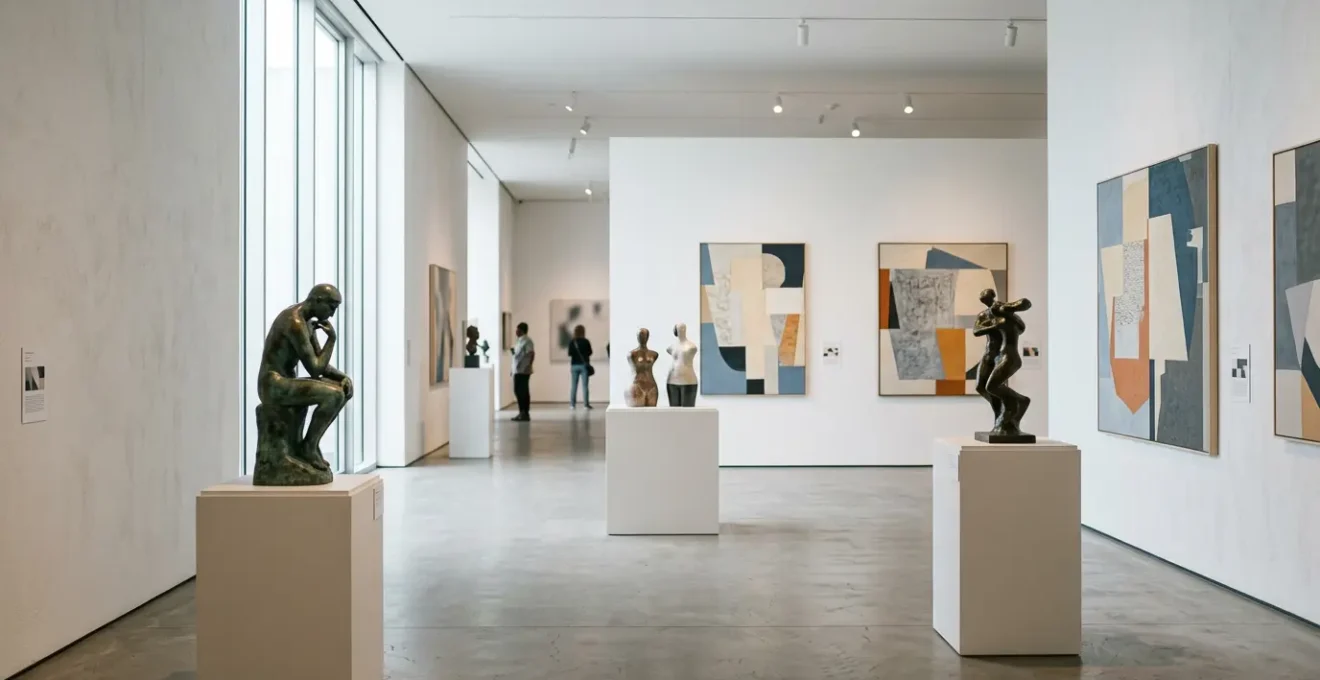
The enduring popularity of figurative art isn’t about its simple relatability, but its profound power as a tool to investigate and construct human identity.
- It allows artists to explore complex narratives and emotions through the body’s silent language of gesture and pose, transcending facial expression.
- The very act of drawing the figure—choosing a method, tackling anatomy—becomes a cognitive exercise in understanding the principles of form and the nature of being.
Recommendation: Approach figurative art not just as a picture of a person, but as the record of a profound human inquiry into seeing, feeling, and representing another.
For over a century, abstraction has been seen as the pinnacle of artistic modernism, a liberation from the constraints of reality. Yet, the human form persists. In galleries, studios, and collections, the figure refuses to vanish. The common explanation is simple: we are human, and we are drawn to images of ourselves. We find them relatable, easy to understand, and a showcase of technical skill. This perspective suggests that figurative art is popular because it is comfortable, a familiar story told in a language everyone speaks.
But what if this is only half the truth? What if the real power of figurative art lies not in its accessibility to the viewer, but in its profound, transformative capacity for the artist? This art form is not merely about depicting a body; it is a crucible for human experience. It is a space where the artist grapples with the complexities of embodiment, identity, and mortality through the very act of representation. It is a discipline that forces a confrontation with the self and the other, revealing truths that abstraction can only allude to.
This exploration goes far beyond surface-level likeness. It delves into the ethics of the gaze, the silent narratives of gesture, the cognitive battle between seeing and knowing, and even the philosophical weight of the materials used. By understanding how artists tackle these challenges, we uncover the deeper reasons why the human figure remains the most inexhaustible subject in art. This article will guide you through this process, revealing the enduring relevance of the human form as a vehicle for profound inquiry.
This guide unpacks the core challenges and decisions that define contemporary figurative art, moving from the ethical to the technical and the philosophical. The following sections explore how artists today are reinventing the nude, telling stories with the body, mastering anatomy, and making fundamental choices that shape their unique vision.
Summary: The Enduring Power of the Human Form in Art
- How to Paint the Nude Today Without Objectifying the Subject?
- Pose and Gesture: How to Tell a Story Without Facial Expressions?
- Structural Anatomy vs. Surface Muscles: What Do You Really Need to Know?
- The Foreshortening Mistake That Makes Legs Look Like Sausages
- How to Warm Up With Gesture Drawing Before Long Poses?
- Why Did the Medici Family Spend Fortunes on Public Art in Florence?
- Sight-Size or Constructive Anatomy: Which Drawing Method Fits Your Brain?
- How to Incorporate Non-Archival Materials Into Fine Art Successfully?
How to Paint the Nude Today Without Objectifying the Subject?
The history of the nude in art is fraught with the politics of the gaze, where the figure, often female, was rendered as a passive object of beauty for a presumed male viewer. To paint the nude today is to directly confront this legacy. The challenge is no longer about achieving an idealized form but about restoring agency to the subject. It is a shift from depicting a body to representing a person in a state of nakedness, with all the vulnerability, power, and complexity that entails.
Contemporary artists are actively dismantling old conventions. They are less interested in classical harmony and more in the raw, unfiltered truth of the human condition. As art historian Frances Borzello notes, this involves a conscious break with the past. In her analysis of the modern nude, she states that many artists today aim to “confront the viewer with all the sexuality, discomfort and anxiety that the unclothed body may express, perhaps eliminating the distinction between the naked and the nude.”
This approach was powerfully demonstrated at the 2024 Venice Biennale. In Jeffrey Gibson’s performance piece *VOID*, a performer embodied a being unbound by earthly conceptions of gender and sexuality, challenging viewers’ preconceived notions. According to an analysis of the Biennale’s most important works, this performance moved beyond objectification by centering the subject’s self-expression rather than passive display. The key is to shift the power dynamic: the subject is not merely being looked at; they are an active participant in the creation of meaning, sharing an experience rather than simply offering a form.
Pose and Gesture: How to Tell a Story Without Facial Expressions?
Once the face is removed as the primary center of emotion, the rest of the body is free to speak. This is where figurative art reveals its unique narrative power. A downturned shoulder, a clenched fist, or the subtle curve of a spine can convey a story with more nuance and universality than a direct facial expression. The body becomes a vessel of pure emotion, its language of gesture and pose transcending cultural and temporal barriers. This is not a lesser form of communication; it is often a more primal and honest one.
This is because the body’s language taps into a deep, shared human experience. Research into the history of portraiture confirms that body language serves as a powerful tool that evokes empathy and creates a profound connection between the viewer and the subject. The artist’s task is to become a choreographer of stillness, selecting the precise moment of tension or release that encapsulates an entire narrative. It’s about understanding that every pose is a story frozen in time.
Look at the image above. Without seeing a face, we can feel the emotion—defiance, longing, or perhaps anguish. The tension in the muscles, the angle of the shoulder, and the gesture of the hand all contribute to a powerful, unspoken narrative. The artist has chosen to focus on the expressive potential of the anatomy itself, proving that the most compelling stories are often told by the body’s silent vocabulary. This focus on embodied storytelling is a core reason for figuration’s enduring appeal.
Structural Anatomy vs. Surface Muscles: What Do You Really Need to Know?
For many aspiring artists, anatomy is a daunting mountain of Latin names and complex muscle charts. This often leads to a focus on surface details—rendering every ripple of the serratus anterior—while missing the essential foundation. The truth is, a profound understanding of figurative art comes not from memorizing every muscle, but from grasping the underlying structural principles that govern the body. It’s about knowing the ‘why’ of the form, not just the ‘what’.
The most effective approach is hierarchical. First, an artist must master the skeleton, not as a collection of bones, but as an architectural armature. Understanding the major masses of the skull, ribcage, and pelvis, and identifying the key bony landmarks where muscles attach, provides the unshakable foundation for any figure. Muscles do not exist in a vacuum; they stretch and contract across this skeletal framework. Without it, a figure will lack weight, structure, and believability, no matter how beautifully its surface is rendered.
From there, the artist can simplify the body’s complexity. A crucial technique is breaking down intricate muscle groups into basic geometric forms like cylinders, spheres, and boxes. This allows the artist to understand the volumes in three-dimensional space before getting lost in surface detail. Finally, this knowledge must be activated through constant practice. Drawing, sculpting, and actively creating are what truly embed anatomical knowledge. Passive study creates a librarian of facts; active creation forges an architect of form.
The Foreshortening Mistake That Makes Legs Look Like Sausages
There is no technical challenge in figure drawing more notorious than foreshortening—the art of depicting a form receding into space. It is where the artist’s eye, hand, and brain engage in a fierce battle. When an arm points toward the viewer, its true length is compressed into a short, complex shape. The most common mistake is to draw it longer than it appears, resulting in limbs that look flat, boneless, and strangely elongated, often described as the “sausage effect.”
This error is not simply a lack of skill; it’s a cognitive problem. As a detailed analysis of drawing psychology reveals, the brain fundamentally dislikes foreshortened body parts and unconsciously flattens them. Our mind holds a “symbol” of an arm—long and straight—and fights to impose this template onto what the eye actually sees. The artist’s primary challenge is to override this internal symbol and trust their visual perception, no matter how counter-intuitive it feels. This requires a conscious strategy to force the brain to see in three dimensions.
The solution lies in thinking about overlapping forms rather than single outlines. A foreshortened leg is not one shape; it is the thigh overlapping the knee, which overlaps the shin. By clearly defining where one form disappears behind another, the artist creates the illusion of depth. Furthermore, all marks—contour lines, shading, and details—must wrap around these cylindrical forms to reinforce their volume. This cognitive battle and its technical solution are a perfect microcosm of why figurative art is so compelling: it is a discipline of learning to see the world as it is, not as our brain tells us it should be.
Your Action Plan to Conquer Foreshortening
- Visualize Overlapping Forms: Stop seeing the limb as one object. Mentally deconstruct it into interlocking cylinders (e.g., upper arm, forearm, hand) to force a 3D understanding.
- Emphasize Overlaps: Actively draw the lines where one form hides part of another. The clarity of these overlaps is what creates the illusion of depth and prevents the “sausage” effect.
- Make Marks Follow the Form: Ensure every line you make, from contour to shading, wraps around the cylindrical volume of the limb. This reinforces its three-dimensionality for the viewer.
- Measure and Trust: Use comparative measurement to check proportions (e.g., “How long is the foreshortened forearm compared to the width of the head?”). Trust your measurements over your brain’s impulse to lengthen the form.
- Practice with a Plan: Dedicate specific drawing sessions to tackling only foreshortened poses. Repetition is key to retraining your brain to accept and accurately depict spatial compression.
How to Warm Up With Gesture Drawing Before Long Poses?
Before an artist settles in for a hours-long pose to render form and detail, there is a critical preparatory ritual: the warm-up. This is not about stretching muscles, but about awakening the senses. Gesture drawing, which involves capturing the essence of a pose in a flurry of rapid sketches (often 30 seconds to two minutes), is the most vital part of this process. Its purpose is often misunderstood as merely a way to “loosen up.” In reality, it is a profound mental shift.
The goal of gesture drawing is to silence the analytical brain—the part that worries about proportions, anatomy, and correctness—and activate the intuitive, perceptual brain. It is an exercise in capturing energy, movement, and the line of action. The artist is not drawing a “person”; they are drawing the *force* that runs through the person. Is the figure collapsing under gravity? Are they reaching, twisting, or bracing? The gesture drawing should capture this dynamic verb in a few expressive marks.
This practice trains the artist to see the whole before the parts. Instead of starting with an eye or a hand, you start with the entire sweep of the pose from head to toe. This builds a powerful foundation for longer drawings, ensuring that the final, detailed figure still retains the life and energy of the initial moment. It is a reminder that a figure is not a static object but a living organism, full of potential for movement. This focus on capturing vitality is a key reason figurative art feels so alive and relevant.
Why Did the Medici Family Spend Fortunes on Public Art in Florence?
The enduring power of figurative art is not just a personal or aesthetic phenomenon; it has deep roots in the construction of society itself. To understand this, we need only look to Renaissance Florence, where the Medici family invested astronomical sums in public art. This was not mere decoration or a simple display of wealth. It was the most sophisticated and effective use of mass communication of its time, a strategy to shape public opinion and weave the family’s narrative into the city’s very identity.
In an age before mass media, a lifelike sculpture or a vibrant fresco in a public square was a powerful magnet for public attention. The Medici understood this and commissioned works that told specific, allegorical stories. The tale of David and Goliath, for example, was used repeatedly to align the small but defiant city-state of Florence with the clever underdog who defeats a tyrant. By funding these works, the Medici were not just patrons; they were positioning themselves as the protectors of Florentine liberty and destiny.
This strategy transformed art patronage from simple propaganda into a form of participatory civic myth-making. The citizens of Florence, seeing these powerful figurative works daily, were invited to see their own struggles and aspirations reflected in heroic marble and paint. The art became a shared story, a humanistic project that bound the people to their city and, by extension, to the Medici leadership. This historical example proves that figurative art has always been more than representation; it’s a tool for building shared identity and meaning on a grand scale.
Sight-Size or Constructive Anatomy: Which Drawing Method Fits Your Brain?
At the heart of creating figurative art lies a fundamental choice in how the artist processes the world. This choice is often crystallized in two opposing methods: Sight-Size and Constructive Anatomy. The decision is not merely technical; it is a philosophical alignment with a particular way of thinking and seeing. One is the path of the poet, the other of the architect. Understanding which method fits your brain is key to unlocking your artistic voice.
The Sight-Size method is an exercise in pure perception. The artist places their canvas directly alongside the subject and draws it at the exact same scale as they see it, constantly stepping back to compare. This process is designed to bypass the analytical brain and its symbols. You are not drawing “an eye”; you are recording a specific shape of light and shadow. It is about faithful, almost passive, observation. This method trains the artist to see without preconception, capturing the fleeting truth of a visual moment.
Constructive Anatomy is the opposite. It is an active, analytical process of building a figure from the inside out, based on a deep knowledge of its underlying structure. The artist uses this internal library of anatomical principles to invent figures, alter poses from reference, and create dynamic compositions from imagination. This is the method of the architect, who can design a building without having it in front of them. It reveals an internal truth—the principles that govern form—rather than an external one. The following table, based on insights from leading anatomy instructors, breaks down this fundamental duality.
| Method | Cognitive Style | Best For | Type of Truth Revealed | Key Strength |
|---|---|---|---|---|
| Sight-Size | Perceptual Brain – Bypasses cognitive symbols to see the world as pure shape and color | Capturing fleeting impressions of light and atmosphere; Recording visual experiences faithfully | External Truth – Faithfully recording what is visually present | Trains artist to observe without preconception; ‘The Poet’s Method’ |
| Constructive Anatomy | Analytical Brain – Builds from internal knowledge and systematic understanding | Inventing figures; Creating dynamic compositions; Building imaginative worlds from scratch | Internal Truth – Understanding underlying principles governing form to depict what could be | Enables drawing from imagination and making changes to reference; ‘The Architect’s Method’ |
Key Takeaways
- Figurative art’s relevance lies in its ability to explore human identity, not just its surface-level relatability.
- Contemporary artists reclaim the nude by focusing on the subject’s agency and lived experience, moving beyond historical objectification.
- The artist’s choice of method (perceptual vs. analytical) is a fundamental cognitive decision that shapes how they interpret and construct reality.
- Even technical challenges like foreshortening reveal a deeper truth: figure drawing is a discipline of overcoming the brain’s symbolic thinking to see the world as it truly is.
How to Incorporate Non-Archival Materials Into Fine Art Successfully?
In our final consideration, we arrive at the physical body of the artwork itself. The tradition of fine art has long been obsessed with permanence, using archival materials designed to last for centuries. However, a growing number of contemporary artists are intentionally using non-archival, ephemeral, and fragile materials in their figurative work. This is not a failure of craft; it is a deliberate and powerful narrative choice. By using materials that decay, the art begins to mirror the transience of the human body it depicts.
This approach imbues the work with a conceptual layer that traditional materials cannot offer. The material itself becomes part of the story. For instance, as noted in a review of the 2024 Venice Biennale, artists are using materials to embed cultural and personal identity directly into their work. Frieda Toranzo Jaeger threaded Indigenous embroidery through painted canvas, physically inserting a non-Western tradition into a European one. Jeannette Ehlers used synthetic Afro hair and gold emergency blankets—both inherently impermanent—to comment on identity, memory, and displacement.
For these artists, the artwork’s physical decay is not a flaw but a feature. It is a statement on mortality, memory, and the fleeting nature of existence. The strategy for success in this realm involves three key steps. First, the material choice must be deeply connected to the subject’s identity. Second, the artist must document the work rigorously, as the concept and its documentation become the permanent asset. Finally, the artist must frame the decay as intentional, making the artwork’s impermanence the core of its message. This turns the artwork from a static object into a performance over time, a slow-motion reflection on life itself.
To truly engage with figurative art, whether as a collector, an artist, or a viewer, is to embrace this depth. The next step is to look beyond the likeness and ask what human process—of seeing, feeling, or constructing—is being recorded in the work before you.