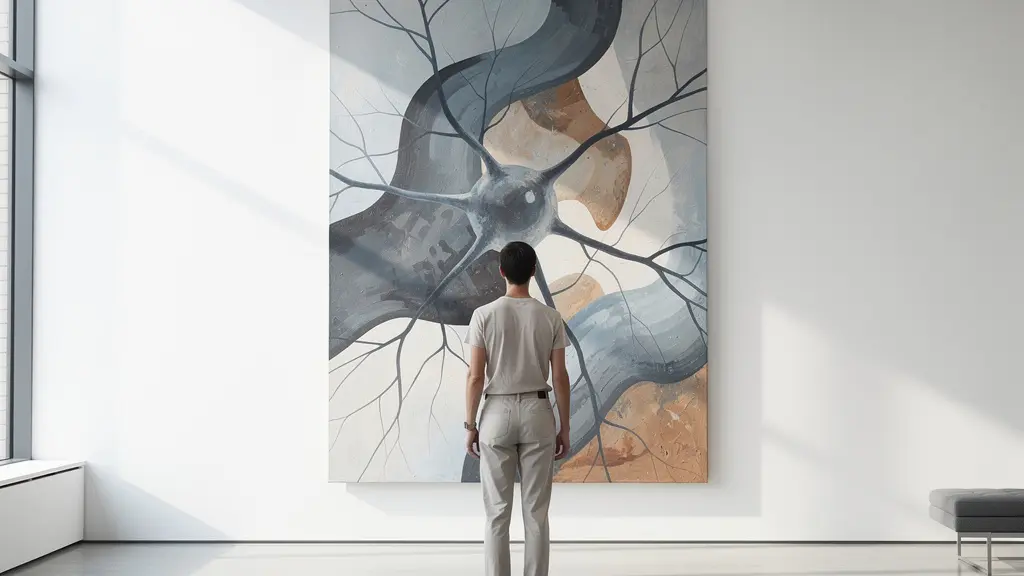
Engaging with art boosts problem-solving not by simple inspiration, but by training your brain to switch between focused and unfocused states, activating a key neural network for insight.
- Abstract and impressionist art are particularly effective as they force your brain into active interpretation, strengthening cognitive flexibility.
- This mental “toggling” is managed by the Default Mode Network (DMN), the brain’s “daydreaming” system, which is crucial for connecting disparate ideas.
Recommendation: Curate a daily 15-20 minute “visual diet” of varied artworks to deliberately practice this cognitive switching and enhance your creative output.
In a world demanding constant focus and productivity, mental fatigue and creative blocks are common enemies for professionals and students alike. The conventional wisdom is to double down: focus harder, eliminate distractions, and push through. We’re told to optimize our environments for deep work, often resulting in sterile, visually monotonous spaces. But what if the key to unlocking superior problem-solving skills wasn’t more focus, but a strategic dose of structured distraction?
While the stress-reducing benefits of art are widely acknowledged, its role as a cognitive enhancement tool is often misunderstood. The solution isn’t merely about “getting inspired” by a pretty picture. The true power lies in a specific neurocognitive mechanism that a daily 20-minute art habit can systematically train. This involves intentionally engaging the brain’s Default Mode Network (DMN), our internal system for mind-wandering, memory consolidation, and self-reflection. By learning to toggle between the brain’s task-focused network and its creative-idling DMN, we can build the mental flexibility required to solve complex problems.
This article explores the science behind this process. We will deconstruct how different types of art uniquely stimulate your brain, provide a practical framework for building a “visual diet,” and explain how to design your environment to foster this cognitive advantage. It’s time to move beyond art as decoration and embrace it as a fundamental tool for cognitive fitness.
text
This guide breaks down the cognitive science and practical steps to integrate art into your daily routine for enhanced mental performance. Explore the sections to understand the mechanisms and apply the strategies.
Summary: The Cognitive Benefits of a Daily Art Habit for Enhanced Problem-Solving
- Why Looking at Abstract Art Activates Your Brain Differently Than Realism?
- How to Build a “Visual Diet” That Stimulates Creativity in Under 15 Minutes?
- Viewing Art vs. Making Art: Which Is More Effective for Stress Relief?
- The Hidden Cost of Visual Monotony on Your Innovation Capacity
- How to Arrange Your Office Art to Maximize Focus and Inspiration?
- Why Is “Ma” (Negative Space) More Important Than the Ink Itself?
- Why Do Impressionist Shadows Look Blue Instead of Black?
- Self-Taught vs. Art School: Which Technical Approach Builds Better Skills?
Why Looking at Abstract Art Activates Your Brain Differently Than Realism?
When you look at a realistic painting, your brain’s task is primarily recognition. It matches the visual information to existing mental models—a face, a landscape, an object. This is a relatively straightforward “bottom-up” process. Abstract art, however, disrupts this pattern. Lacking clear representational cues, it forces your brain to engage in a more complex, “top-down” interpretation. You are no longer just seeing; you are actively sense-making.
This increased cognitive load is precisely what stimulates the Default Mode Network (DMN), the brain network associated with inward thought, self-reflection, and creative insight. Typically, the DMN is suppressed when we focus on external tasks. As Edward A. Vessel and his team note in their study on aesthetic experiences, for art that is judged as intensely moving, the usual suppression of the DMN is alleviated, allowing for activity patterns similar to self-reflection. This suggests that abstract art doesn’t just give your focus-network a break; it actively engages the part of your brain responsible for connecting disparate ideas and generating “aha!” moments.
Case Study: The DMN and Aesthetic Judgment
A study in PNAS discovered that the DMN is a hub for processing aesthetic appeal across different visual domains. Researchers observed that aesthetic judgments for indeterminate content like abstract art took longer than for representational images. This delay isn’t a sign of confusion, but of deeper cognitive engagement, as the brain works harder to derive meaning and form a judgment. This deeper processing is a workout for the neural pathways that underpin flexible thinking and creative problem-solving.
In essence, while realism asks your brain “What is this?”, abstract art asks “What could this be?”. This open-ended question is a powerful catalyst for activating the very cognitive states that lead to innovative solutions. Indeed, research from Frontiers in Human Neuroscience demonstrates that for the most moving artworks, a step-like increase in DMN activity was observed, a response not seen for less impactful stimuli.
How to Build a “Visual Diet” That Stimulates Creativity in Under 15 Minutes?
Just as a balanced nutritional diet fuels the body, a varied “visual diet” fuels the mind. The goal is to move beyond passive, accidental visual consumption (like scrolling through social media) and towards intentional, curated exposure to stimulating art. Building this habit doesn’t require hours in a museum; it can be integrated into your day in short, focused bursts totaling less than 15-20 minutes.
The key is variety and consistency. Exposing your brain to different styles, mediums, and levels of complexity prevents habituation and keeps your interpretive faculties sharp. A simple daily protocol can establish this cognitive practice, training your brain to switch between different modes of thinking. The focus is on creating small, repeatable rituals that deliver a dose of visual novelty and complexity.
A practical approach involves structuring your day with small art “snacks.” This proactive curation ensures you are consistently challenging your brain’s pattern-recognition and sense-making abilities. Here’s a sample protocol to get started:
- Morning (5 minutes): View one piece of high-quality digital art. Use curated platforms like Google Arts & Culture or a dedicated art app to explore a new artist or movement. Focus on an abstract or impressionist piece.
- Midday (5 minutes): Engage in a quick, mindless sketching or doodling session during a break. The goal is not to create a masterpiece but to engage the hands and mind in a non-linear, creative act.
- Evening (10 minutes): Take a “deep dive” into a single artist’s work. Watch a short documentary or browse a virtual gallery tour focusing on their evolution. This builds context and deeper appreciation.
- Weekly/Monthly: If possible, dedicate time to visit a physical gallery or museum. The immersive experience provides a level of sensory input that digital viewing cannot replicate.
Viewing Art vs. Making Art: Which Is More Effective for Stress Relief?
A common question is whether the benefits come from passive consumption or active creation. While both viewing and making art are powerful tools for well-being, they operate through different cognitive and physiological mechanisms and are best suited for different types of stress. Choosing the right activity depends on the specific mental state you’re trying to address: decision fatigue or anxiety.
Viewing art is an act of cognitive unloading. It is most effective when you’re suffering from decision fatigue or mental overload. By immersing yourself in a complex visual field, you give your brain’s “task-positive network” (the part responsible for focus and execution) a much-needed rest. This allows the DMN to come online, facilitating a receptive, contemplative state that reduces the feeling of being overwhelmed. It requires no skill and can provide benefits in as little as a few minutes.
Making art, on the other hand, induces a “flow state”—a state of deep, effortless immersion. This is highly effective for combating anxiety, rumination, and feelings of helplessness. The active, hands-on engagement provides a sense of agency and directs focus away from anxious thoughts. The skill level is irrelevant to the benefit; the process itself is what matters. Research supports this, showing significant physiological changes. For example, an analysis of cortisol levels, the body’s primary stress hormone, provides clear evidence. One study found that after just 45 minutes of making art, 75% of participants showed a significant reduction in cortisol, regardless of prior artistic experience.
| Aspect | Viewing Art | Making Art |
|---|---|---|
| Primary Mechanism | Cognitive unloading, receptive state | Flow state induction, active engagement |
| Best For | Decision fatigue, mental overload | Anxiety, rumination, lack of agency |
| Time Required | As little as 3 minutes | Minimum 15-20 minutes |
| Skill Requirement | None | None (skill level doesn’t affect benefits) |
| Cortisol Impact | Moderate reduction | Significant reduction in 75% of people |
The Hidden Cost of Visual Monotony on Your Innovation Capacity
We often design our workspaces for maximum focus, which can inadvertently lead to visual monotony: beige walls, uniform furniture, and a lack of stimulating sensory input. While intended to minimize distraction, this sterile environment comes with a hidden cognitive cost. It starves the brain of the novel stimuli needed to spark the Default Mode Network and promote the mental states conducive to creativity and insight.
When your brain is in a visually unvarying environment, it quickly habituates. It learns that there is nothing new to process, so it can operate on a kind of cognitive autopilot. This is efficient for repetitive tasks but disastrous for innovation. Without new or complex visual data to interpret, there is no trigger for the “mental toggle” between focused work and creative mind-wandering. Your thinking can become rigid and constrained, circling the same well-worn neural pathways.
This state of cognitive rigidity is the enemy of problem-solving. Innovation often arises from connecting seemingly unrelated ideas, a hallmark function of the DMN. A monotonous environment fails to provide the raw material—the unexpected shapes, colors, and compositions—that can act as a catalyst for these new connections. You become less likely to have a sudden insight or a fresh perspective because the part of your brain responsible for generating them is under-stimulated.
The cost, therefore, isn’t just aesthetic boredom; it’s a measurable decline in your capacity for divergent thinking and innovation. You are effectively placing your brain in a low-power mode where it is optimized for maintenance, not for exploration. Breaking this monotony with intentionally placed, complex art isn’t a frivolous decoration; it’s a strategic intervention to keep your brain’s creative engine primed and ready.
How to Arrange Your Office Art to Maximize Focus and Inspiration?
Strategically placing art in your workspace transforms it from a passive backdrop into an active tool for cognitive management. The goal is to create an environment that supports both deep, focused work and moments of creative insight. This isn’t about cluttering your walls, but about understanding how to use different types of art to influence your mental state based on their location in your field of vision.
The arrangement should be evidence-based, leveraging principles of neuroaesthetics. Art placed directly in your line of sight should be different from pieces in your periphery. The former should support focus, while the latter should be available for intentional “glance breaks” to trigger diffuse thinking. Think of it as choreographing a dance between your brain’s focus and daydreaming networks.
Here is an evidence-based strategy for art placement in a professional setting:
- Direct Line of Sight: In the area you look at most when you’re taking a brief break from the screen, place calming, expansive art. Pieces depicting nature scenes or abstract works with simple, flowing patterns work well. Art with natural fractal patterns has been scientifically shown to reduce stress.
- Peripheral Vision Zones: To the sides of your main work area, position more complex, detailed, or challenging abstract pieces. These are not meant to be constantly stared at. They serve as destinations for intentional “glance breaks.”
- The 20-20-Art Rule: Adapt the classic 20-20-20 rule (every 20 minutes, look at something 20 feet away for 20 seconds). Instead, every 20 minutes, shift your gaze to one of the complex peripheral artworks for 20 seconds. This short break is enough to help toggle your brain from a focused state to a more diffuse, creative one.
- Collaboration & High-Traffic Areas: In meeting rooms or hallways, install dynamic, bold, or even provocative pieces. These can act as conversation starters and create an atmosphere of energy and innovation.
- Monthly Rotation: To prevent habituation and maintain a sense of novelty, rotate the pieces in your workspace every month or two. This simple change is enough to re-engage your brain’s interpretive faculties.
Your Action Plan: Auditing Your Workspace for Cognitive Stimulation
- Identify Sightlines: Map out your primary line of sight during focused work and your main peripheral zones.
- Inventory Existing Art: List the artworks you currently have. Categorize them as ‘calming/expansive’ vs. ‘complex/challenging’.
- Assess for Coherence: Does the art in your focus zone promote calm? Does the art in your peripheral zones offer complexity for glance breaks?
- Evaluate Emotional Response: Quickly rate each piece. Does it evoke curiosity and positive emotion, or is it just visual noise?
- Create an Integration Plan: Based on the audit, swap, move, or acquire pieces to align with the strategic placement principles. Prioritize changing the art in your peripheral zones first.
Why Is “Ma” (Negative Space) More Important Than the Ink Itself?
In Japanese art and aesthetics, the concept of Ma (間) refers to the empty space, the interval, or the pause between elements. It’s the unpainted part of the scroll, the silence between musical notes. Far from being a void, Ma is an active component of the composition, giving shape and significance to the elements it surrounds. From a neurocognitive perspective, Ma is a powerful tool for engaging the Default Mode Network.
Visually cluttered or dense compositions constantly bombard the brain with external stimuli, which, as neuroscientist Vessel and colleagues explain, typically causes below-baseline activity in the DMN. The brain is too busy processing the “ink” to engage in inward contemplation. Art that skillfully employs negative space does the opposite. It provides “mental breathing room.”
Study: How Negative Space Gives the Brain Room to Think
Neuroscience research demonstrates that when viewing compositions with substantial negative space, the DMN exhibits unique patterns. Unlike cluttered stimuli that suppress DMN activity, the deliberate emptiness of Ma allows the network to remain active or return to its baseline state more easily. This facilitates the mental pause necessary for insight generation. The empty space isn’t empty to the brain; it’s an invitation to fill the void with its own connections and interpretations, a core function of creative problem-solving.
This is why minimalist art or a traditional Japanese ink wash painting can feel so profound. The artist has not only guided your eye to the subject but has also carefully crafted the emptiness around it to guide your mind. The negative space acts as a quiet stage upon which the DMN can perform its work of connecting memories, projecting future possibilities, and discovering novel patterns. It underscores the principle that for creative insight, what isn’t there can be just as important as what is.
Why Do Impressionist Shadows Look Blue Instead of Black?
A common feature of Impressionist painting is the use of colored shadows, often blues and purples, instead of the traditional gray or black. This was not an arbitrary choice but a revolutionary one based on observations of light and its reflection. Cognitively, this technique is powerful because it creates a degree of perceptual ambiguity that forces the viewer’s brain to work harder, engaging both sensory and interpretive pathways in a unique way.
Our brains are wired with a “top-down” expectation: shadows are black or gray. When an Impressionist painting presents a blue shadow, it creates a “prediction error.” The brain’s visual system receives “bottom-up” sensory data (the color blue) that conflicts with its expectation. To resolve this conflict, the brain must engage in active interpretation, recruiting higher-order cognitive functions. It has to update its model and accept that, in this context of reflected light from a blue sky, the shadow is indeed blue.
This process of resolving perceptual ambiguity is a mental workout. As fMRI studies on art perception show, viewing ambiguous or impressionistic works activates not just the sensory (occipito-temporal) regions but also engages the Default Mode Network differently than photorealistic art. The brain is not just passively receiving information; it is actively testing hypotheses about what it’s seeing. This mental “hypothesis testing” strengthens the same neural circuits used in flexible thinking and reframing problems.
The blue shadow, therefore, is more than an aesthetic device. It’s a cognitive trigger. It challenges our assumptions and forces a re-evaluation of what we see, training our minds to be more open to unexpected possibilities. This is the essence of creative problem-solving: the ability to see beyond the expected “black shadow” and recognize the “blue” reality that others might miss.
Key Takeaways
- Creative problem-solving is enhanced by toggling between focused and unfocused brain states, a skill trainable through art.
- Abstract and impressionistic art are more effective than realism for this training because their ambiguity forces active interpretation, engaging the Default Mode Network (DMN).
- A daily, curated “visual diet” of 15-20 minutes is a practical way to build this cognitive flexibility without needing hours of practice.
Self-Taught vs. Art School: Which Technical Approach Builds Better Skills?
The debate between formal art education and a self-taught path often centers on technique and style. However, from a cognitive skills perspective, each approach cultivates different but equally valuable aspects of problem-solving. The “better” path depends on the type of cognitive skill one aims to develop: convergent thinking (finding the single best solution) or divergent thinking (generating multiple possible solutions).
Art school provides a structured environment that excels at developing convergent thinking. Students learn proven techniques, historical frameworks, and systematic approaches to known artistic challenges. This rigorous foundation allows for the rapid acquisition of technical mastery and the ability to reliably execute a specific vision. The problem-solving is often systematic, guided by principles and feedback within a supportive structure.
Art allows you to literally and figuratively step away from everything you’re drowning in. When you physically go to an art museum, you change your environment
– Amy Herman, Hone your problem-solving skills down to a fine art — with fine art
The self-taught approach, by contrast, is a powerful incubator for divergent thinking. Lacking a formal roadmap, the self-taught artist must invent their own solutions through relentless trial and error. This process fosters immense resilience and a comfort with uncertainty. The problem-solving is inherently novel and experimental, often leading to unique personal styles and innovative techniques that might not emerge from a structured curriculum. The high potential for failure builds a robust ability to pivot and adapt.
| Skill Type | Art School Approach | Self-Taught Approach |
|---|---|---|
| Convergent Thinking | Strong foundation in proven techniques | May miss fundamental principles |
| Divergent Thinking | Structured exploration within frameworks | Unlimited experimentation and innovation |
| Problem-Solving | Systematic approaches to known challenges | Novel solutions through trial and error |
| Resilience | Support system reduces failure impact | High resilience through independent struggle |
| Technical Mastery | Faster acquisition of complex techniques | Unique personal style development |
Integrating these insights into your life begins with understanding that art is not a luxury, but a cognitive tool. By consciously engaging with art for just a short period each day, you are not merely decorating your time; you are actively training your brain for greater creativity, resilience, and problem-solving capacity. The next logical step is to begin curating your own visual environment to support this goal.