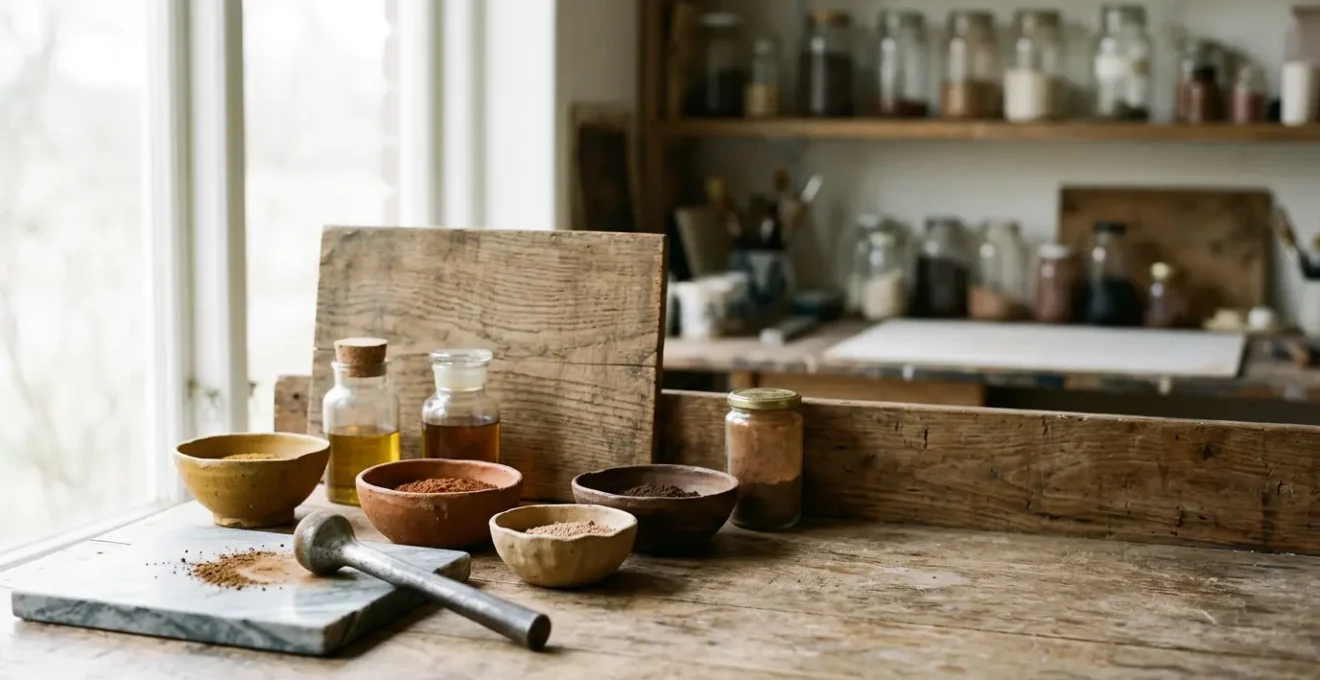
The longevity of Old Master paintings is not magic; it is a deliberate system of chemical and physical stability designed to withstand centuries.
- Natural earth pigments offer superior chemical stability and lightfastness compared to many synthetic dyes.
- Rigid supports like wood panels prevent the mechanical stress and cracking inherent in flexible canvases.
Recommendation: Adopt a workflow that prioritizes material compatibility and controlled chemical processes, such as curing, over modern demands for speed.
An artist completes a work, stepping back to admire the final form. Yet, a nagging question often follows this moment of creation: will it last? In an era defined by rapid innovation and disposable goods, the materials of modern art—fast-drying acrylics, brilliant but volatile synthetic dyes, and pre-stretched, mass-produced canvases—offer convenience. However, this convenience often comes at the expense of permanence. The specter of faded colors, a yellowed varnish, or a web of cracks appearing within a single generation haunts artists concerned with their legacy.
The common advice often circles around using “artist-grade” materials, but this label can be misleading. The fundamental issue is not one of branding, but of chemistry and physics. The longevity of a painting is a battle fought on a microscopic level against light, humidity, and the internal tensions of the materials themselves. To create a truly archival work, one that might hang in a gallery centuries from now, requires moving beyond a superficial understanding of supplies.
But what if the secret to unrivaled durability was not hidden in a future technological breakthrough, but in the past? The enduring brilliance of Renaissance masterpieces is not an accident of history or artistic mystique. It is the direct result of a deep, empirical understanding of material science. The Old Masters were, in effect, practical chemists who selected their pigments, binders, and supports to create a stable, unified system.
This article deconstructs this classical approach from the perspective of a conservator. We will explore the physico-chemical reasons why traditional materials succeed where many modern alternatives fail. By examining the molecular stability of pigments, the mechanical properties of supports, and the logic of layered application, you will gain the knowledge to make deliberate choices that ensure your art achieves true archival quality.
Summary: Returning to Classical Mediums for Archival Quality
- Why Natural Earth Pigments Outlast Synthetic Dyes by Centuries?
- Panel vs. Canvas: Which Support Prevents Cracking Over 100 Years?
- How the Slowness of Traditional Methods Improves Artistic Focus?
- The Varnishing Mistake That Can Dissolve Traditional Egg Tempera
- When to Apply the Second Layer to Ensure Proper adhesion?
- Why Cheap Materials in Modern Art Will Cost You Double in Restoration?
- Why Must All Modern Restoration Techniques Be Fully Reversible?
- How to Adopt the “Old Master” Workflow for Modern Realism?
Why Natural Earth Pigments Outlast Synthetic Dyes by Centuries?
The longevity of a color is determined by its chemical stability, particularly its ability to resist decomposition when exposed to light. This property, known as lightfastness, is where natural earth pigments demonstrate their profound superiority. These pigments, such as ochres, siennas, and umbers, are primarily composed of iron oxides and clays. Their chemical structure is incredibly stable, having already endured geological pressures and weathering for millennia. They are, in essence, inert. This means they do not undergo significant chemical change when exposed to ultraviolet (UV) radiation, the primary culprit behind fading.
In contrast, many modern synthetic organic dyes, while offering an initially dazzling range of hues, have complex molecular structures that are far more susceptible to being broken down by UV light. This photochemical reaction alters the molecule, changing how it absorbs and reflects light, which we perceive as fading or a shift in color. The enduring vibrancy of prehistoric cave paintings, with cave paintings done in sienna still surviving today, serves as the ultimate testament to the permanence of these materials. Their stability is not a feature; it is their very nature.
This inherent permanence is why they have been the backbone of artists’ palettes for thousands of years. As conservation science confirms, this choice is not about nostalgia but about fundamental chemistry. A leading authority on historical materials, Natural Pigments, summarizes this advantage well:
Earth pigments exhibit excellent lightfastness and opacity, making them suitable for various painting techniques and surfaces.
– Natural Pigments Conservation Research, Natural Pigments – Earth Pigments Technical Documentation
Choosing a natural earth pigment is choosing a material that has already proven its ability to last for eons. It is the most fundamental decision an artist can make to ensure the chromatic integrity of their work for centuries to come, removing one of the most significant variables of decay from the equation.
Panel vs. Canvas: Which Support Prevents Cracking Over 100 Years?
While pigments determine chemical stability, the support—the surface upon which the paint is applied—dictates the work’s long-term mechanical stability. The primary battle here is against cracking, which is a physical response to stress. A stretched canvas, the default for many artists, is an inherently unstable structure. It is a woven fabric under tension, highly responsive to changes in temperature and humidity. It expands in humid conditions and contracts as it dries, creating constant, microscopic movements across its surface.
This movement places the dried, brittle paint film under immense stress. The paint is pulled and pushed, and since it has very little elasticity, it eventually fractures to relieve the tension. This often manifests in a pattern specific to fabric supports. As conservation laboratories have documented that on flexible supports, impacts can cause characteristic “bulls-eye” cracking patterns that are a direct result of the canvas deforming. The weave of the canvas itself creates microscopic high-stress points at every intersection of warp and weft.
In contrast, a rigid support, such as a properly prepared wood or composite panel, behaves as a single, unified unit. It expands and contracts far less than canvas and does so more uniformly. By minimizing this differential movement, it drastically reduces the mechanical stress on the paint layers. This is why many of the best-preserved paintings from the Renaissance, like those by Jan van Eyck or Leonardo da Vinci, were executed on wood panels. They understood that to prevent the paint film from breaking, you must first immobilize its foundation. Choosing a panel over a canvas is the single most effective decision an artist can make to prevent the web of cracks that plagues so many older canvas paintings.
How the Slowness of Traditional Methods Improves Artistic Focus?
In a culture that prizes speed and efficiency, the deliberate, time-consuming processes of the Old Masters can seem anachronistic. Grinding pigments by hand with a muller, preparing hide glue size, or applying gesso in multiple thin layers over days are activities that run counter to the modern impulse for immediate results. However, this “slowness” is not a drawback; it is a critical component of the archival method, fostering a level of material intimacy and focus that is difficult to achieve otherwise.
The act of manually preparing materials creates a profound connection between the artist and their medium. When you grind a pigment, you are not just making paint; you are feeling its texture, learning its specific properties, and understanding how much binder it requires. This tactile feedback loop provides a deep, intuitive knowledge that cannot be gained from squeezing paint from a tube. This methodical, repetitive work induces a state of meditative focus, quieting the mind and allowing for deeper concentration on the artistic process itself. It transforms the act of preparation from a chore into a ritual.
This deliberate pace carries over into the act of painting. Working with slower-drying oils or building up tempera in fine layers forces a more considered approach. It encourages planning and patience, where each stage of the painting is a completed thought before the next begins. This stands in stark contrast to the often frenetic and reactive nature of working with fast-drying acrylics. The slowness of traditional methods is not an inefficiency to be overcome, but rather a structural element of the creative process that cultivates discipline, material knowledge, and ultimately, a higher degree of control and artistic intent in the final work.
The Varnishing Mistake That Can Dissolve Traditional Egg Tempera
One of the most dangerous areas in art is the intersection of different material systems. A critical error that can irretrievably damage a work is applying a modern, aggressive solvent-based varnish over a delicate, traditional paint film like egg tempera. Egg tempera is an emulsion where pigment is bound in egg yolk. When it dries, it becomes highly durable and water-resistant through a process of cross-linking proteins. However, it remains vulnerable to certain strong organic solvents.
Modern conservation varnishes are often acrylic resins dissolved in powerful solvents designed for easy removal with a specific chemical. If an artist, unfamiliar with the chemistry, applies one of these varnishes to an uncured or even a cured tempera painting, the solvent can re-dissolve the binder, causing the paint to lift, smudge, or even change color. This is a form of “inherent vice,” a conservation term for a work’s self-destruction due to the incompatibility of its own materials. The mistake is not in the varnish itself, but in its application outside of its intended system.
Case Study: The Peril of Incompatible Materials
Conservation professionals frequently encounter damage caused by the use of incompatible materials. This is especially true for contemporary mixed-media works. As conservator Ana Alba notes, the code of ethics for conservation requires using fully reversible materials because conservators are forbidden from permanently altering the artist’s original work. When an artist uses experimental materials or combines traditional and modern systems without understanding their chemical interactions, they create a minefield for future restoration. A modern coating applied to a traditional surface might be impossible to remove without damaging the original, making proper conservation ethically and practically impossible.
This highlights a core principle of archival work: material systems must be internally consistent. The Old Masters worked within cohesive systems—oil-based pigments with oil-based varnishes, or water-based media kept separate. The modern artist has a vast array of choices, but with this freedom comes the responsibility to understand the chemical boundaries of each medium. An incompatible final layer can negate centuries of potential longevity in a single, irreversible application.
When to Apply the Second Layer to Ensure Proper adhesion?
The timing of layered paint application is governed by a chemical process, not a clock. The common wisdom to wait until a layer is “dry to the touch” is dangerously incomplete. Oil paint does not simply “dry” like water evaporating; it cures through a slow process of oxidation and polymerization. This means the oil molecules react with oxygen in the air to link together, forming a solid, durable film. This process can take months or even years to complete fully.
Applying a new layer of paint prematurely traps the underlying layer, cutting off its access to oxygen. This can drastically slow or even halt the curing process, leaving a soft, unstable layer of paint permanently entombed beneath the surface. Furthermore, if a fast-drying, rigid layer is applied over a slower-drying, more flexible layer, the top layer will crack as the layer beneath it continues to shift and shrink over a longer period. This is the chemical basis for the famous “fat over lean” rule, where “fatter” (more oily and flexible) layers must always be placed on top of “leaner” (less oily and more rigid) ones.
The choice of pigment also has a profound impact on this process. Different pigments can either accelerate or inhibit the oxidation of the oil binder, affecting the mechanical stability of the resulting paint film. For instance, research on canvas painting mechanics shows that certain formulations of zinc white oil paint are prone to becoming extremely brittle and forming cracks under stress, more so than traditional lead white. This demonstrates that archival painting requires understanding not just the color of a pigment, but its effect on the structural integrity of the paint film as it cures. Rushing the layering process is a gamble against the fundamental chemistry of the medium.
Why Cheap Materials in Modern Art Will Cost You Double in Restoration?
The initial savings from using cheap, student-grade materials is a false economy that will inevitably lead to far greater costs in the future. These materials—be it a poorly primed canvas, a fugitive (non-lightfast) pigment, or an acidic support—are a form of built-in obsolescence. They introduce inherent vice into the artwork from its inception, guaranteeing that it will require costly conservation work to survive.
Consider a canvas made with inferior cotton and primed with a cheap, brittle acrylic ground. Over time, the canvas will become slack, the ground will crack and delaminate, and the painting will need to be painstakingly removed from its original support and re-lined onto a new one. This is a highly specialized and expensive procedure. Similarly, a painting made with fugitive colors will eventually fade, requiring a conservator to perform extensive in-painting to restore its original appearance. These interventions are not minor touch-ups; they are complex, time-consuming, and therefore, expensive.
The financial reality of art conservation is stark. While costs vary, professional conservators have noted that a small painting with an average amount of restoration work can cost $800 to $1,000, with costs for larger or more damaged works easily running into the tens of thousands. This creates a tragic paradox where the cost of saving the artwork can exceed its market value. As many conservation experts advise, it is often not economically viable to restore a painting worth less than a few hundred dollars because the conservation will cost more. By choosing high-quality, stable, archival materials from the start, the artist is not just making an aesthetic choice; they are making the most prudent financial investment in the future of their own work.
Why Must All Modern Restoration Techniques Be Fully Reversible?
The cardinal rule of modern art conservation is the principle of reversibility. This ethical mandate dictates that any treatment or material applied to an artwork by a conservator must be removable in the future without damaging the original object. This principle is not a matter of technical preference but a profound acknowledgment of humility and responsibility in the face of art history.
There are two primary reasons for this. First, conservation science is constantly evolving. A technique considered state-of-the-art today may be seen as crude or even harmful in fifty years. By ensuring that all interventions are reversible, today’s conservators allow future generations with more advanced knowledge and tools to potentially re-treat the work in a better way. A permanent repair is a permanent alteration, closing the door on future improvements. As defined by conservation ethics standards, the goal is to stabilize and preserve, not to irrevocably change.
Second, the line between “damage” and “artist’s original intent” can be incredibly fine and subject to intense debate. What one generation sees as accumulated grime, another might interpret as an intentional patina or a final ‘a secco’ layer applied by the master. Making a permanent change based on one interpretation risks destroying an original part of the work forever.
Case Study: The Sistine Chapel Restoration Controversy
The restoration of Michelangelo’s Sistine Chapel frescoes in the 1980s and 90s is perhaps the most famous example of this dilemma. The cleaning removed centuries of soot and previous restoration attempts, revealing astonishingly bright colors that challenged long-held beliefs about Michelangelo’s palette. Supporters hailed it as a revelation of the master’s true vision. However, critics argued vehemently that the restorers had also removed ‘a secco’ finishing touches that Michelangelo applied after the fresco plaster had dried. The central, unanswerable question was whether the removed layers were dirt or part of the original artwork. The controversy surrounding this project underscores why reversibility is paramount: it provides a safeguard against interpretations that might, with the best intentions, permanently erase a piece of art history.
Key Takeaways
- Material Stability is Paramount: Archival quality begins with choosing chemically stable materials like natural earth pigments that resist light and time.
- Manage Mechanical Stress: The physical structure of your artwork is as important as its chemistry. Rigid supports like panels prevent the cracking caused by the movement of flexible canvas.
- Embrace a Systematic Workflow: Adhering to principles like “fat over lean” and allowing for proper curing times is not optional; it is a required part of building a durable paint film.
How to Adopt the “Old Master” Workflow for Modern Realism?
Adopting an “Old Master” workflow is not about slavishly copying historical techniques but about internalizing the underlying principles of material science and applying them to a modern practice. It is a shift in mindset from seeking immediate results to building a stable, permanent object layer by layer. This involves making deliberate choices at every stage of the process, from preparing the support to applying the final varnish.
The core of this workflow is control and consistency. It begins with selecting a rigid support and sealing it properly to create an inert foundation. The application of paint must follow the “fat over lean” rule, which is a practical application of understanding the curing process. Each subsequent layer should have a slightly higher oil-to-pigment ratio than the one beneath it. This ensures that the outer layers remain more flexible and dry more slowly, preventing the tension that leads to cracking. This systematic approach transforms painting from a purely expressive act into a blend of art and engineering.
Integrating these archival methods does not mean abandoning a modern aesthetic. Rather, it provides a durable foundation upon which any style, including modern realism, can be built. By controlling the environmental conditions of the studio and handling the artwork with care, the artist completes the chain of responsibility. The following plan provides a framework for integrating these classical principles into a contemporary studio practice.
Action Plan: A Hybrid Studio Workflow for Permanence
- Material Selection: Choose ground materials with appropriate stiffness. Select pigments and binders with known lightfastness and long-term mechanical stability, especially for use in environments with humidity fluctuations.
- Environmental Control: Maintain your studio and storage areas within a controlled and stable humidity range (ideally 40-60% RH) to minimize mechanical stress on all supports.
- Support Preparation: Prioritize rigid supports such as properly sealed wood panels or aluminum composite materials. These move as a single unit, unlike flexible canvas which creates thousands of micro-stress points.
- Layering Strategy: Strictly adhere to the fat over lean principle. Leaner (more solvent, less oil) layers dry faster and more rigidly. Place fatter (more oil) layers on top to ensure the overall film remains flexible as it cures.
- Proper Handling and Curing: Ensure artworks are fully supported during storage to prevent sagging or impact. Allow for ample curing time between layers and before varnishing—weeks and months, not days.
By viewing material selection and application through the lens of a conservator, you cease to be a passive consumer of art supplies. You become an active architect of your artwork’s future, ensuring the vision you realize today has the structural and chemical integrity to endure for generations.