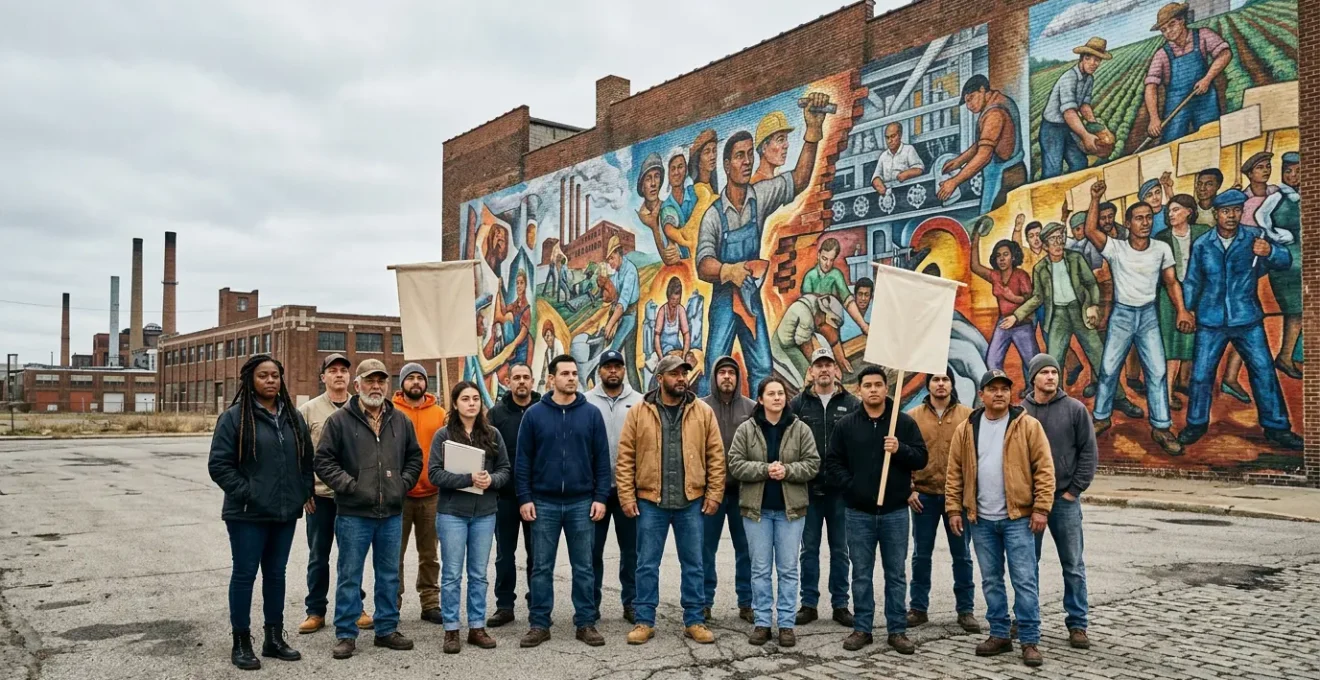
Social Realism’s historical impact wasn’t just about documenting poverty; it was a masterclass in political strategy where the how, when, and where of an artwork’s release determined its power to create tangible change.
- The choice of medium—from public murals to mass-produced posters—was a deliberate act of targeting specific audiences and asserting a unique form of authority.
- The timing of an artwork’s release, synchronized with public sentiment, could create a “narrative window” for immediate policy action, turning images into catalysts for legislation.
Recommendation: For activists and historians, analyzing protest art requires looking beyond the image to dissect the strategic decisions behind its creation and distribution.
For generations, the story of Social Realism has been told as a chronicle of compassionate artists documenting the struggles of the working class during the Great Depression. We picture the stoic faces in Dorothea Lange’s photographs or the monumental workers in Diego Rivera’s murals and see a truthful mirror held up to a society in crisis. This perspective, while true, misses the movement’s most radical and potent dimension. The artists and their patrons were not merely passive observers; they were active political strategists deploying art with the precision of a weapon.
The common approach is to analyze the subject matter—the poverty, the labor, the injustice. But this only scratches the surface. The real genius of the movement lay not just in *what* was depicted, but in the calculated decisions behind *how* it was shared. It was a battle of narratives fought in public squares, on factory walls, and in the pages of daily newspapers. The true question isn’t whether art can reflect society, but whether it can be engineered to fundamentally change it.
This analysis moves beyond simple art history to reveal the political playbook of Social Realism. We will dissect how the United States and the USSR used realism for opposing ends, why the medium of the mural became a tool for mass education, and how the ethical controversies and censorship surrounding key works only amplified their power. By understanding the strategic mechanics of this movement, from the timing of a photograph’s release to the symbolism in a painting, we uncover timeless lessons on how visual narratives can be harnessed to achieve concrete social and political outcomes.
To understand how art was systematically weaponized for social influence, we will explore the methods, controversies, and lasting impacts of the era’s most pivotal works. The following sections break down the key strategies that transformed painters and photographers into political agents.
Summary: Beyond the Canvas: How Social Realism Was Weaponized to Engineer Social Change
- Propaganda or Truth: How Did the US and USSR Use Realism Differently?
- Why Were Murals the Most Effective Way to Educate Illiterate Populations?
- Staged or Spontaneous: The Ethics of Dorothea Lange’s Migrant Mother
- The Diego Rivera Mistake: What Happens When Art Offends the Patron?
- When Is the Right Moment to Release Protest Art for Maximum Impact?
- Political Poster or Oil Painting: How Power Projects Itself Visually?
- Bull or Fascism: What Do the Animals in Guernica Really Represent?
- How Does “Relational Aesthetics” Turn the Audience Into the Art?
Propaganda or Truth: How Did the US and USSR Use Realism Differently?
The term “realism” became a battleground for ideology in the 20th century, with the United States and the Soviet Union wielding it for fundamentally opposite purposes. While both used art as a state tool, their methods reveal a crucial distinction between promoting a political philosophy and mandating it. The core difference between American Social Realism and Soviet Socialist Realism was not in style, but in the relationship between the artist and the state: one was a funded project, the other a forced doctrine.
In the United States, the New Deal’s Works Progress Administration (WPA) and its Federal Art Project were created to provide employment for artists during the Great Depression. This initiative resulted in a massive output of public art. While critics like Representative J. Parnell Thomas of the House Committee on Un-American Activities decried WPA divisions as a “‘hotbed of Communists’ and ‘one more link in the vast and unparalleled New Deal propaganda network'”, the art itself was not subject to a single, monolithic ideological script. The goal was to maintain social morale and document American life, creating a “usable past” that could unify a fractured nation. The sheer scale, with over 10,000 artists employed, led to a diversity of voices, even within its government-funded framework.
Contrast this with the Soviet Union, where Socialist Realism was established as the sole official state-sanctioned artistic method from 1934 until 1988. This was not a program for employment but an instrument of absolute ideological control. As dictated by the state, art had to “depict reality in its revolutionary development,” meaning it had to show an idealized, optimistic vision of Soviet life and communist progress. Artists were required to produce unambiguous narratives celebrating leaders, factory workers, and collective farms. Any deviation from this rigid formula was deemed anti-Soviet, and artists faced persecution, imprisonment, or death. Where American realism documented struggle to evoke empathy and inspire reform, Soviet realism erased struggle to project an image of utopian perfection.
I want to use my art as a weapon.
– Diego Rivera, discussing his role as propagandist
Ultimately, American Social Realism functioned as state-sponsored public relations, aiming to influence opinion and foster a sense of national identity during a crisis. Soviet Socialist Realism was an apparatus of totalitarian control, designed to eliminate dissent and manufacture a singular, state-approved reality. The first documented a nation’s challenges; the second erased them in favor of a state-mandated fantasy.
Why Were Murals the Most Effective Way to Educate Illiterate Populations?
In the early 20th century, murals became a revolutionary tool for social and political education, largely because they transcended the barrier of written language. For a government seeking to forge a new national identity among a population that could not read, the public wall was more powerful than the printed page. This strategy was most famously and effectively deployed in post-revolutionary Mexico, where art became a cornerstone of state building.
Following the Mexican Revolution (1910-1920), the new government under President Álvaro Obregón faced the immense challenge of unifying a fractured and largely uneducated nation. With a staggering illiteracy rate that affected nearly 90% of the population, conventional methods of communicating history, civic values, and political ideology were useless. The Secretariat of Public Education, led by José Vasconcelos, commissioned artists like Diego Rivera, José Clemente Orozco, and David Alfaro Siqueiros to paint the nation’s history and its revolutionary ideals directly onto the walls of public buildings. This was a deliberate act of visual literacy.
Murals transformed static architecture into dynamic classrooms. By depicting vivid, sequential narratives—from pre-Columbian history to the struggles against Spanish colonizers and the promise of a socialist future—they made complex ideas accessible to everyone. A worker or farmer walking through a public courtyard could “read” the story of their country on the walls. The medium itself was a statement: fresco painting is permanent, monumental, and public. Unlike an oil painting hidden in a private mansion, a mural belongs to the people, reinforcing the populist message of the revolution. It was art as public infrastructure, as essential to the new state as roads or schools.
The effectiveness of this strategy lay in its directness and scale. The murals were unavoidable, integrated into the daily lives of citizens. They created a shared visual vocabulary and a collective memory, bypassing the need for traditional literacy to foster a unified national consciousness. The wall became the people’s textbook, and the painter their most influential teacher.
Staged or Spontaneous: The Ethics of Dorothea Lange’s Migrant Mother
The question of whether Dorothea Lange’s iconic 1936 photograph, *Migrant Mother*, was staged or spontaneous misses the more critical ethical dilemma: the conflict between the photograph’s immense social impact and its profound personal cost to the subject. The image was not staged in the sense of being fictionalized; the poverty was real. However, the interaction was directed by the photographer, raising enduring questions about consent, exploitation, and the power dynamic between the person behind the lens and the person in front of it.
The photograph’s effect was immediate and undeniable. After its publication, federal records document that 20,000 pounds of food were rushed to the pea-picker camp in Nipomo, California, to aid the starving workers. The image put a human face on the suffering of the Great Depression, catalyzing public empathy and government action. From a purely strategic perspective, it was a resounding success, a perfect example of art triggering a direct policy response. It stands as one of history’s most powerful pieces of photojournalism, achieving exactly what the Resettlement Administration, Lange’s employer, intended.
However, the woman in the photograph, Florence Owens Thompson, remained anonymous for over 40 years. Her story reveals the human cost of becoming a symbol. As she later recounted in a 1978 interview, the experience left her feeling used and erased.
I wish she hadn’t taken my picture. I can’t get a penny out of it. She didn’t ask my name. She said she wouldn’t sell the pictures. She said she’d send me a copy. She never did.
– Florence Owens Thompson, Modesto Bee interview, 1978
Thompson, a full-blooded Cherokee woman, never profited from the image that became one of the most famous of the 20th century. Because it was a work of a U.S. government employee, it was in the public domain, free for anyone to use. While the image helped millions, its subject was left with a legacy she never chose. This case forces a difficult but necessary reckoning: does a work’s positive social outcome justify the uncompensated and unconsented appropriation of an individual’s image and story? It highlights the central ethical tightrope of documentary work, where the drive to expose injustice can itself become a form of exploitation.
The Diego Rivera Mistake: What Happens When Art Offends the Patron?
The infamous clash between Diego Rivera and the Rockefeller family over the “Man at the Crossroads” mural is the ultimate case study in what happens when revolutionary art confronts its capitalist patron. The incident, which ended with the mural’s destruction, is often framed as a simple case of censorship. However, a deeper analysis reveals how the act of destruction itself became a more powerful political statement than the original artwork, demonstrating that the conflict between artist and patron can amplify the art’s message exponentially.
Man at the Crossroads: Destruction and Resurrection
In 1933, Diego Rivera was commissioned by one of America’s most powerful families to paint a mural in the heart of Rockefeller Center. When his patron, Nelson Rockefeller, discovered that the mural included a clear portrait of Vladimir Lenin, he demanded its removal. Rivera, a committed communist, refused to compromise his artistic and political vision. In response, Rockefeller had the mural covered and, in early 1934, destroyed. Far from silencing Rivera, this act of censorship turned him into an international martyr for artistic freedom. Rivera masterfully leveraged the controversy, recreating the mural in Mexico City under the new title “Man, Controller of the Universe.” The new version was even more provocative, adding a portrait of John D. Rockefeller, Jr. drinking in a nightclub, directly linking capitalism with debauchery. The destruction of the first mural ensured the second became a global sensation, its message of class struggle now inseparable from the story of its suppression by one of the world’s wealthiest men.
This event illustrates a critical principle of protest art: censorship is a form of publicity. By destroying the mural, the Rockefellers did not erase its message; they validated it. Their actions confirmed Rivera’s depiction of a class struggle where the powerful would stop at nothing to suppress dissenting ideas. The “Diego Rivera Mistake” was not hiring a communist artist, but believing his art could be controlled. The empty wall in Rockefeller Center became a more potent symbol of capitalist intolerance than the painted wall ever could have been.
For Rivera, whose stated goal was to use his “art as a weapon,” the destruction of his work was the ultimate victory. It transformed a piece of commissioned art into a legendary act of political defiance. The story of the mural’s destruction has been told far more widely than the original image was ever seen, proving that when power tries to silence art, it often just gives it a louder voice.
When Is the Right Moment to Release Protest Art for Maximum Impact?
The effectiveness of protest art is not just determined by its message, but by its timing. A powerful image released at the wrong moment can fade into obscurity, while the same image released at the right one can ignite a movement or force legislative change. The key is to synchronize the art’s release with a “narrative window”—a specific, often brief, period when public attention and emotional energy are focused on a particular issue. Dorothea Lange’s *Migrant Mother* is, again, the quintessential example of this strategic timing.
Lange did not simply take the photograph in March 1936 and send it through standard bureaucratic channels to her superiors in Washington D.C. Recognizing the urgency of the situation, she and her editor made a critical strategic decision. They sent the photos directly to the *San Francisco News*. The newspaper immediately published the images alongside an explosive report on the thousands of workers starving in the Nipomo pea-picker camp. This act created an immediate feedback loop: the photograph provided the emotional core, and the news report provided the political context and call to action.
This release was perfectly timed to land within an existing narrative window. The Great Depression was at its height, New Deal reformist sentiment was strong, and public sympathy for the plight of the poor was a powerful political force. Lange’s image did not create this sentiment, but it crystallized it into a single, unforgettable icon. The public was already primed to be outraged, and *Migrant Mother* gave that outrage a focal point. The result was an immediate policy response, with food aid dispatched within days. The art was successful because it was deployed not in a vacuum, but as a catalyst within a pre-existing, emotionally charged public conversation.
Your Action Plan: Auditing the Narrative Window for Maximum Impact
- Points of Contact: Identify the key media outlets, social media hashtags, and influential figures currently dominating the public conversation on your issue.
- Collect Data: Inventory the existing narratives. What are the dominant stories, keywords, and emotions (e.g., outrage, sympathy, fear) currently in circulation?
- Assess Coherence: Determine if your art’s message directly aligns with, or strategically challenges, the prevailing public sentiment. Does it offer a new face to an old problem?
- Evaluate Mémorability & Emotion: Is your visual stark, simple, and emotionally resonant enough to cut through the media noise and become a shareable symbol?
- Plan for Integration: Define your primary distribution channel and a clear, immediate call to action. What specific response do you want to trigger once the art is seen?
The lesson is clear for activists and political artists: creating the work is only half the battle. Identifying or creating a narrative window and strategically timing the release for when the public is most receptive is what turns a piece of art into a genuine instrument of change.
Political Poster or Oil Painting: How Power Projects Itself Visually?
The choice of artistic medium is a political act in itself. In the context of Social Realism, the distinction between a unique oil painting and a mass-produced poster represents two fundamentally different strategies for projecting power. One asserts authority through exclusivity, permanence, and cultural prestige; the other asserts power through ubiquity, accessibility, and mass mobilization. The medium is not a neutral container for the message; it is a core part of the message.
The oil painting has historically been the medium of elite power. Its authority derives from its uniqueness, the high cost of its materials, and the months or years of skilled labor required for its creation. Placed in boardrooms, government halls, or museums, an oil portrait of a leader (like those of Soviet officials by Aleksandr Gerasimov) serves to legitimize their rule, projecting an aura of permanence and timeless authority. Its audience is select—patrons, elites, and future historians. It is a top-down declaration of power, intended to be revered from a distance.
The mass-produced poster, particularly the silkscreen prints pioneered by the WPA, represents the opposite strategy: populist power. Its authority comes not from uniqueness but from its reproducibility and widespread presence. As federal art project records show, over 2 million posters were printed from thousands of designs, blanketing public spaces like streets, union halls, and factories. This medium was democratic by design. It was cheap to produce, quick to disseminate, and spoke in a direct, graphic language to a mass audience. Its function was not to legitimize a single leader, but to mobilize a population around a specific idea—be it public health, civic pride, or support for labor.
This table compares the strategic functions of these two mediums, revealing how the choice of format is a declaration of political intent.
| Characteristic | Oil Painting (Elite Power) | Mass-Produced Poster (Populist Power) |
|---|---|---|
| Source of Authority | Uniqueness, cost, permanence | Ubiquity, accessibility, reproducibility |
| Placement Strategy | Elite spaces (boardrooms, museums, private collections) | Public spaces (streets, union halls, factories) |
| Production Time | Months to years (single work) | Days to weeks (thousands of copies) |
| Intended Audience | Patrons, collectors, cultural elites | Working class, general public, mass movements |
| Political Function | Legitimize individual leaders or institutions | Mobilize masses, communicate urgent messages |
| Historical Example | Soviet leader portraits by Aleksandr Gerasimov | WPA silkscreen posters (1935-1943) |
Ultimately, the medium determines the art’s relationship with its audience. The oil painting demands reverence for established power, while the poster invites participation in a collective movement. In the battle for public opinion, the choice of canvas versus paper was a choice between two different visions of society.
Bull or Fascism: What Do the Animals in Guernica Really Represent?
Pablo Picasso’s monumental 1937 painting, *Guernica*, stands as one of history’s most powerful anti-war statements. Yet, the precise meaning of its central figures—the bull and the horse—has been debated for decades. Do they represent specific political entities like Fascism and the Republic, or do they embody something more universal? The enduring power of *Guernica* lies precisely in this strategic ambiguity. By refusing to assign a single, fixed meaning to his symbols, Picasso elevated a painting about a specific atrocity into a timeless, universal cry against human suffering.
The painting was created in response to the Nazi bombing of the Basque town of Guernica during the Spanish Civil War. The immediate context is one of political protest against fascist brutality. It is therefore tempting to read the goring horse as the suffering Spanish Republic and the stoic, menacing bull as the unfeeling cruelty of General Franco and his fascist allies. Many interpretations have followed this line, seeing the work as a clear political allegory. However, Picasso himself consistently resisted such a simplistic, one-to-one mapping of his symbols.
When asked to explain the symbolism, Picasso famously said the bull is a bull and the horse is a horse, and that it was up to the public to see what they wanted to see. This was not an evasion, but a strategic choice. By leaving the symbols open to interpretation, he untethered the painting from its specific historical moment. The bull can be brutality in all its forms, not just fascism. The screaming mother clutching her dead child is not just a Spanish mother, but every mother who has lost a child to violence. This refusal to be overly literal is what allows *Guernica* to resonate with audiences facing different conflicts in different eras. It becomes a universal icon of the horror of war, applicable to any context where innocent civilians suffer.
Had Picasso explicitly labeled the bull “Fascism,” the painting might have become a historical document, its relevance fading with the specific political conflicts of the 1930s. Instead, its symbolic ambiguity gives it a transcendent power. The animals represent the primal forces of violence, suffering, and perhaps resilience, allowing the work to function as a perpetual memorial to the victims of all wars. Its message is not just “No to Franco,” but “No to brutality, everywhere and always.”
Key Takeaways
- Art’s political effectiveness hinges on strategic alignment with a “narrative window” of public attention.
- The medium is the message: a public mural has a different political function than a private oil painting or a mass-produced poster.
- Censorship can amplify a protest artwork’s message, turning an act of suppression into a more powerful public statement.
How Does “Relational Aesthetics” Turn the Audience Into the Art?
The legacy of Social Realism’s desire to engage society has evolved far beyond the canvas and the mural. If the artists of the 1930s sought to educate and mobilize the public, contemporary artists have taken this goal a step further, creating work where the public is not just the audience, but the primary medium. This evolution finds its clearest expression in the concept of “Relational Aesthetics,” a term coined in the 1990s to describe art based on human relationships and their social context.
Relational Aesthetics moves the focus from the art object (a painting, a sculpture) to the social event or interaction that the artist orchestrates. The artwork might be a shared meal, a conversation, or a collaborative project. For example, artist Rirkrit Tiravanija has famously cooked and served curry to gallery visitors, with the “art” being not the food itself, but the act of coming together, sharing a meal, and the conversations that arise. The aesthetic experience is found in the human interaction, not in contemplating a static object. In this framework, the audience is no longer a passive viewer but an active participant, co-creating the work through their presence and engagement.
This can be seen as the logical conclusion of the social mission that began with Social Realism. While a Rivera mural tells the audience a story about community and labor, a relational artwork invites the audience to *become* a temporary community. It attempts to create a micro-utopia, a social model that exists for a brief period within the gallery space. The political power of such work lies in its ability to create new forms of social bonds, however fleeting. It asks participants to reconsider their relationships with one another and with the spaces they inhabit.
Where Social Realism sought to represent the world in order to change it, Relational Aesthetics seeks to create a small, new version of the world and offer it as a lived experience. The goal is no longer to depict social change but to enact it on a small scale, turning the gallery into a laboratory for human connection. The audience does not look at the art; they *are* the art, and their interactions form the living, breathing substance of the work.
To truly understand the power of art in society, the next step is to analyze not just the object, but the human relationships and social situations it is designed to create.