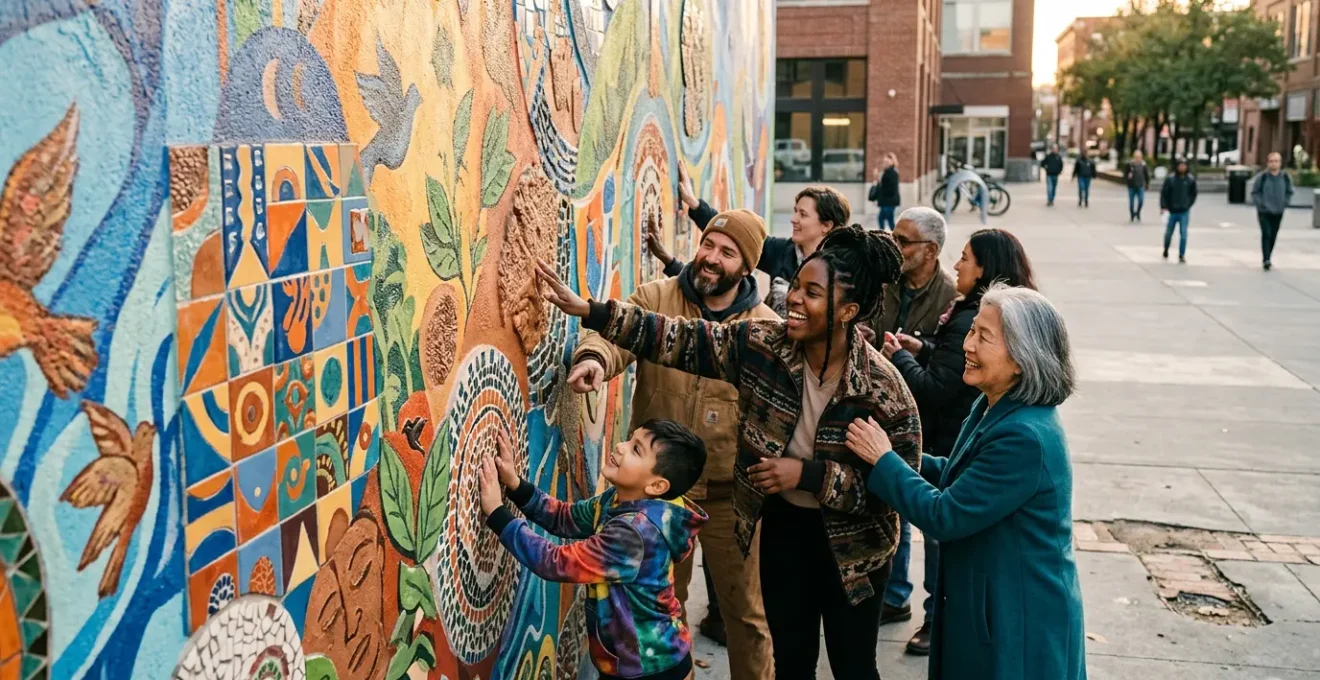
Public art’s impact on voting is not an aesthetic question; it is a measurable application of behavioral science.
- Co-creative participation generates powerful psychological ownership, converting passive viewers into invested stakeholders.
- Strategic placement in high-traffic, everyday locations dramatically lowers the “activation energy” required for civic engagement.
Recommendation: Shift from measuring subjective “feelings” to tracking a quantifiable conversion funnel: from viewers to leads to verified new voters.
For civic leaders, the persistent challenge of voter apathy often feels like an intractable problem. Traditional methods like flyers, phone banking, and ad campaigns frequently yield diminishing returns, especially among disengaged populations. In the search for novel solutions, public art is often proposed as a way to foster community pride and broadcast a message. However, this perspective fundamentally misunderstands its true potential.
The common assumption is that art inspires by being seen. But from a behavioral science standpoint, this is a flawed premise. An aesthetically pleasing mural is no more likely to create a voter than a well-designed billboard. The critical error is focusing on passive consumption rather than active engagement. The key to unlocking art’s civic power lies not in its message, but in its ability to function as a carefully designed behavioral intervention.
This analysis moves beyond feel-good platitudes to provide a statistical and psychological framework. The question is not *if* art can increase turnout, but *how* it can be engineered to do so. It requires shifting our mindset from art as decoration to art as a tool for triggering specific psychological mechanisms: creating ownership, lowering the barrier to entry, and providing quantifiable metrics for success. This guide will deconstruct this process, offering a data-driven blueprint for turning artistic projects into engines of civic action.
To effectively deploy art as a strategic tool, it is essential to understand the specific mechanisms that translate creative expression into tangible civic outcomes. The following sections break down this process, from initial engagement to final measurement, providing a complete framework for any leader aiming to make a measurable impact.
Table of Contents: A Guide to Turning Art into Civic Action
- Why Interactive Murals Get More Engagement Than Static Posters?
- Vandalism or Free Speech: Where Is the Line for Political Graffiti?
- How to Curate a Community Quilt Project Without Losing Quality?
- The Echo Chamber Mistake: Is Your Art Only Reaching People Who Agree?
- Sidewalk or Billboard: Which Location Captures the Non-Voter’s Eye?
- Metrics or Feelings: How to Prove Your Art Project Helped the Community?
- Fist or Color: How to Design a Logo for a Political Movement?
- How Did Social Realism Change Labor Laws in the 20th Century?
Why Interactive Murals Get More Engagement Than Static Posters?
The differential impact between a static poster and an interactive mural is not a matter of aesthetics but of psychology. A passive viewer may appreciate a poster, but a participant develops a sense of psychological ownership over the work they helped create. This phenomenon, often called the “IKEA effect,” demonstrates that people place a significantly higher value on things they have a hand in building. For instance, studies on self-assembled products show builders attribute a 63% valuation premium to their creations compared to identical, pre-built items.
This principle is the engine of participatory art. When a citizen adds even a single brushstroke to a community mural, they are no longer just an observer. They become a co-creator and stakeholder. This investment transforms the art’s message from an external broadcast into an internal belief. The project becomes “our mural,” and its underlying civic goals become “our goals.” This shift is fundamental to converting passive agreement into active participation, such as registering to vote or volunteering.
The data on public art supports this. Beyond simple appreciation, well-executed projects tangibly change behavior. According to research from Toronto Metropolitan University, public art can increase the likelihood of people spending time in an area by 50%. This increased “dwell time” creates more opportunities for engagement and interaction around the art piece, laying the groundwork for deeper civic conversations and action. It turns a public space into a civic hub.
Vandalism or Free Speech: Where Is the Line for Political Graffiti?
For civic leaders, a major deterrent to using public space for art is the perceived risk of unsanctioned additions or what is legally defined as vandalism. The line between provocative political expression and property damage is a complex legal and social tightrope. While sanctioned murals operate within clear legal boundaries, the world of political graffiti highlights the tension between First Amendment protections and property rights. This is not merely an abstract debate; it has direct implications for any public-facing art project.
The legal landscape is defined by context and enforcement. As a case study, a 2024 Ninth Circuit ruling regarding Seattle’s anti-graffiti ordinance found that the city could not selectively enforce its laws against specific political messages, such as anti-police slogans. The court affirmed that while graffiti on private property without consent is not protected, laws that are overly broad or unevenly applied to suppress certain viewpoints are unconstitutional. This demonstrates that the *content* and *application* of the law are as important as the act itself.
This legal ambiguity was further highlighted in a ruling on Seattle’s previous ordinance. As U.S. District Judge Marsha Pechman noted, the law was so broad it had a chilling effect on harmless expression:
On its face, the Ordinance sweeps so broadly that it criminalizes innocuous drawings (from a child’s drawing of a mermaid to pro-police messages written by the Seattle Police Foundation) that can hardly be said to constitute ‘visual blight’ and which would naturally wash away in the next rain storm.
– Judge Marsha Pechman, U.S. District Court ruling
For a civic leader, the takeaway is that risk management for public art requires a clear framework. Sanctioned, community-involving projects provide a powerful buffer against these legal and perceptual risks. By officially designating a space for public expression and involving the community in its creation, the project is framed as a collaborative asset rather than an illegal act, channeling expressive energy into a productive, legally sound format.
How to Curate a Community Quilt Project Without Losing Quality?
A common fear among organizers of participatory projects, like a community quilt or mural, is that inviting mass participation will lead to an incoherent or aesthetically weak final product. However, this assumes that process and product are in opposition. A behavioral approach argues the opposite: a high-quality process generates a high-quality outcome, where “quality” is measured by community cohesion and inspired action, not just artistic polish. The key is not to relinquish control, but to structure participation effectively.
The “Murals for Communities” project, which spanned three European cities, provides a successful blueprint. By organizing 54 engagement workshops that resulted in 18 murals, the project demonstrated that the creation process itself was a powerful tool for community bonding. As a study on the project revealed, these workshops enabled residents to become active participants in social interaction and urban development. The success was rooted in a structured process that balanced individual expression with a collective vision.
This balance can be achieved through a “Core and Contribution” model. This framework allows for widespread, authentic participation without sacrificing the project’s overall visual and thematic integrity. It provides the necessary structure to guide creativity toward a shared goal.
Action Plan: The Core and Contribution Model
- Define a clear core concept: Establish strong, non-negotiable visual identity elements (e.g., a specific color palette, material type, central symbols) that provide cohesion across all contributions.
- Design a contribution framework: Create structured and well-defined opportunities for authentic expression within the established constraints (e.g., pre-cut quilt squares, designated paint-by-number sections).
- Provide a participation toolkit: Develop physical or digital kits with pre-defined elements and clear instructions that allow for decentralized, asynchronous participation while maintaining consistency.
- Prioritize process over perfection: Measure the project’s success primarily by the strength of the community bonds built and the civic actions inspired, rather than by aesthetic perfection alone.
- Enable iterative collaboration: Build a flexible process that allows for continuous collaboration and feedback from diverse community stakeholders throughout the project’s lifecycle.
By implementing such a model, civic leaders can harness the power of mass participation to build psychological ownership and community pride, while ensuring the final artwork remains a powerful and cohesive symbol of a collective effort.
The Echo Chamber Mistake: Is Your Art Only Reaching People Who Agree?
One of the most significant strategic errors in civic engagement is preaching to the choir. An art project, no matter how powerful, fails its primary mission if it only engages those who are already politically active. The true target for increasing turnout is the apathetic or marginally engaged citizen. Unfortunately, data shows that most civic activities naturally attract a self-selecting group. According to a 2024 nationally representative poll, only 53% of adults reported being civically engaged, with the highest participation rates among those with high incomes (69%), postgraduate degrees (67%), and liberal ideologies (64%).
This creates a formidable civic engagement echo chamber. To break out of it, an art project must be designed not just for a specific message, but for a specific location and context that intersects with the daily lives of the target demographic. It cannot be placed in a location that only the “already engaged” frequent. This is less about the art’s content and more about its strategic distribution. Are you placing it in a fine art gallery or on the wall of a laundromat? Near a university or at a bus stop in a low-turnout precinct?
The goal is to create low-stakes, incidental micro-engagements. These small interactions are crucial, as they serve as a gateway to more significant civic action. As Professor Kyle Saunders of Colorado State University notes in his research on the topic, there is a direct behavioral link:
The more likely someone is to participate in non-voting activities, the more likely they are to vote.
– Professor Kyle Saunders, Colorado State University
An art installation that prompts a brief conversation, a photo for social media, or a moment of reflection is a successful non-voting activity. It acts as the first step on a ladder of engagement. By strategically placing these artistic “on-ramps” in the path of the civically disengaged, leaders can begin the process of turning passive bystanders into active citizens.
Sidewalk or Billboard: Which Location Captures the Non-Voter’s Eye?
The effectiveness of a public art installation as a behavioral intervention is heavily dependent on its ability to minimize activation energy—the effort required for an individual to engage. A billboard, though large, is a high-activation-energy medium; it is distant, passive, and competes with countless other advertisements. A sidewalk-level installation, however, is a low-activation-energy medium. It integrates directly into a person’s daily path, requiring zero additional effort to encounter and interact with it.
This principle of incidental encounter is crucial for reaching non-voters, who are by definition unlikely to seek out political information. The art must come to them, seamlessly and organically. Monumental, high-minded installations often fail this test. They may be critically acclaimed but are functionally invisible to someone not already primed to look for them. In contrast, art that is woven into the fabric of a neighborhood—on the side of a corner store, in a park, or at a public transit stop—creates opportunities for engagement that feel personal and accessible.
A 2018 case study of the Marcus Garvey Youth Clubhouse in Brooklyn provides a powerful example. The project focused on sidewalk-level arts programming designed collaboratively with local youth. This approach transformed a public space into a hub for art creation and performance. As a report from the Urban Institute highlights, this low-barrier strategy did more than just create art; it fostered economic opportunity and demonstrably improved neighborhood perceptions of public safety. It reached people where they were, turning a simple sidewalk into a locus of community-building and positive change.
For civic leaders, the strategic lesson is clear: impact is a function of accessibility. To capture the non-voter’s eye, prioritize interventions that are at human scale and integrated into the rhythm of everyday life. The goal is to make civic engagement an unavoidable, incidental, and ultimately effortless part of a person’s daily routine.
Metrics or Feelings: How to Prove Your Art Project Helped the Community?
How do you prove that an art project actually worked? For a civic leader accountable for public or donor funds, “raising awareness” or “fostering good feelings” are insufficient metrics. A behavioral science approach demands quantifiable data to prove a return on investment (ROI). While it may seem difficult to measure art’s impact, it is entirely possible by reframing the project as a conversion funnel and tracking concrete behavioral changes. The key is to look for measurable proxies that indicate a shift in community behavior.
For an analogy, consider the “Asphalt Art Initiative.” An analysis of 17 sites where asphalt art was installed showed a remarkable 50% decrease in crash rates involving pedestrians or cyclists. This is a perfect example of art directly and measurably altering public behavior. The art wasn’t just decorative; it functioned as a visual cue that changed how drivers perceived and moved through the space. We can apply this same quantitative rigor to measuring civic engagement.
To do so, leaders must build a measurement framework from the project’s inception. This “Art-Activism Conversion Funnel” moves beyond vague goals to track a clear path from viewership to action:
- Track Viewers (Top of Funnel): This is the measure of reach. Use simple tools like foot traffic counters or analysis of social media geo-tags to estimate the total number of people exposed to the installation.
- Measure Leads (Mid-Funnel): This is the crucial step of capturing intent. Integrate a clear, low-effort call to action directly into the art, such as a QR code linking to a voter registration page, a station for filling out pledge-to-vote cards, or a unique hashtag for social media. The number of scans, cards, or posts are your “leads.”
- Convert to Action (Bottom of Funnel): This is the proof of impact. After the election, match the names from your lead-generation efforts against public voter registration databases to identify and count how many new voters were successfully registered or how many existing voters turned out.
- Calculate Cost-Per-Added-Voter (CPAV): The final ROI metric. Divide the total project cost by the number of verified new voters or volunteers generated. This provides a hard number that can be compared to the CPAV of traditional outreach methods like phone banking or canvassing.
Alongside this quantitative data, a structured process for collecting participant testimonials, complete with demographic information, can provide the qualitative stories that give context and emotional weight to the numbers.
Key Takeaways
- Public art’s civic impact is not magical; it’s a function of engineering specific behavioral triggers like psychological ownership through participation.
- Success requires breaking out of the “civic echo chamber” by placing low-barrier art interventions directly in the path of apathetic citizens.
- The ROI of art activism is quantifiable. By creating a conversion funnel (Viewers → Leads → Voters), leaders can calculate a Cost-Per-Added-Voter.
Fist or Color: How to Design a Logo for a Political Movement?
The visual identity of a political movement—its logo, color scheme, or central image—is not merely branding. In the context of a participatory campaign, it functions as a critical piece of technology. The most effective designs operate as an “empty signifier”: a symbol that is simple, reproducible, and open enough for a community to pour its own meaning and identity into it. A complex logo with a prescriptive message demands passive acceptance; a simple, open symbol invites active co-option and dissemination.
Shepard Fairey’s iconic “HOPE” poster from the 2008 Obama campaign is the archetypal case study. The design’s power did not reside in a detailed policy statement. Its strength came from its simplicity: a stylized, high-contrast portrait and a bold, single-word message. This minimalist framework, combined with a distinct color palette, was easy for others to replicate, parody, and adapt. This ease of reproduction was a strategic asset, allowing the movement’s visual identity to spread in a decentralized, grassroots manner. It made supporters feel like participants in the campaign’s branding, not just consumers of it.
This strategy of providing tools for participation is a core tenet of modern art activism. The Amplifier Foundation’s “Plan Your Vote” initiative explicitly adopted this model. Rather than broadcasting a single message, they created a library of downloadable artwork from various artists. Their call to action was not just “see this,” but “use this.” As the foundation stated:
We’re giving you the tools to participate in democracy and calling on the country to download our artwork and put it in a public space.
– Amplifier Foundation, Plan Your Vote initiative 2020
The design choice for a movement’s logo, therefore, is less about “fist or color” and more about “closed or open.” Does the design prescribe a single meaning, or does it provide a flexible container for collective identity? For civic leaders, the goal is to commission or select imagery that is easily shared, owned, and remixed by the community it seeks to empower.
How Did Social Realism Change Labor Laws in the 20th Century?
The history of art and political change provides the ultimate blueprint for impact, demonstrating that art, while powerful, is only one component of a larger machine. The Social Realism movement, particularly the documentary photography of the early 20th century, did not change laws by itself. It succeeded because it was integrated into a sophisticated political strategy. Awareness alone is insufficient; art must be paired with actionable policy and organized advocacy to create legislative change.
The work of photographer Lewis Hine for the National Child Labor Committee (NCLC) is the definitive case study. Hine did not simply take heartbreaking photos of child laborers and hope for the best. He and the NCLC executed a three-part strategy:
- Powerful Visual Documentation: Hine’s stark, undeniable images provided the emotional and evidentiary foundation of the campaign. They made an abstract problem visceral and impossible to ignore.
- Clear Policy Demands: The NCLC did not just say “child labor is bad.” They used Hine’s photos as evidence in reports and lobbying materials that advocated for specific, targeted legislation to ban child labor in various industries.
- A Dedicated Political Organization: The NCLC acted as the political engine, using the images and reports to systematically lobby lawmakers, publish articles, and build a public coalition dedicated to passing those specific laws.
This historical model holds true today. An art installation that raises awareness about low voter turnout is a starting point. To be effective, it must be connected to a voter registration drive (the policy demand) run by a local civic group (the political organization). The art creates the emotional impetus and the initial engagement, which the organization then channels into a concrete, measurable action.
As the Arts + Mind Lab notes, printed and visual artwork has been a staple of political communication for centuries, even if it “took a backseat to television” for a time. Its resurgence as a tool for engagement requires us to relearn the lessons of the past. Art opens the door; a well-organized political strategy is what walks people through it.
To translate these insights into a concrete strategy for your community, the next step is to begin designing an art-based behavioral intervention that incorporates the measurement frameworks and psychological principles discussed throughout this guide.