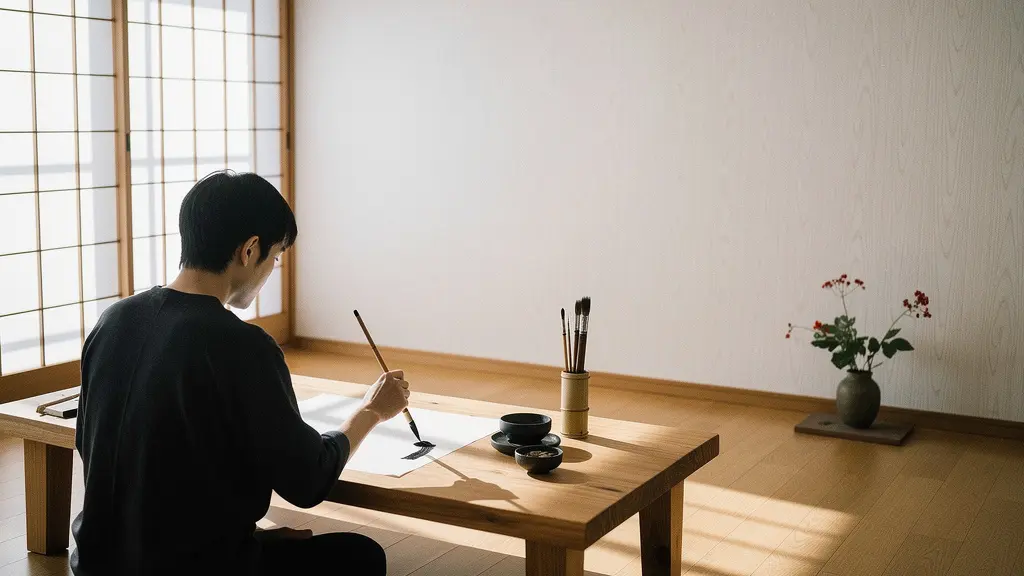
Contrary to belief, the goal of meditative ink wash painting is not to create a beautiful image, but to generate a physical record of a calm and focused mind.
- The materials—paper, brush, and ink—act as biofeedback instruments, revealing your inner state through the marks you make.
- True practice lies in observing the process (your breath, your focus, your “mistakes”) rather than judging the final product.
Recommendation: Shift your focus from “making art” to “observing self.” Treat each session as an opportunity to see your mind on paper, not as a test of artistic skill.
In the quest for inner peace, many of us turn to meditation, only to find the silence deafening or the stillness challenging. We are told to focus on our breath, to quiet our thoughts, but the mind often rebels. What if there was a way to anchor that fleeting focus, to give your meditation a physical form? This is the promise of ink wash painting, or Sumi-e, an ancient art form that is less about creating a picture and more about cultivating a state of being.
You may think that art requires talent, that a blank page is intimidating, or that you need expensive supplies to even begin. These are common barriers. Many guides focus on the technical aspects of painting a bamboo stalk or a mountain range. But they miss the fundamental point. The true practice isn’t about what you paint; it’s about how the act of painting changes your awareness. It’s a moving meditation where the brush becomes an extension of your breath and the ink a reflection of your mind’s stillness.
This guide will not teach you to be a master painter. It will teach you to be a master observer of your own mind. We will explore how the empty space on the page can be more meaningful than the mark, how to synchronize your body and mind through breath, and why the most profound lessons are found not in perfection, but in the “mistakes” you cannot erase. We will reframe the entire practice: the goal is not the product on the wall, but the process that quiets the soul. Let’s begin the journey of transforming a simple brushstroke into a profound act of daily meditation.
To navigate this path from artistic technique to mindful practice, this article explores the essential principles that bridge the two worlds. The following sections break down each core concept, offering a clear structure for your journey into meditative ink wash painting.
Summary: A Guide to Meditative Brushstrokes
- Why Is “Ma” (Negative Space) More Important Than the Ink Itself?
- Paper, Brush, Ink, Stone: Which Quality Matters Most for Beginners?
- How to Synchronize Your Breathing With Your Brush for Fluid Lines?
- The Correction Mistake That Ruins the Spontaneity of Ink Wash
- When to Mount Your Rice Paper Work to Prevent Wrinkling?
- Why Looking at Abstract Art Activates Your Brain Differently Than Realism?
- Zorn Palette or CMYK: Which Limited Palette Teaches Harmony Best?
- How to Start a Japanese Woodblock Print Collection on a Budget?
Why Is “Ma” (Negative Space) More Important Than the Ink Itself?
In Western art, we are trained to fill the canvas. Success is measured by what is added. In the meditative practice of ink wash, the opposite is true. The focus is on “Ma” (間), the Japanese concept of negative space. This is not simply empty background; it is an active, essential element of the composition. It is the pause between notes that creates music, the silence between words that gives them meaning. For the mindful painter, Ma is the foundation of tranquility.
When you look at a blank sheet of rice paper, you are not looking at nothing. You are looking at pure potential. The practice of Ma teaches you to honor this potential by using it consciously. Instead of thinking “What should I paint here?”, the meditative question becomes “Where does the silence want to remain?”. This shift in perspective is profound. It moves you from an aggressive state of “doing” to a receptive state of “allowing.” The ink mark you eventually make is defined and given life by the space you choose to leave untouched.
Cultivating an appreciation for Ma is cultivating mindfulness itself. It is the practice of noticing what isn’t there, of finding peace in emptiness, and of understanding that every action is balanced by inaction. The negative space in your painting becomes a physical record of your restraint and intentionality, a testament to your ability to listen to the silence.
Action Plan: Meditating on the White
- Sit comfortably with blank rice paper before you for 2 minutes, focusing only on its surface as pure potential.
- Place your hands on either side of the paper without touching it, feeling the energy of the empty space.
- Close your eyes and visualize the paper’s whiteness as the silence between your thoughts.
- Open your eyes and identify where the ‘Ma’ wants to remain untouched before you make any mark.
- Make your first stroke only after feeling where the emptiness should be preserved, honoring the space as much as the ink.
Ultimately, Ma is the canvas for your mind. By preserving it, you are creating a space for calm to exist, both on the paper and within yourself.
Paper, Brush, Ink, Stone: Which Quality Matters Most for Beginners?
Walking into an art store can be overwhelming. There are brushes made from wolf, sheep, and weasel hair; dozens of shades of bottled ink; and paper of varying weights and textures. The beginner’s instinct is often to believe that better materials will yield better results. In the context of meditative painting, this is a misconception that can hinder your practice. The most important “quality” for a beginner is not expense or rarity, but accessibility that fosters fearlessness.
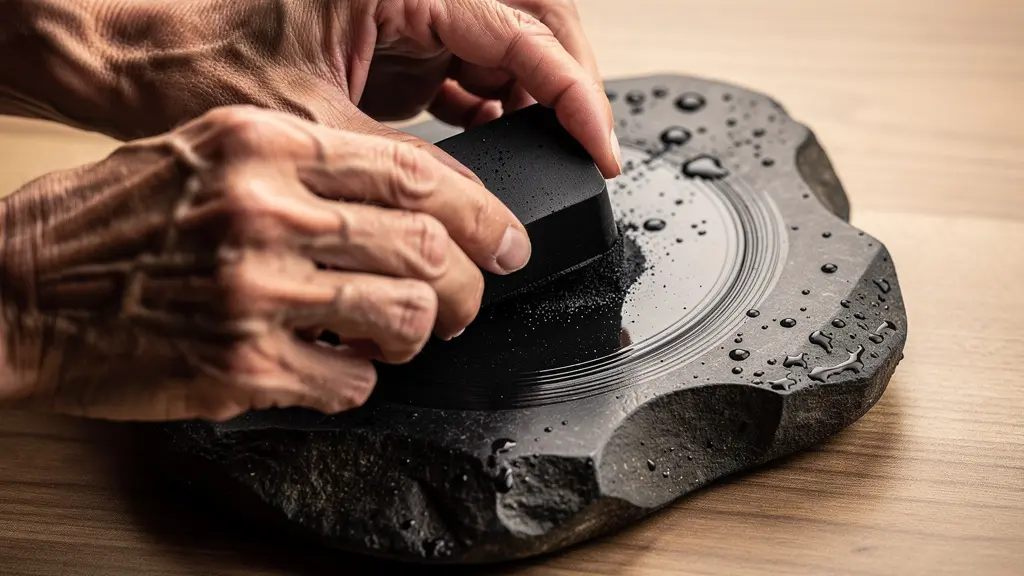
The philosophy of using “good enough” materials is a cornerstone of this practice. If you are using a $50 sheet of paper, every stroke is fraught with anxiety. You fear “wasting” it. This fear is the enemy of meditative flow. A simple roll of newsprint or an inexpensive “beginner” rice paper roll removes this pressure. It gives you permission to play, to experiment, and to make “bad” paintings. It is in this freedom from consequence that the meditative state can flourish. The act of grinding your own ink on a stone, for example, is not about creating superior ink; it’s a ritual that slows you down and begins the meditation before the brush even touches the paper.
Historical records show that for centuries, the purpose of this art was the practice itself, not the resulting product. In fact, 95% of Zen monks from 1600-present created their art for meditation, not for sale. This reinforces the idea that the tools are for the artist’s inner work, not for creating a marketable commodity. For a beginner, a student-grade brush, a simple bottle of ink, and a cheap roll of paper are more valuable than the most expensive setup, because they liberate you to focus on what truly matters: your mind.
Therefore, choose the tools that you are not afraid to use. The best material for a beginner is the one that encourages you to put ink on paper, freely and often.
How to Synchronize Your Breathing With Your Brush for Fluid Lines?
In meditation, the breath is the anchor. It is the constant, rhythmic tide that you return to when the mind wanders. In ink wash painting, the breath is the engine. It powers the brush, transforming an internal rhythm into an external, visible line. A shaky, hesitant line reveals agitated breathing and a scattered mind. A smooth, fluid, and confident line is the energetic signature of a calm, centered, and focused practitioner. Synchronizing your breath with your brush is the most direct way to turn painting into meditation.
This is not a metaphorical connection; it is a practical technique. The physical act of painting becomes a form of biofeedback. Participants in studies on this topic report that this synchronization creates immediate awareness; as noted in a practice known as Drawing the Breath, there is a lot of value in this simple activity for practicing mindfulness. When your mind is calm, your breath is deep and even, and the brush flows. When you are anxious or distracted, your breath becomes shallow and erratic, and the brush stutters. You don’t need a machine to tell you your mental state; you just need to look at the line you’ve just painted.
A simple yet powerful method to begin this practice is to use “Box Breathing,” a technique used to regulate the nervous system, and apply it to your brushstrokes. The goal is to make the connection between breath and movement so natural that it becomes second nature.
- Inhale for 4 seconds: As you breathe in, lift your brush and prepare your posture.
- Hold for 4 seconds: Pause with the brush above the paper, visualizing the stroke you intend to make.
- Exhale for 4 seconds: As you breathe out, execute one continuous, deliberate brushstroke.
- Hold for 4 seconds: Let the brush rest, either on or off the paper, observing the mark and the silence.
Through this practice, the brushstroke ceases to be a mere line and becomes a “breath-mark,” a visible record of a single, mindful moment in time.
The Correction Mistake That Ruins the Spontaneity of Ink Wash
In most art forms, a mistake can be painted over, erased, or undone. This is not the case with ink wash on rice paper. Once the ink touches the delicate fibers, it is permanent. A beginner’s first instinct, upon seeing an unintended drip or a wobbly line, is to “fix” it—to add more ink, to try and blot it, to paint over it. This is the single greatest mistake, as it destroys not only the painting but the meditation itself. The desire to correct is a function of the ego, the part of the mind that seeks control and fears imperfection.
The practice of ink wash is a direct training in letting go of that control. The inability to erase is not a limitation; it is the practice’s greatest strength. It forces you to accept the present moment, exactly as it is. That “mistake” is a true and honest record of your state of mind at that instant. Perhaps your focus lapsed, a sudden noise startled you, or a wave of anxiety passed through you. The mark is the evidence. To try and “correct” it is to try and lie about that moment. The meditative path is to accept it, breathe, and integrate it into what comes next.
This automatic, almost unconscious urge to fix things is deeply ingrained. In fact, research on mindfulness practices shows that 95% of our behavior runs on autopilot. The discipline of ink wash is about switching off that autopilot. It’s about consciously choosing to observe the “accident” without judgment and then responding to it, rather than reacting against it. This trains the mind to be more resilient and accepting, a skill that extends far beyond the paper.
Instead of correcting, learn to incorporate. See the unexpected mark not as an error, but as an opportunity. Ask yourself: “What does this mark want to become now?” This shifts you from a place of frustration to a place of creative collaboration with the present moment.
Every un-erasable mark teaches a profound life skill: to accept what is, to work with what you have, and to find beauty not in flawless perfection, but in the story of the journey, “mistakes” and all.
When to Mount Your Rice Paper Work to Prevent Wrinkling?
After you have finished a painting session, you are left with a sheet of rice paper that is likely buckled and wrinkled from the water in the ink. The technical solution to this is “mounting,” a process of carefully gluing the delicate paper onto a sturdier backing. For a professional artist, knowing when and how to do this is a crucial skill for presentation. But for the meditative practitioner, the question of mounting is first and foremost a philosophical one.
If the primary goal of our practice is the process, not the product, then is mounting necessary at all? Some artists choose to embrace the wrinkles as part of the wabi-sabi aesthetic—the beauty of imperfection and transience. The wrinkles tell the story of the water and the ink’s interaction with the paper. They are part of the physical record. To flatten them is, in a way, to erase part of that story. For many daily practices, leaving the work unmounted is a powerful statement of non-attachment to the outcome.
However, there is another perspective that aligns equally well with the meditative path. This view sees mounting not as a corrective chore for a finished product, but as the final, respectful step in the meditative ritual. It is an act of honoring the time and focus you dedicated to the practice. As Sumi-e instructor Patricia Larkin Green suggests, the act of mounting is a “concluding ritual.”
The act of mounting is not a technical chore, but the concluding ritual of the meditation, where you honor the time and focus you dedicated to the practice.
– Patricia Larkin Green, Sumi-e Classes and Workshops
So, when should you mount your work? The answer is: mount your work when the act of mounting feels like an extension of the meditation, not a chore done for an audience. Perhaps you reserve this ritual for one piece a month that particularly captures a moment of breakthrough or peace. The mounting itself becomes a slow, mindful process that seals and respects your effort.
Ultimately, the decision to mount is a personal one. It asks you to define what “finished” means, and whether you are preserving a product for display or honoring a process of self-discovery.
Why Looking at Abstract Art Activates Your Brain Differently Than Realism?
When we look at a realistic painting of a landscape, our brain gets busy. It identifies objects: “that’s a tree,” “that’s a mountain,” “that’s a river.” This process of recognition and labeling is highly efficient but also limiting. The brain finds a category, files the image away, and moves on. Abstract art, particularly the minimalist and spontaneous forms found in ink wash, denies the brain this easy categorization. It forces the mind into a different, more meditative mode of perception.
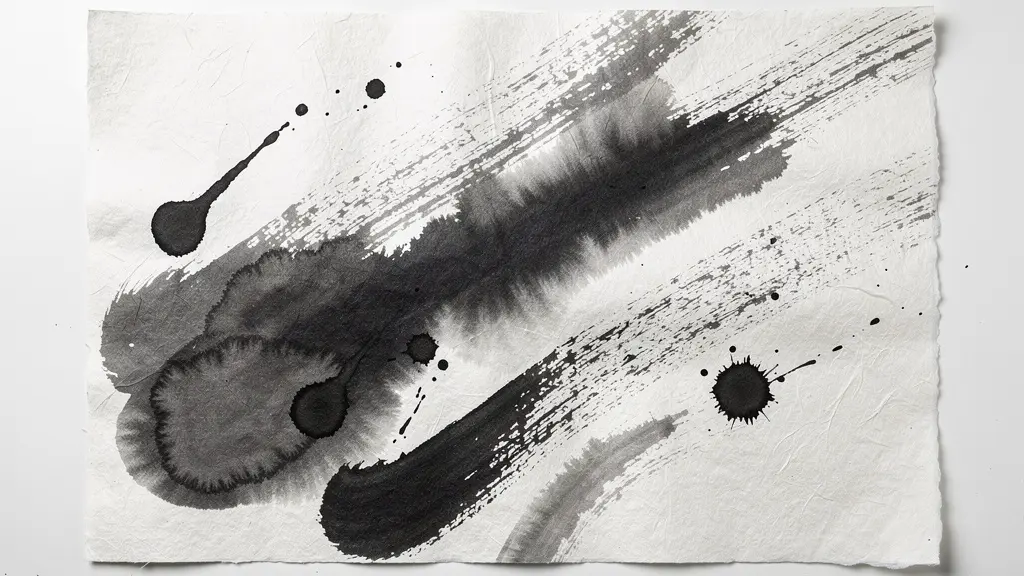
Confronted with marks that represent nothing but themselves—the energy of a brushstroke, the bleed of wet ink, the texture of a dry scumble—your brain’s interpretive circuits are bypassed. There is nothing to name. Instead, you are invited to simply experience. You notice the relationship between forms, the gradient of tones, the rhythm of the lines. This is a state of pure looking, much like the state of pure listening in silent meditation. In fact, neuroscience research reveals that Zen art’s minimalistic compositions activate different neural pathways than realistic art, engaging areas of the brain associated with introspection and present-moment awareness.
This is why practicing abstract ink wash is such a powerful meditative tool. It trains your “observing mind.” You learn to create marks that are not “of” something, but are simply themselves. This practice of “no-mind” or “mushin” (無心) is a core goal in Zen. It’s not about having an empty mind, but a mind that is not fixated on interpretation and judgment. Creating abstract marks helps you find this state. You let go of the need to represent and simply allow energy to flow from your body, through the brush, and onto the paper, creating a work that is to be felt rather than understood.
By engaging with abstraction, you are not just making random marks. You are actively training your brain to exit its default mode of labeling and judging, and to enter a more spacious, open, and meditative state of awareness.
Zorn Palette or CMYK: Which Limited Palette Teaches Harmony Best?
In the world of painting, artists often use limited palettes—a small, curated selection of colors—to create harmony and mood. The Zorn palette (four colors) or a CMYK-based primary palette are common examples. But for the deepest meditative practice, the most powerful limited palette is not a selection of colors, but the radical reduction to one: black ink. The infinite spectrum of grays and the starkness of black and white offer a unique path to tranquility.
Why is monochrome so conducive to a meditative state? Because every color you add introduces another variable, another decision, another distraction for the mind. “Should this be a warmer red or a cooler red? Does this blue harmonize with that yellow?” These questions, while central to color theory, pull you out of a state of singular focus. When you work only with ink, the decisions are simplified and deepened. The only questions are about value (lightness and darkness) and water. How much water do I add to the ink to achieve this specific shade of gray? The mind’s focus becomes singular and intense.
This singular focus on tone is embodied in the Japanese principle of “Notan” (濃淡), which describes the balance and relationship between light and dark. Mastering Notan requires immense focus on the consistency of the ink and the wetness of the brush. It becomes a meditation on dilution. This practice calms the activating effect color has on the brain, quieting mental chatter and allowing for a deeper dive into the meditative state.
A comparative view highlights how a monochrome palette is uniquely suited for a meditative practice, as it minimizes mental stimulation and demands a singular focus.
| Aspect | Monochrome Ink | Limited Color | Full Color |
|---|---|---|---|
| Mental Stimulation | Low – Quieting effect | Moderate | High – Activating |
| Focus Required | Singular (value only) | Divided (value + hue) | Complex (multiple variables) |
| Meditative Depth | Deepest | Moderate | Surface level |
| Learning Curve | Simple entry, infinite mastery | Moderate complexity | Steep initial curve |
While color painting has its own joys, for the purpose of a quieting meditation, the universe found in the gradients between black and white is more than enough. It teaches harmony not through variety, but through nuance.
Key Takeaways
- Process Over Product: The goal is not the finished painting, but the mindful state achieved during its creation. The artwork is merely a byproduct.
- Tools as Biofeedback: Your brush, ink, and paper are instruments for observing your own mind. A shaky line is not a mistake, but data about your inner state.
- Breath as the Engine: Synchronize your brushstrokes with your breathing to transform the physical act of painting into a moving meditation.
How to Start a Japanese Woodblock Print Collection on a Budget?
The title of this section may seem misplaced. We have been discussing the personal, internal practice of ink wash painting. Why pivot to collecting external art, specifically woodblock prints? The answer lies in reframing the word “collection.” In our consumer culture, collecting means acquiring objects. In a meditative context, to “collect” means to accumulate moments of presence. The most valuable collection you can build is a journal of your own meditative journey.
Instead of seeking to purchase art from others, the practice encourages you to create and curate a portfolio of your own focus. This shifts the entire paradigm. Your “collection” is not about monetary value or famous artists; it’s a deeply personal record of your own inner exploration. It’s a physical timeline of your progress in cultivating calm and awareness. This approach aligns perfectly with a “budget,” as the only cost is your time and inexpensive materials.
Virginia Lloyd-Davies, author of Sumi-e Painting: Master the meditative art, captures this idea perfectly by stating that the goal is to create and “collect” a portfolio of your own moments of presence and focus. This is your true collection. Each page in your journal is more valuable than a print on the wall, because you were there when it was made. You know the story of the breath that created that line, the moment of peace that allowed that wash of ink to settle perfectly.
To start this collection, dedicate a simple, unlined notebook to this purpose. Each day, take five minutes to create a small ink wash on a single page. Date it, and perhaps add a word about your emotional state before and after. This daily ritual builds a powerful collection over time, one that reflects your journey in a way no purchased art ever could.
This is how you start a priceless collection on a minimal budget. You collect days, you collect breaths, you collect moments of quiet clarity. You become the artist and the curator of your own museum of mindfulness.