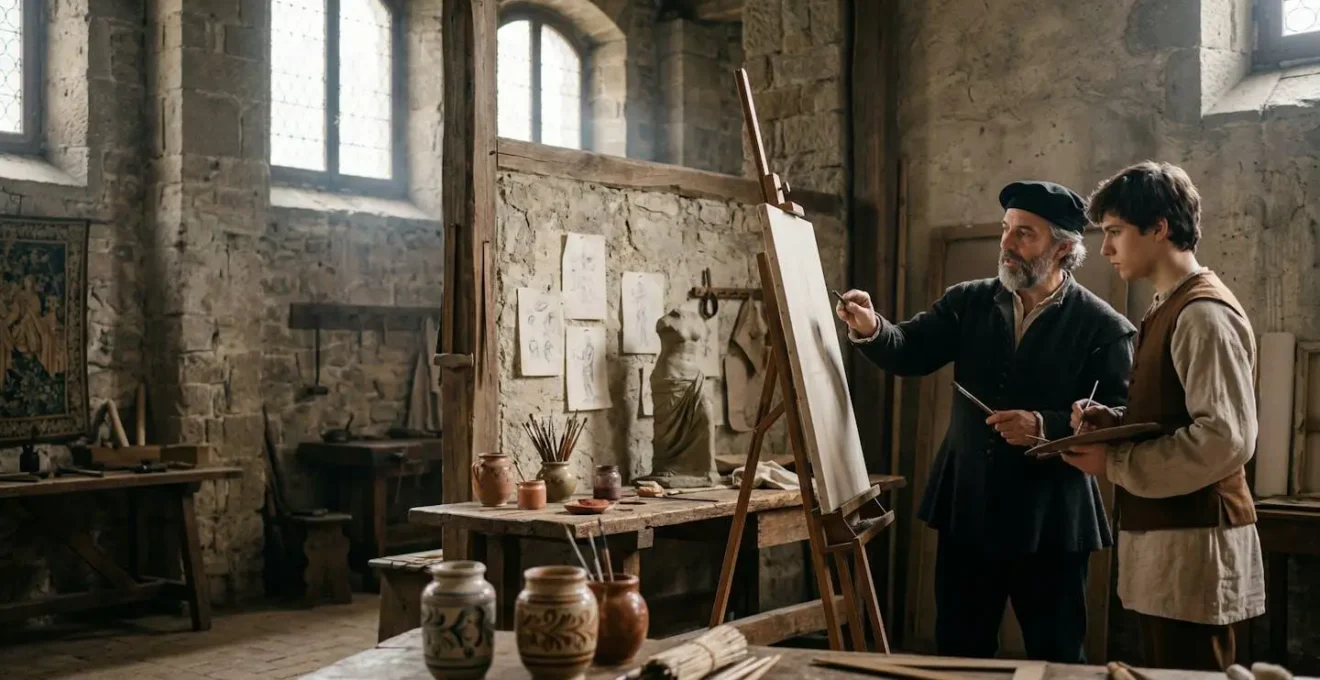
Contrary to the myth of the lone genius, Leonardo da Vinci’s brilliance was forged, not born. This article reveals how Verrocchio’s workshop functioned as a creative ecosystem, providing the technical ‘DNA’ Leonardo inherited, transformed, and ultimately rebelled against to redefine Western art. The true story is not one of solitary creation, but of a profound and dynamic artistic lineage.
We picture Leonardo da Vinci as the archetypal Renaissance Man, a solitary genius whose brilliance seemed to spring from a divine source. We hear the famous story of him, as a young apprentice, painting an angel so beautiful that his master, Andrea del Verrocchio, vowed never to paint again. This anecdote, while compelling, simplifies a much more fascinating truth. It frames genius as a spontaneous event rather than the culmination of a rigorous, collaborative, and deeply influential process.
The common narrative misses the most crucial element: the environment that made Leonardo’s ascent possible. The key to understanding his genius lies not in his supposed innate superiority, but in the very structure and philosophy of Verrocchio’s workshop. This was no mere school; it was a crucible of skill, a competitive ecosystem where techniques were passed down, challenged, and ultimately reborn. The real story is one of creative inheritance, where an artist absorbs the DNA of their predecessors before transforming it into something entirely new.
This article will deconstruct the “lone genius” myth by tracing the genealogy of Leonardo’s skill. We will explore the hierarchical structure of the Renaissance workshop, dissect the nature of artistic rebellion, examine how geography and patronage shaped creative lineages, and reveal how this centuries-old model of influence and innovation continues to define artistic creation today.
Summary: The Making of a Master: Deconstructing da Vinci’s Genius
- Master or Apprentice: Who Actually Painted the Backgrounds?
- Why Must Every Art Movement Reject the Previous Generation?
- Venetian Color vs. Florentine Line: How Geography Dictated Lineage?
- The “Lone Genius” Myth That Ignores Collaboration and Training
- Which Old Master Is Francis Bacon Actually Quoting in His Screams?
- Why Do Academies Force Students to Copy Old Masters for Years?
- Why Did the Medici Family Spend Fortunes on Public Art in Florence?
- How Do Contemporary Artists “Steal” From History Without Plagiarizing?
Master or Apprentice: Who Actually Painted the Backgrounds?
The journey to mastery in a Renaissance workshop, or *bottega*, was a long and structured climb, not a sudden revelation of talent. An aspiring artist entered as an apprentice, embarking on a path of deep immersion. In fact, historical records show that Renaissance apprentices trained for one to eight years before they could even hope to become masters themselves. This period was dedicated to absorbing the workshop’s specific “artistic DNA” through a series of escalating tasks.
Far from being immediately handed a brush to create a masterpiece, a young Leonardo would have started with menial chores: grinding pigments, preparing wooden panels, and studying the master’s drawings. This system was designed to build foundational skills from the ground up. Only after proving their dedication and competence would an apprentice be trusted with the act of painting itself. Even then, the work was hierarchical and collaborative.
The question of who painted what in a workshop piece is central to understanding this model. As the National Gallery of Art explains, the division of labor was clear. An apprentice’s first foray into a major commission was often in the less critical areas of a composition. As an expert from the gallery notes, “Once a student had graduated to painting, he would usually spend time executing less important parts of a composition, such as sections of landscape background.” This was Leonardo’s reality: his genius was first applied not to a divine angel, but likely to the rocks and trees behind Verrocchio’s central figures.
Why Must Every Art Movement Reject the Previous Generation?
After an artist has fully internalized the techniques of their master, a critical moment arrives. To become a true master in their own right, they cannot simply replicate the past; they must engage in an act of informed rebellion. This is not a rejection born of disrespect, but an evolution born of deep understanding. The student takes the inherited artistic DNA and mutates it to create a new form. Leonardo’s career is the quintessential example of this evolutionary leap.
Verrocchio was a master of the Florentine style, defined by crisp outlines and sculptural clarity, a technique known as *disegno*. Leonardo, having mastered this approach, began to push its boundaries. He sought a greater sense of atmosphere and psychological depth, which the hard-edged precision of his master’s style could not fully provide. His solution was a radical departure that would change art history.
This is beautifully captured in one of his masterpieces. As one biography notes, “In The Virgin of the Rocks, he abandoned the hard edges used by his teacher, Verrocchio, in favour of these soft, smoky transitions.” This technique, *sfumato*, involves blurring the lines between objects and creating a hazy, atmospheric effect. It was a direct-to-toe rejection of his training’s core tenets, allowing him to model forms with light and shadow rather than with lines.
The smoky quality seen in this visual detail is the essence of *sfumato*. Instead of a defined border, forms emerge from the gloom, their edges softened as if veiled by mist. This was more than a stylistic choice; it was a philosophical shift. Leonardo was painting not just what he saw, but how he saw it—through air, light, and atmosphere. He built upon Verrocchio’s foundation of form to add a new layer of emotional and visual realism.
Venetian Color vs. Florentine Line: How Geography Dictated Lineage?
The concept of artistic lineage extends beyond a single master-apprentice relationship. Entire cities and regions developed their own distinct “artistic DNA,” shaped by their unique economic, cultural, and geographical circumstances. The famous rivalry between the art of Florence and Venice during the Renaissance is the perfect illustration of how location can dictate the very philosophy of creation.
In Florence, where Verrocchio and Leonardo trained, the intellectual and artistic culture prized drawing and design above all else. This approach was known as *disegno*. The ability to render form accurately through precise lines was seen as the foundation of all art, a rational and scientific pursuit. The focus was on structure, composition, and the intellectual grasp of form. This was the world that shaped Leonardo’s initial training.
Venice, a bustling maritime trade hub, developed a completely different philosophy known as *colorito*. Here, color and the application of paint were considered the primary means of expression. As explained in an essay by the Metropolitan Museum of Art, this was a fundamental divide: “In Florence, *disegno*, that is, ‘drawing’ or ‘design,’ was viewed as the essential beginning of artistic endeavor… In Venice, *colorito*, ‘coloring’—not only color but also its judicious application—was deemed fundamental.” This difference was not arbitrary; it was rooted in economics. As a major port, Venice had superior access to the exotic and expensive pigments flowing in from the East, such as lapis lazuli for brilliant ultramarine blue. This material advantage fueled a culture of experimentation with vibrant, emotionally charged color that Florentine artists, more reliant on local materials for fresco and drawing, could not easily match. The city’s very identity as a nexus of trade was imprinted on its art.
This regional divergence shows that an artist’s lineage is a complex tapestry woven from their master’s hand, their own innovations, and the very soil and commerce of the place they call home. The geographical context becomes a silent master, shaping the tools, techniques, and aesthetic values available to every artist within its sphere of influence.
The “Lone Genius” Myth That Ignores Collaboration and Training
Perhaps the most persistent myth in art history is that of the lone genius, an isolated figure creating masterpieces from sheer inspiration. The reality of Verrocchio’s workshop shatters this romantic notion. It was not a solitary studio but a vibrant, multidisciplinary ecosystem buzzing with activity, competition, and, most importantly, collaboration. Leonardo was not Verrocchio’s only student; he was part of a cohort of future legends.
The workshop was a crucible where talent was forged through shared knowledge and mutual influence. As the World History Encyclopedia highlights, “Other notable future artists then at the workshop included Sandro Botticelli and Pietro Perugino.” Imagine the creative energy in a room shared by these three nascent masters, each learning from Verrocchio but also from each other. The training was incredibly broad, encompassing everything from drafting and chemistry to metallurgy and carpentry. This cross-pollination of skills was fundamental, creating artists who were also engineers, scientists, and craftsmen.
This model of collective creativity is not a historical relic; it is a timeless principle for innovation. The structure of Verrocchio’s workshop finds a striking modern parallel in the celebrated “Braintrust” meetings at Pixar Animation Studios. In his analysis of Pixar’s success, co-founder Ed Catmull describes a process where a team of directors and creatives provide candid, constructive feedback on works-in-progress. This collaborative, non-hierarchical peer review is directly analogous to the dynamic of the Renaissance *bottega*. It proves that great ideas are rarely born in isolation but are refined and strengthened through a community of trusted peers—a principle that was as true for Leonardo as it is for today’s top creative minds.
The idea of a collaborative ecosystem is thus central to demystifying genius. Innovation thrives not in a vacuum, but in a culture of shared expertise and open critique, where the collective is as important as the individual.
Which Old Master Is Francis Bacon Actually Quoting in His Screams?
The concept of “quoting” in art is a testament to the enduring power of artistic lineage. When a 20th-century artist like Francis Bacon references a work by Velázquez or an Eisenstein film, he is not merely copying; he is engaging in a dialogue across centuries, tapping into a long chain of creative inheritance. To understand this dialogue, one must first grasp how deeply techniques and ideas are transmitted from master to student. The relationship between Leonardo and Verrocchio is the archetypal example of this transmission.
Leonardo’s most famous innovations were not conjured from thin air. They were evolutions of methods he learned and perfected in Verrocchio’s workshop. His revolutionary approaches to drawing and painting were built directly on the technical foundations his master provided. This direct lineage is confirmed by technical analysis of his work. Art historian Jill Dunkerton, in the National Gallery’s Technical Bulletin, states that “Many aspects of Leonardo’s technique, including his underdrawing procedure and use of monochrome undermodelling, appear to originate with his master.”
This is a crucial insight. It means that the very scaffolding of a Leonardo masterpiece—the hidden layers of drawing and tonal preparation that give it depth and luminosity—was a system passed down from Verrocchio. Leonardo did not invent his process; he inherited it, refined it, and pushed it to a level of subtlety and psychological complexity his master had never achieved. The “artistic DNA” is undeniable.
So, when we ask which Old Master an artist like Bacon is quoting, the answer is never simple. He is quoting not just a single artist, but the entire genealogy of skill that produced them. He is referencing a visual language that has been passed down, mutated, and enriched through countless master-apprentice relationships. The screams of Bacon’s popes echo with the weight of this history, a lineage that runs directly back through the workshops of masters like Verrocchio.
Why Do Academies Force Students to Copy Old Masters for Years?
The practice of copying the work of Old Masters, a cornerstone of academic art training for centuries, is often misunderstood as a rote, uncreative exercise. However, its purpose is not to produce skilled forgers but to force a deep internalization of an artist’s technique and way of seeing. It is the most direct way to absorb a master’s “artistic DNA.” Leonardo’s own development of *sfumato* is the ultimate proof of this principle: it was born from his rigorous study of Verrocchio’s specific drawing methods.
Verrocchio was a pioneer in his own right. The Art Institute of Chicago notes that Verrocchio’s experimental use of black chalk to create subtle tonal gradations was the direct technical basis for Leonardo’s *sfumato*. Leonardo learned the “how” from his master—the physical act of building up tone—before he applied a new “why” to it, creating atmosphere and mystery.
The workshop employed tangible, hands-on methods for this transfer of knowledge. The art historian Giorgio Vasari described a specific drapery study technique used by Leonardo, learned directly from Verrocchio’s practice. It involved draping cloth dipped in plaster over clay models and then painstakingly drawing the complex folds. This was not simple imitation. It was a rigorous process of translating a three-dimensional form into a two-dimensional representation, building neural pathways between observation, analysis, and execution. It was about understanding the fundamental principles of light, form, and texture.
Action plan: Internalize a Master’s Technique Through Copying
- Analyze the Original: Deconstruct the master’s work. Identify the core techniques used for composition, line, color, and light. Don’t just look; see the decisions they made.
- Replicate the Process: Recreate a small section of the work using the same materials and methods where possible. If they used underdrawing, start there. If they built color in layers, follow that process.
- Isolate and Drill a Skill: Focus on one specific element you admire, such as the way the artist renders hands or the texture of fabric. Practice that single element repeatedly.
- Translate, Don’t Trace: Instead of a 1:1 copy, try to apply the master’s technique to a different subject. Draw a modern object using a Renaissance master’s cross-hatching style, for example.
- Reflect and Articulate: Write down what you learned. What was difficult? What “aha” moments did you have? Articulating the process solidifies the learning and moves it from muscle memory to conscious knowledge.
Why Did the Medici Family Spend Fortunes on Public Art in Florence?
No artistic ecosystem, no matter how talented its members, can thrive without a critical external force: patronage. In Renaissance Florence, the Medici family was the ultimate engine of artistic production. Their vast wealth and political power did more than just fund art; it actively shaped the city’s creative lineage, directing the flow of talent and using artists as strategic assets. Verrocchio’s career, and by extension Leonardo’s opportunity, was inextricably linked to this system of patronage.
Verrocchio’s rise to become Florence’s preeminent sculptor and painter owed a great deal to the commissions he received from Lorenzo de’ Medici, known as “the Magnificent.” This support was not an act of simple generosity. For the Medici, art was a powerful tool for projecting an image of sophistication, power, and civic pride. It was a form of soft power, enhancing their status at home and abroad.
The Medici’s strategy was remarkably sophisticated, operating like a modern luxury brand building its global prestige. Art historian Federico Zeri noted that Lorenzo strategically exported his “house” artists to foreign courts as cultural ambassadors. He sent Verrocchio to Venice, Pollaiolo to Rome, and, most famously, Leonardo to Milan. This was not just about finding work for his favorite artists; it was a calculated move to “culturally penetrate” rival powers. By embedding Florentine art and artists in the courts of his rivals, Lorenzo was building a powerful brand for Florence, establishing its cultural supremacy and yielding long-term political and economic dividends.
This patronage model created a highly competitive but well-funded environment where workshops like Verrocchio’s could flourish. It provided the grand commissions that pushed artists to their limits and funded the training of the next generation. The genius of Leonardo, therefore, was nurtured not only by his master’s teaching but also by the political ambitions and strategic vision of the city’s ruling family.
Key takeaways
- Genius is forged, not born; it arises from a dynamic ecosystem of training, collaboration, and competition.
- True innovation is an “informed rebellion” — a conscious break from a deeply understood tradition, not a rejection out of ignorance.
-Artistic lineage is a form of “creative DNA” passed down from master to apprentice, which is then transformed by each new generation.
How Do Contemporary Artists “Steal” From History Without Plagiarizing?
The timeless cycle of artistic lineage—inheritance, transformation, and rebellion—culminates in a moment when the apprentice not only equals but surpasses the master. This is the final, crucial step that validates the entire system. The legendary tale of Leonardo and Verrocchio working on *The Baptism of Christ* is the archetypal story of this moment. Giorgio Vasari famously wrote that the young Leonardo painted an angel with such superior skill “that Verrocchio resolved never to touch the brush again.” While likely an exaggeration, the story captures a profound truth: the goal of a great master is to produce a student who will eventually make their own work obsolete.
This brings us to the modern-day question of influence versus plagiarism. How do artists “steal” from history without simply copying? The answer lies in transformation. It is not about taking an idea, but about inheriting a language and using it to say something new. This principle holds true even in the high-stakes contemporary art market, where the concept of the “workshop” is alive and well.
Consider the practices of artists like Damien Hirst, who employs numerous assistants, or the debate over the attribution of *Salvator Mundi*. Believed by many to be a work by Leonardo with contributions from his workshop, the painting still fetched the highest price ever at auction. As one analysis points out, this shows that the market ultimately values the mind that guides the work, not just the hand that holds the brush. What matters is the transformative vision of the master, which elevates the collective output of the workshop. The value is in the evolution of the artistic DNA, not merely its faithful replication.
Contemporary artists “steal” from history by engaging in the same process as Leonardo. They absorb the lessons of the past, internalize the techniques of the masters, and then filter that knowledge through their own unique perspective and context. They are not plagiarizing; they are participating in the grand, centuries-old dialogue of art. They are taking their inheritance and rebelling against it in an informed way to create the next link in the chain of skill genealogy.
By looking at art history through this lens of creative lineage, we can see every artwork not as an isolated object, but as a conversation across time. The next step is to start identifying these hidden threads of influence in the art you encounter every day.