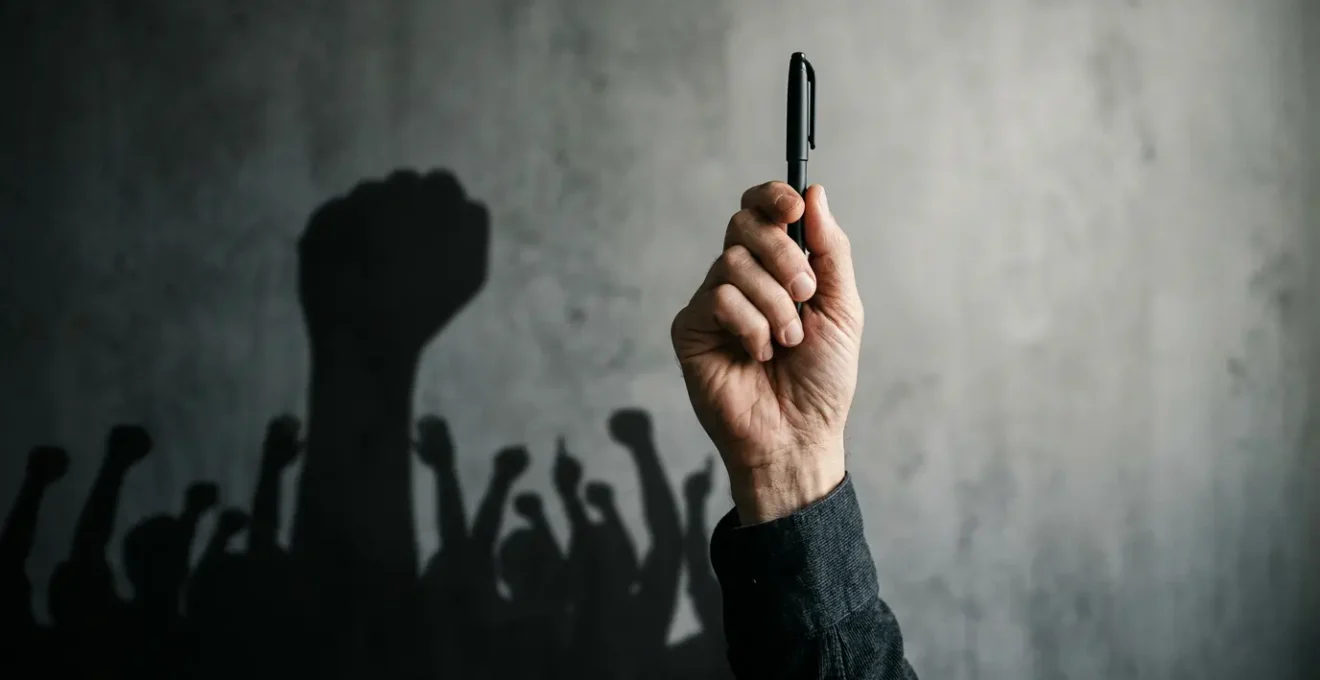
We often think of satirical cartoons as simply making fun of dictators. The reality is far more potent. They do not just criticize; they systematically deconstruct the psychological architecture of fear and inevitability that authoritarian regimes rely on, creating a shared, unspoken consensus of dissent that is fundamentally ungovernable.
In the tense landscape of an authoritarian state, what is the most dangerous weapon? It is not always a bomb or a bullet. Sometimes, it is a simple drawing, a caricature published in a newspaper or shared on social media. The immediate response from the state—censorship, arrests, and violent crackdowns—confirms the profound threat these images pose. For decades, political analysts have acknowledged that satire is a potent tool, capable of simplifying complex issues and making dissent more palatable to the public.
This common understanding, however, only scratches the surface. It positions the cartoon as a mere projectile of criticism lobbed at a fortified wall. But what if the cartoon’s true power lies not in direct attack, but in subtle demolition? What if its primary function is to expose the cracks in the regime’s carefully constructed facade of legitimacy and control? The real threat of a satirical cartoon is its ability to dismantle the psychological architecture of power from within, by exposing the absurdity of its claims and fostering a silent, collective realization that the emperor has no clothes.
This analysis will dissect the mechanisms through which visual satire operates as a tool of political defiance. We will explore the strategic use of ambiguity to evade censors, the creation of unifying symbols for social movements, and the ongoing battle over historical narratives embodied in public monuments. By examining how power projects itself visually and how dissent is co-opted, we will uncover the foundational reasons why a simple drawing can be one of the most effective challengers to absolute authority.
This article provides a structured analysis of the visual and psychological warfare between artists and authoritarian states. The following sections break down the key strategies, tactics, and battlegrounds where this conflict unfolds.
Summary: How Visual Dissent Undermines Authoritarian Control
- Why Is Ambiguity the Artist’s Best Defense Against Censors?
- Fist or Color: How to Design a Logo for a Political Movement?
- Topple or Contextualize: What Should We Do With Statues of Oppressors?
- The “Che Guevara T-Shirt” Effect: How Capitalism Absorbs Rebellion
- Poster, Sticker, Mural: In What Order Should Street Art Spread?
- Political Poster or Oil Painting: How Power Projects Itself Visually?
- Why Were Murals the Most Effective Way to Educate Illiterate Populations?
- Can a Public Art Installation Actually Increase Voter Turnout?
Why Is Ambiguity the Artist’s Best Defense Against Censors?
In an environment of intense scrutiny, direct criticism is a fast track to imprisonment or worse. Therefore, the most skilled political cartoonists master the art of weaponized ambiguity. They create images that operate on two levels: a surface meaning that is innocent or nonsensical, and a deeper, symbolic meaning that is instantly recognizable to a populace sharing a common context of oppression. This creates an “absurdity gap”—the chasm between the regime’s self-perception and the ridiculous light in which it is cast—that citizens can see, but which the censor struggles to officially condemn without admitting the validity of the critique.
This strategic ambiguity provides plausible deniability. The artist can claim the image is about something else entirely, forcing the authorities into a difficult position. To punish the cartoonist is to acknowledge that the satirical interpretation is the correct one, thereby amplifying the cartoon’s message. As analyst Cherian George notes, “Cartoons often crystallize what the public already knows or feels.” They do not need to be explicit because they are activating a pre-existing, shared understanding. This process transforms a piece of art from a simple statement into a catalyst for a collective, unspoken consensus of dissent.
The decision-making process for the artist is a high-stakes calculation. It is a constant balancing act between clarity and safety, between making a point and staying free. This calculated risk is at the heart of effective visual satire under authoritarianism. As one analysis notes:
Political cartoonists engage in varying degrees of self-censorship, with some electing to completely align with the political positions of their countries, while others opt for bolder, albeit calculated, artwork.
– Sara Qaed & Maher Ashour, Gulf International Forum analysis on political satire in the GCC
By mastering this coded language, cartoonists create a dialogue that flies under the radar of the state, strengthening the resolve of the public while frustrating the instruments of control. It is a quiet but profound act of defiance that chips away at the regime’s authority, one ambiguous image at a time.
Fist or Color: How to Design a Logo for a Political Movement?
While individual cartoons plant seeds of doubt, a sustained political movement requires a unifying visual identity. The design of a logo or symbol is not a matter of mere aesthetics; it is a crucial strategic decision that can determine a movement’s reach and resilience. An effective symbol must be simple, memorable, and, most importantly, easily replicable. It needs to transcend the digital realm and be something a person can draw by hand on a wall, a sign, or a piece of paper. This is the difference between a top-down corporate brand and a bottom-up symbol of grassroots power.
The clenched fist is a historic and powerful example. It is an anatomically simple shape that requires no artistic skill to reproduce, yet it carries immense semiotic weight, signifying solidarity, strength, and defiance. The choice of color is equally critical. Colors evoke immediate emotional responses and can be used to claim a national identity (like the colors of a flag) or to signify a specific ideology (such as red for socialism or green for environmentalism). A movement’s visual identity must be powerful enough to be recognized at a glance but open enough for people to adopt and make their own.
The visual grammar of these symbols often evolves toward simplicity and abstraction, ensuring they can spread like a virus through a population, carried by countless individuals rather than a centralized marketing department. This decentralized approach is a direct challenge to the highly centralized control of an authoritarian state.
Case Study: Black Lives Matter Visual Identity Strategy
A powerful modern example of this principle in action is the visual identity of the Black Lives Matter movement. As highlighted in an analysis of design in social movements, the organization collaborated with the Design Action Collective to create a visual identity built on accessibility. The use of a simple, bold layout and a freely available font was a deliberate choice. This strategy ensured that supporters anywhere in the world could easily recreate the logo, both digitally and by hand, facilitating widespread grassroots adoption and preventing the message from being controlled by a central authority.
Action Plan: Auditing a Symbol for a Political Movement
- Replicability Test: Can the symbol be accurately drawn from memory in under 10 seconds with a single pen? If not, it is too complex for grassroots proliferation.
- Medium Versatility: Can the design work as a social media avatar, a stencil for spray paint, a sticker, and a banner? It must be effective across all potential channels of dissent.
- Semiotic Clarity: Does the symbol have a clear primary meaning for the target audience? Test it for unintended interpretations that could be co-opted or ridiculed by the regime.
- Emotional Resonance: Does the combination of shape and color evoke the desired emotion—hope, anger, solidarity, or urgency? Gather feedback from a diverse group of intended supporters.
- Future-Proofing: Avoid elements that tie the symbol to a specific event or leader. The most enduring symbols represent a timeless idea, not a fleeting moment.
Topple or Contextualize: What Should We Do With Statues of Oppressors?
The visual battleground extends beyond ephemeral posters to the permanent fixtures of public space: statues and monuments. These are not neutral historical artifacts; they are a form of state-sanctioned propaganda cast in bronze. Authoritarian regimes, and the oppressive systems they emerge from, erect these monuments to solidify their narrative of power, legitimacy, and history. A statue of a general, a king, or a colonial leader is a daily, physical assertion that their values are the foundation of the society. It is a key part of the psychological architecture of control, making a particular version of history seem permanent and unchallengeable.
Consequently, the debate over whether to topple or contextualize these statues is a debate over who controls the public narrative. Tearing down a statue is a visceral act of symbolic rejection. It is a declaration that the official history is a lie and that the values represented by the figure are no longer tolerated. This act physically dismantles a piece of the regime’s psychological infrastructure. As historian Dell Upton stated regarding Confederate monuments, they were not intended as art but as “affirmations that the American polity was a white polity.” Removing them is a direct challenge to that affirmation.
The timing of when these monuments were erected often reveals their true purpose. For example, a historical analysis of Confederate monuments in the United States shows two major spikes in construction: one during the height of the Jim Crow era and another during the Civil Rights movement. This proves they were not built out of post-war grief but as tools of intimidation and to reinforce a white supremacist power structure in the face of Black progress. Contextualizing these statues—adding plaques that explain their oppressive history—is a less dramatic but still potent act of discursive warfare. It co-opts the regime’s symbol and turns it into a lesson about the very oppression it was built to glorify.
The “Che Guevara T-Shirt” Effect: How Capitalism Absorbs Rebellion
While direct censorship is the primary tool of authoritarian states, a more insidious threat to visual dissent exists in liberal-capitalist societies: recuperation. This is the process by which symbols of rebellion are stripped of their political power, commodified, and sold back to the public as consumer goods. The most iconic example is the “Che Guevara T-Shirt” effect, where a potent symbol of anti-capitalist revolution becomes a mass-marketed fashion item, utterly divorced from its original ideology.
This process of absorption is a powerful neutralizing agent. When a symbol of dissent becomes a trendy product, its revolutionary edge is blunted. The act of wearing the t-shirt is transformed from a political statement into a personal consumption choice. It allows individuals to feel a sense of rebellion without engaging in any actual political action or challenging the status quo. As one analysis on the subject puts it, commodification is a “consumerist approach to revolution that seeks to monetise its ideas while ideologically neutralising any real threat to the status-quo.”
For authoritarian regimes that allow a degree of market economy, this effect can be a useful, indirect form of control. By allowing rebellious imagery to be commercialized, they permit a safety valve for dissent that ultimately poses no real threat. The anger and desire for change are channeled into the marketplace, where they are rendered harmless. The symbol, once a weapon against the system, becomes just another product within it, and the psychological architecture of power remains untouched.
Poster, Sticker, Mural: In What Order Should Street Art Spread?
For a visual dissent campaign to be effective on the ground, it must follow a strategic deployment sequence, balancing risk, cost, and impact. This is not a random process but a calculated escalation. The campaign typically begins with the smallest, most ephemeral, and lowest-risk format: the sticker. Stickers are cheap to produce, can be deployed in seconds, and their small size allows them to appear in heavily surveilled areas—on lamp posts, bus stops, and bathroom stalls. They are the guerrilla warriors of street art, creating a widespread, low-level hum of dissent that signals to others that they are not alone.
The next level of escalation is the poster. Larger and more visible than stickers, posters require more time to affix, increasing the risk for the activist. They are used to claim more significant visual territory, such as construction hoardings or community notice boards. A successful poster campaign can create a powerful visual saturation in a specific neighborhood, making the movement’s presence feel overwhelming and inevitable. This step transitions from quiet signaling to a more overt claim on public space.
The final and most high-risk stage is the mural. A mural is a semi-permanent declaration of power. It requires significant time, resources, and often a team of people, making it a bold and dangerous act in an authoritarian state. Murals transform a wall from a piece of architecture into a massive political statement. They become landmarks of defiance, too large to be easily ignored or removed without a major effort, which in itself becomes a political event. This ordered progression—from the whisper of the sticker to the shout of the mural—allows a movement to build momentum, test the state’s response at each stage, and organically grow its visual footprint from the shadows into the spotlight.
Political Poster or Oil Painting: How Power Projects Itself Visually?
The visual language of power and the visual language of dissent operate on fundamentally different principles and timelines. Established power, with its vast resources and control over institutions, projects itself through permanence and grandeur. The chosen medium is often the oil painting or the monumental sculpture. These are objects designed to last for centuries, to hang in museums and palaces, and to convey a sense of timeless authority and gravitas. The process is slow, expensive, and deliberate. The goal is to create an official history, a hagiography of the ruler that seems destined, inevitable, and beyond question.
In stark contrast, dissent projects itself through speed and urgency. The medium of the revolution is the political poster or the digital cartoon. As noted by JSTOR Daily, “A cartoon is designed to convey its message quickly and ungently, an urgent dispatch meant to swiftly strike a nerve.” It is cheap, ephemeral, and designed for mass reproduction and rapid circulation. Its value lies not in its permanence but in its immediate impact. It is a response to a specific moment of injustice, a visual shout in the public square. This medium’s very ephemerality is a strength; it is agile, adaptive, and difficult to completely eradicate once it enters the public consciousness.
This difference in media reveals a difference in philosophy. The oil painting says, “Power is eternal and divinely ordained.” The political poster says, “Power is unjust, and it must be challenged *now*.” The high stakes of this challenge are evident in the violent reactions from those in power. Far from being dismissed as trivial, cartoonists are seen as a genuine threat. In fact, an analysis by Cartoonists Rights Network International found that over 100 cartoonists have been victims of violence, imprisonment, or severe harassment since 1999. This demonstrates that regimes understand the unique power of these “ungentle” images to undermine their carefully crafted image of eternal authority.
Why Were Murals the Most Effective Way to Educate Illiterate Populations?
The power of the visual is not just a matter of cultural interpretation; it is rooted in human neuroscience. Our brains are hardwired to process images at an incredible speed. This neurological fact has made large-scale public art, particularly murals, one of the most effective tools for political education and mobilization in history, especially among populations with low literacy rates. When a population cannot be reached through newspapers or books, it can be reached through a wall.
The scientific basis for this is compelling. A landmark study from MIT revealed that the human brain can process an image in as little as 13 milliseconds. This is exponentially faster than the time it takes to read and comprehend a sentence. In that fraction of a second, a mural can convey a complex narrative, evoke a powerful emotion, and deliver a political message. This bypasses the need for textual literacy and communicates directly with the viewer’s emotional and cognitive centers. As the Museum of Protest explains:
Images trigger strong emotions. The brain’s visual processing is tied directly to the amygdala (the emotional center), so pictures impact emotions faster and more powerfully than words.
– Museum of Protest, Guide on Supporting with Visuals in Social Movements
Historically, revolutionary movements from Mexico to Northern Ireland have used murals as “public textbooks.” They depict historical events, celebrate martyrs, and visualize a desired future, creating a shared public memory and a unified political consciousness. For an illiterate farmer or factory worker, the mural was not just art; it was the news, history class, and a political manifesto all in one. It was an accessible and deeply resonant medium that could build a consensus of dissent on a massive scale, turning entire neighborhoods into galleries of resistance and classrooms of revolution.
Key Takeaways
- Satire’s primary threat is not ridicule but its ability to dismantle the psychological foundations of authoritarian control.
- Effective visual dissent relies on strategic ambiguity and easily replicable symbols to spread through a population.
- The battle over public art, like statues and murals, is a direct conflict over the control of a nation’s historical narrative and values.
Can a Public Art Installation Actually Increase Voter Turnout?
Ultimately, the critical question for any form of political dissent is whether it can translate into concrete political change. Can a poster, a mural, or a satirical cartoon move beyond shaping consciousness to altering behavior, such as increasing voter turnout? While direct, quantifiable links are notoriously difficult to prove, the underlying logic suggests it is not only possible but is a primary goal of such art. Public art serves to break the cycle of political apathy and learned helplessness that authoritarian or stagnant political systems cultivate.
This happens through several mechanisms. First, public art makes political issues visible and present in people’s daily lives, combating the “out of sight, out of mind” effect. A powerful installation about voting rights or political corruption forces a daily reckoning with the issue. Second, it helps build a sense of collective identity and shared purpose. Seeing symbols of dissent in public reassures individuals that their discontent is not isolated, a phenomenon that social scientists call overcoming “pluralistic ignorance.” This feeling of being part of a larger group can empower people to take action, such as registering to vote.
The most profound effect, as articulated by Cherian George, is how it emboldens citizens by shattering the aura of the regime. He describes cartoons as the visual equivalent of the boy who points out the emperor has no clothes. Once the absurdity is seen, it cannot be unseen.
What seems to irritate leaders with an authoritarian disposition is that cartoons embolden citizens. It’s like the fable of the boy who points out that the emperor has no clothes. You cannot unsee it.
– Cherian George, The Diplomat interview on Red Lines
This act of “unseeing” the regime’s power is the final step in demolishing its psychological architecture. It transforms a cynical, disengaged subject into an empowered citizen who sees voting not as a futile act but as a tool to ratify the new reality the artist has revealed. The art creates the possibility of change, and the voting booth is where that possibility is formalized.
For students of political science and history, the crucial work is to move beyond simply observing this art and begin applying a strategic framework to analyze its methods and effects. By dissecting these visual campaigns, we can better understand the ongoing, and often hidden, battle for freedom of expression worldwide.