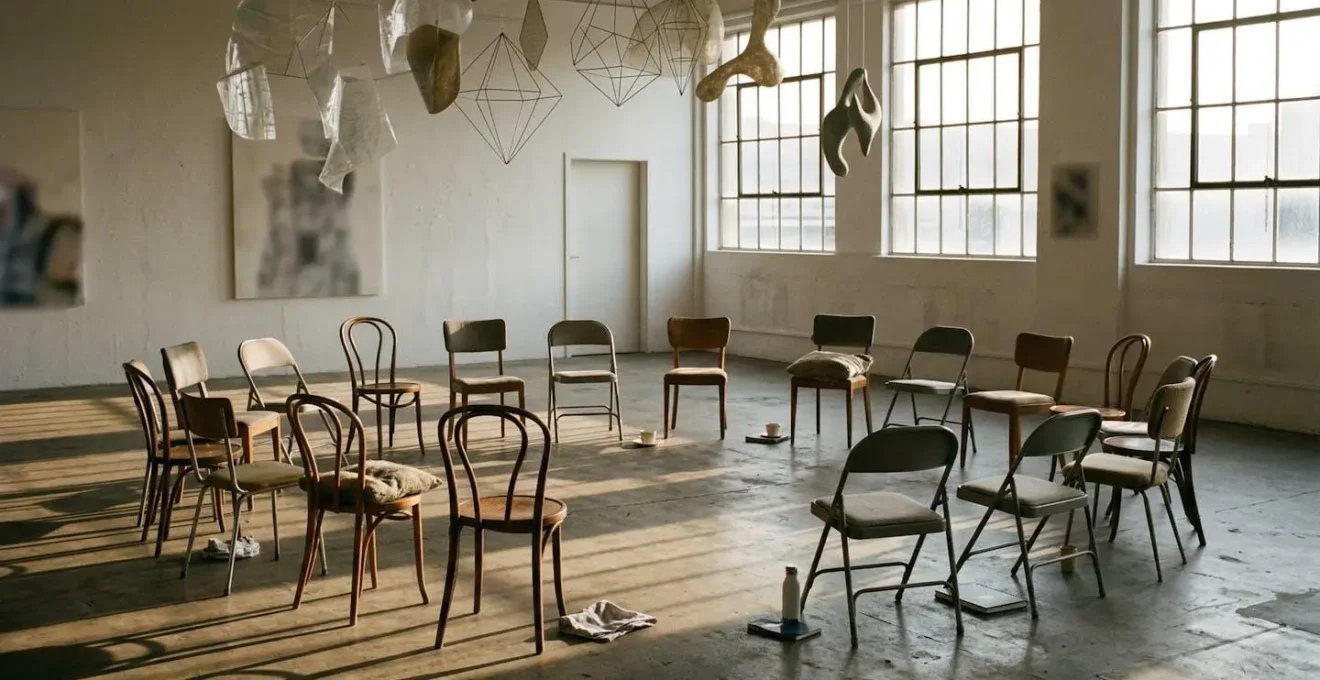
Contrary to the popular view that relational aesthetics is simply about creating pleasant social gatherings like dinners or parties, its true radicalism lies elsewhere. This artistic practice is not primarily about fostering harmony, but about using human interaction as a medium to expose the often-invisible rules, power dynamics, and ethical tensions that govern our social lives. The artwork, therefore, is not the event itself, but the audience’s dawning, and often uncomfortable, self-awareness of their role within a constructed social system.
An artist serves a meal to gallery-goers. Another sets up a space for visitors to talk. A third reenacts a historical protest with local residents. To the uninitiated, and even to many art students and curators, these activities can seem bafflingly mundane, bearing little resemblance to traditional painting or sculpture. This is the central challenge of relational aesthetics: a practice where the artistic material is not clay or paint, but the very fabric of human relationships. The confusion is understandable, as it prompts the fundamental question: if the art is just a social event, where is the “art”?
The term, coined by French curator Nicolas Bourriaud in the 1990s, describes art that takes “the whole of human relations and their social context” as its theoretical and practical point of departure. It moves art from an object to be contemplated to a situation to be experienced. But simply labeling it “participatory art” or “social practice” misses the point. The most common interpretations either celebrate it as a utopian project for mending social bonds or, following critics like Claire Bishop, dismiss it as an ethically dubious practice lacking critical rigor. Both views are too simplistic.
The key to understanding relational aesthetics is to shift the focus. The goal is not necessarily to create a “good” or “nice” experience. Instead, it is to construct a socio-structural frame—a “micro-utopia” or, more provocatively, a “relational antagonism”—that forces participants to become acutely aware of the mechanics of their own interactions. The art doesn’t happen *to* you; it happens *through* you. Your participation, your choices, your comfort or discomfort—that is the substance of the work.
This article will dissect the operational paradoxes at the heart of relational aesthetics. We will explore how to evaluate its impact beyond mere feelings, the ethical tightrope between empowerment and exploitation, the problem of an artwork that vanishes once the event is over, and the financial structures that shape these social encounters. By examining these tensions, we can build a critical toolkit for understanding how this art turns the audience into the exhibit itself.
This guide unpacks the core tensions and critical questions at the heart of relational aesthetics, moving from foundational theory to practical application. The following sections provide a framework for analyzing this often-elusive art form.
Summary: Deconstructing Relational Art from Theory to Practice
- Metrics or Feelings: How to Prove Your Art Project Helped the Community?
- Exploitation or Empowerment: Are You Using the Community for Your Portfolio?
- Documentation vs. Experience: What Is Left After the Event Is Over?
- The “Parachute Artist” Mistake That Alienates Local Residents
- Crowdfunding or Public Grants: Which Funding Model Allows More Freedom?
- Why Interactive Murals Get More Engagement Than Static Posters?
- Universal Museum vs. Source Community: Who Should Own Heritage?
- How Do Satirical Cartoons Threaten Authoritarian Regimes?
Metrics or Feelings: How to Prove Your Art Project Helped the Community?
How does one measure the success of an artwork whose medium is an intangible social bond? This is a primary challenge for curators and artists working in the relational sphere. Traditional art is judged on aesthetics, craft, or market value. A relational project, however, is often justified by its purported social “good.” But proving this impact moves us away from simple quantitative data and toward a more complex, qualitative assessment. While a meta-analysis covering 44 studies confirms that participatory arts can foster social connectedness, this finding only scratches the surface. It tells us *that* something happens, but not *what* or *how*.
The critical question is not “Did people feel good?” but “Were the terms of engagement meaningful and respectful?” This requires a shift from measuring outcomes to evaluating the process itself. The temptation is to rely on attendance numbers, positive survey responses, or media mentions. These metrics are easy to gather but ultimately superficial. They fail to capture the nuances of power, agency, and reciprocity that define an ethical relational encounter. A project can generate positive feelings while still being fundamentally extractive or tokenistic.
A more rigorous approach focuses on the quality of the relationships forged. Artist and professor Helina Metaferia has developed a framework for this kind of evaluation. She advocates for what she calls “metrics of integrity,” emphasizing the participants’ own feelings about the collaborative experience. As she explains in an interview with Artnet News:
Artist and professor Helina Metaferia has developed a rubric for community engaged art: what she calls ‘metrics of integrity.’ The key, she explains, is evaluating how the people you work with to create your work feel about the experience.
– Helina Metaferia, Artnet News interview on social practice art evaluation
This reorients the burden of proof. The success of a relational project is not proven by a report filled with charts, but by the willing, continued, and empowered engagement of its community partners. It is measured in trust built, skills shared, and the collective agreement that the project served the community’s interests, not just the artist’s. The proof is in the relationship itself.
Exploitation or Empowerment: Are You Using the Community for Your Portfolio?
Every relational art project walks a fine ethical line. When an artist uses a community’s stories, presence, or labor to create a work, the potential for exploitation is immense. The artist gains cultural capital, a line on their CV, and institutional validation, but what does the community receive in return? Without a clear framework of consent, collaboration, and shared ownership, participation can quickly become a form of uncompensated labor, and empowerment a guise for appropriation. The very act of framing a social interaction as “art” introduces a power imbalance that must be constantly negotiated.
This paragraph introduces the complex interplay of ethics and power. To better understand this dynamic, the image below visualizes the collaborative yet potentially fraught nature of community-based art.
As the visual suggests, genuine collaboration requires shared agency. The most potent critique of relational aesthetics, articulated by art historian Claire Bishop, targets precisely this issue. She questions the often-unexamined political and ethical nature of the “relations” being produced. In her seminal essay, “Antagonism and Relational Aesthetics,” she poses the crucial question that every artist and curator in this field must confront:
If relational art produces human relations, then the next logical question to ask is what types of relations are being produced, for whom, and why?
– Claire Bishop, Antagonism and Relational Aesthetics, October Journal
Answering this requires an “ethical rubric” for each project. This involves asking difficult questions from the outset. Who initiated the project? Who defines its goals? How are decisions made? Is compensation—financial or otherwise—fairly distributed? Is there a clear process for feedback, dissent, or even withdrawal from the project? Without this self-interrogation, the artist risks treating a community as a raw material, no different from a tube of paint or a block of marble.
Action Plan: Auditing the Ethics of Your Participatory Project
- Initiation and Consent: Identify all points of contact. Was the project invited by the community or proposed by an outsider? Is consent informed, ongoing, and can it be withdrawn?
- Goals and Governance: Collect and inventory all stated goals. Who defined them? How are decisions made? Is there a shared governance structure or does the artist hold ultimate authority?
- Value and Reciprocity: Confront the project’s value proposition. Who benefits (artist, institution, community)? Is the exchange equitable? List all forms of compensation (stipends, skills, visibility, etc.).
- Representation and Authorship: Analyze how the community is represented. Are participants portrayed as active agents or passive subjects? Who is credited as the “author” of the final work?
- Exit Strategy and Legacy: Create a plan for the project’s conclusion. What skills, resources, or relationships will remain in the community after the artist leaves?
Documentation vs. Experience: What Is Left After the Event Is Over?
Relational art is fundamentally ephemeral. A shared meal is consumed, a conversation ends, a temporary structure is dismantled. This presents a deep paradox for the art world, an ecosystem built on the collection, preservation, and exhibition of durable objects. If the artwork is the “experience,” what remains when the experience is over? The default solution is documentation: photographs, videos, testimonials, and ephemera. Yet, this documentation often functions as a poor substitute, a pale artifact of memory that can never capture the multi-sensory and inter-subjective reality of the event itself.
More problematically, documentation can sanitize or misrepresent the work. A photograph of smiling people sharing a meal, for instance, erases any tensions, disagreements, or moments of awkwardness that may have been integral to the actual social dynamic. It presents a neat, marketable image that flattens the complexity of the relational encounter. This is where the critique of the work’s assumed political efficacy becomes most acute. While compelling statistics reveal that 64% of participants in community art projects report a stronger sense of belonging, the documentation rarely explores the quality or contingency of that feeling.
Theorist Claire Bishop argues against the naive acceptance of these social events as inherently positive or democratic. She critiques the comfortable notion of “togetherness” that many relational projects and their documentation seem to promote.
The relations set up by relational aesthetics are not intrinsically democratic, as Bourriaud suggests, since they rest too comfortably within an ideal of subjectivity as whole and of community as immanent togetherness.
– Claire Bishop, Antagonism and Relational Aesthetics
This insight forces us to view documentation with suspicion. It is not a neutral window onto the past event; it is a new object, with its own aesthetic and political agenda. For the curator or student, the critical task is to analyze the gap between the documented artifact and the likely reality of the live experience. The most interesting relational works are often those that acknowledge this gap, either by creating documentation that is intentionally fragmented or by generating non-visual legacies—such as ongoing relationships, new community initiatives, or simply the powerful, un-photographable memory of a shared moment of tension or revelation.
The “Parachute Artist” Mistake That Alienates Local Residents
A common failure in community-based art is the “parachute artist” syndrome. This describes an artist who, often with institutional backing, “drops into” a community for a short period, extracts stories or participation for a project, and then leaves. This approach is rooted in a fundamental misunderstanding of relational aesthetics. It treats the community as a backdrop or a resource, rather than as the very substance of the work. The result is often alienation, resentment, and projects that feel superficial and disconnected from the local reality. It is the antithesis of a practice grounded in genuine relationship-building.
The image below contrasts the idea of a temporary, parachuted-in installation with a more organic, embedded artistic presence that becomes part of the community fabric.
This visual highlights the difference between intervention and integration. True relational work requires time, trust, and a deep, immersive understanding of the social context. The artist must move from being an outsider to becoming, at least temporarily, a part of the social network they wish to engage. This aligns directly with Nicolas Bourriaud’s foundational definition of the practice, which emphasizes the social context as the starting point, not an afterthought.
A set of artistic practices which take as their theoretical and practical point of departure the whole of human relations and their social context, rather than an independent and private space.
– Nicolas Bourriaud, Relational Aesthetics (1998)
Avoiding the “parachute” mistake means prioritizing presence over production. It requires a commitment to what is often called “deep hanging out”—spending significant time in a place without a predetermined agenda, listening, observing, and building relationships before a project is even conceived. This process-based approach ensures that any subsequent artistic action emerges from the genuine needs and desires of the community, rather than being imposed from the outside. The resulting work is more likely to be meaningful, sustainable, and truly collaborative, leaving a positive legacy long after the official project timeline has ended.
Crowdfunding or Public Grants: Which Funding Model Allows More Freedom?
The form of a relational art project is profoundly shaped by its funding. The source of money—be it a state-funded public grant, a private foundation, a university, or a mass-market crowdfunding platform—inevitably influences the “models of action” the art can propose. Each model comes with its own set of expectations, limitations, and ideological baggage. An artist seeking to create a critical or antagonistic work may find themselves constrained by a public grant’s requirement for measurable, positive community “outcomes,” while a crowdfunded project might have to appeal to a populist, easily digestible narrative to attract donors.
The funding landscape is increasingly pushing arts organizations toward social engagement. As research on King County arts organizations which reveals over 4 in 5 have partners outside the arts sector, artists are more frequently asked to work with social services, healthcare, or municipal bodies. This can provide vital resources but also risks turning art into a tool for social engineering, where its aesthetic and critical functions are subservient to a funder’s social agenda. The artist must navigate the tension between fulfilling grant requirements and maintaining the project’s artistic integrity.
Nicolas Bourriaud’s theory posits art as a space for experimenting with new ways of living. This ideal of artistic freedom clashes with the pragmatic realities of fundraising. The central question for the artist and curator becomes: which funding model allows for the most authentic realization of this goal?
The role of artworks is no longer to form imaginary and utopian realities, but to actually be ways of living and models of action within the existing real, whatever scale chosen by the artist.
– Nicolas Bourriaud, Relational Aesthetics theory
There is no simple answer. Public grants can offer stability and legitimacy but may come with bureaucratic oversight and a pressure for consensus. Crowdfunding offers a direct line to an audience but can favor projects that are spectacular or emotionally simple over those that are complex or challenging. Private philanthropy might allow for more risk-taking, but it can also reflect the specific interests and ideologies of the donor. Ultimately, the most “freedom” may come not from a specific model, but from a diversified funding strategy and a transparent, ongoing negotiation with all stakeholders about the project’s true purpose: is it to solve a problem, to create a beautiful experience, or to ask a difficult question?
Why Interactive Murals Get More Engagement Than Static Posters?
The principles of relational aesthetics are not confined to the gallery or the institution; they are increasingly visible in the realm of public art. Consider the difference between a static poster advertising a cultural event and an interactive mural that invites passersby to add their own mark, answer a question, or take a piece of it with them. The latter almost invariably generates more profound and memorable engagement. This is not simply because it is novel; it is because it transforms the passerby from a passive consumer of a message into an active co-author of a public statement.
This dynamic taps into a deep-seated human desire for agency and connection within our shared spaces. Public art that embraces interactivity aligns with the finding that art is valued for its contribution to personal and social health. For instance, according to a 2018 survey, 79% of King County residents value the arts for their personal wellbeing. An interactive mural does more than just decorate a wall; it creates a “social environment,” a micro-site for interaction, however brief. It offers a moment of participation in the civic life of the street, making the urban environment feel less anonymous and more like a shared home.
A static poster operates on a one-way model of communication: it broadcasts a message to an audience. An interactive mural, by contrast, creates a feedback loop. It is a conversation starter. The artist initiates the framework, but the work’s final form is completed by the public’s responses. Each contribution, whether a chalk drawing or a sticky note, becomes a visible trace of a person’s presence and point of view. The mural ceases to be a singular object and becomes a living archive of community sentiment.
This is relational aesthetics in its most accessible form. It demonstrates that the power of participation is not just a high-minded theoretical concept. It is a practical strategy for creating more meaningful and impactful art in the public sphere. It proves that giving the audience a role to play—even a small one—is the most effective way to capture their attention and earn a place in their memory. The engagement is higher because the public is not just looking at the art; they *are* the art.
Universal Museum vs. Source Community: Who Should Own Heritage?
The debate over the ownership and restitution of cultural heritage, often framed as a battle between the “universal museum” and the “source community,” can be powerfully re-examined through the lens of relational aesthetics. The traditional argument centers on the object: who has the right to possess and display it? A relational perspective, however, would shift the question from ownership to activation. The crucial issue is not who owns the artifact, but who has the right and the means to use it to create a living “social environment.”
From this viewpoint, an object of heritage sitting isolated in a glass case in a foreign museum is dormant. Its potential for creating relationships, transmitting memory, and strengthening community identity is muted. It is an object of contemplation for a detached audience. When returned to its source community, however, that same object can be activated through rituals, storytelling, and shared experiences. It becomes the catalyst for the kinds of human relations that Bourriaud identified as the core material of this art form.
The artwork creates a social environment in which people come together to participate in a shared activity.
– Nicolas Bourriaud, Relational art definition
This reframing moves beyond a zero-sum game of possession. It suggests that the value of heritage is not in its physical presence alone, but in its capacity to be performed and experienced collectively. A powerful example of this principle in action is Jeremy Deller’s 2001 project, *The Battle of Orgreave*, which demonstrates how a community can reclaim and embody its own history.
Case Study: Jeremy Deller’s The Battle of Orgreave (2001)
For this project, British artist Jeremy Deller choreographed a large-scale reenactment of the violent 1984 confrontation between striking miners and police. Crucially, he collaborated with around 200 former miners and local residents who had been part of the original event, placing them alongside 800 professional historical reenactors. The project did not just document history; it created a social environment for collective remembrance, catharsis, and intergenerational dialogue. As detailed by The Art Story’s analysis of relational aesthetics, the artwork was the act of coming together, demonstrating how collective memory itself can become a participatory, living medium.
Deller’s work shows that the “source community” is not just the rightful owner of its heritage, but its most expert performer. The question of ownership becomes less about a legal title and more about who is best positioned to reactivate the object’s social power. The universal museum can preserve the object, but the source community can make it live again.
Key Takeaways
- Relational art’s success is not measured by quantitative data but by the qualitative integrity of the relationships it fosters, prioritizing participant agency.
- The practice carries a significant ethical risk of exploiting communities; artists must actively negotiate power, consent, and reciprocity.
- The ephemeral nature of the work means its documentation is not a neutral record but a new, often misleading, artifact that can flatten the complexity of the live experience.
How Do Satirical Cartoons Threaten Authoritarian Regimes?
While a satirical cartoon may seem worlds away from a collaborative dinner, it can function as a potent form of relational aesthetics, particularly in its more antagonistic mode. Its power lies not just in its message, but in its ability to create a “social environment” of dissent. An authoritarian regime relies on maintaining a facade of unified, seamless social consensus. It works to atomize its citizens, fostering a sense of isolation that prevents collective opposition from forming. A widely shared satirical image shatters this illusion. The very act of sharing, laughing at, and discussing the cartoon creates a temporary, clandestine public sphere.
This is where Claire Bishop’s concept of “relational antagonism” becomes crucial. In contrast to Bourriaud’s focus on conviviality, Bishop, drawing on the political theory of Chantal Mouffe and Ernesto Laclau, argues that a truly democratic space is not one of harmony, but one where conflict and dissent can be made visible and articulated. An effective political artwork does not smooth over social divisions, but productively stages them.
Conflict, division and instability do not ruin the democratic public sphere but are conditions of its fully functioning existence.
– Claire Bishop (referencing Laclau and Mouffe), Antagonism and Relational Aesthetics essay
A satirical cartoon is a catalyst for such antagonism. It provides a shared symbol around which a dissident “we” can form, recognizing their shared critique of the ruling power. The laughter it provokes is not just an expression of amusement; it is a political act, a collective rejection of the regime’s authority and seriousness. This model of relational art, which embraces tension, is exemplified by the work of artists like Santiago Sierra.
Case Study: The Antagonism of Santiago Sierra
Spanish artist Santiago Sierra’s practice is a direct challenge to harmonious relational aesthetics. He often hires marginalized individuals to perform grueling or humiliating tasks for pay, such as having a line tattooed on their backs or blocking a museum entrance. His work makes explicit the transactional and often exploitative nature of social and economic relations under capitalism. As noted in an analysis of his practice, Sierra’s work creates sustained tension and unease. It does not offer a utopian escape but instead provides a “more concrete and polemical” ground for rethinking our relationship to the world, forcing the audience to confront their own complicity in the systems being critiqued.
Like Sierra’s provocative actions, a successful satirical cartoon does not aim to create a comfortable “togetherness.” It threatens a regime by creating a relational field of discomfort, ridicule, and shared dissent. It reminds people they are not alone in their opposition, transforming isolated individuals into a potential political force. The art is the spark that illuminates the cracks in the wall of consensus.
By moving beyond the surface-level event, we can begin to evaluate these works with the critical rigor they demand, recognizing that the most profound relational art is that which makes us question the very terms of our own social existence.