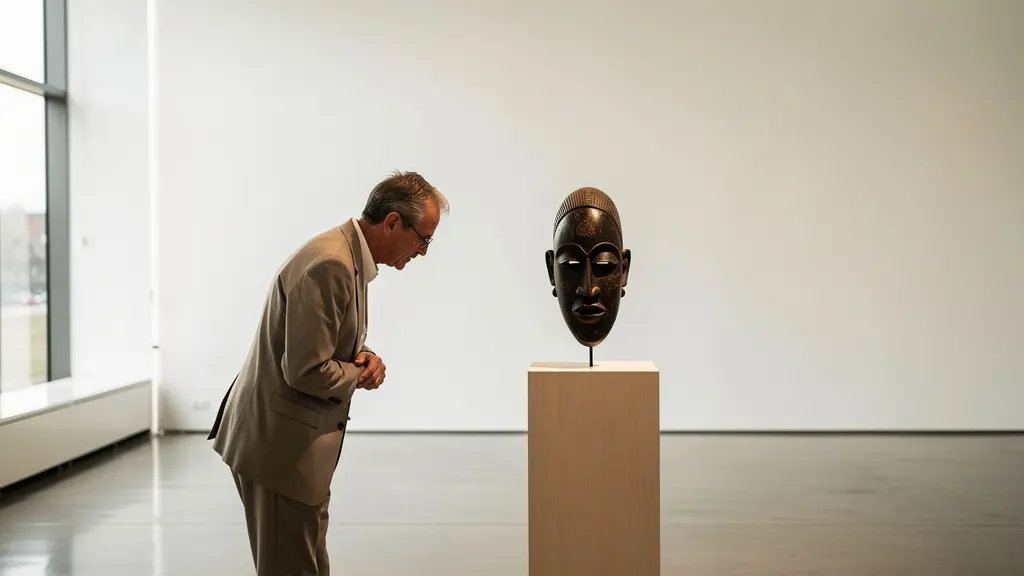
Authentic African mask collecting is not an act of acquisition, but an ethical commitment to becoming a custodian of an object’s cultural and spiritual history.
- Authenticity lies less in aesthetics and more in the verifiable story of the object’s ritual use and its journey from its community of origin.
- Distinguishing a real mask from a copy requires a forensic approach to examining patina, tool marks, and signs of wear.
Recommendation: Shift your mindset from “owner” to “custodian.” Prioritize research and documentation over impulse buys to ensure your collection is both ethical and valuable.
For many aspiring collectors, the allure of an African mask is undeniable. It is a powerful object, radiating a history and aesthetic that can transform a room. Yet, this attraction is fraught with complexity. The market is saturated with forgeries, and the shadow of colonialism and illicit trafficking looms large. To simply acquire a mask for its decorative quality is to miss its essence and potentially participate in a system of cultural erasure. The journey into collecting these pieces is less about what hangs on your wall and more about the responsibility you accept.
Most guides focus on spotting fakes or negotiating prices. They offer simple checklists about looking for wear and tear or buying from “reputable” dealers. But this approach barely scratches the surface. It fails to address the fundamental ethical question: what does it mean to remove a sacred object from its spiritual context? This is where the true work of the conscientious collector begins. It involves a paradigm shift—from seeing oneself as an owner to becoming a temporary custodian of an object’s biography.
This guide moves beyond superficial advice. We will explore the nuanced world of ethical provenance, forensic authentication, and responsible display. By embracing a framework of custodianship, you will not only build a collection of authentic and meaningful pieces but also honor the cultures and artists who created them. This is the path from being a mere buyer to becoming a respected guardian of cultural heritage.
To navigate this complex field, this article provides a structured framework. We will delve into the ethics of display, the science of authentication, the legal pitfalls to avoid, and the profound difference between true craftsmanship and mass production.
Summary: A Guide to Responsible African Art Collection
- Why Is Hanging a Ritual Mask on a Wall Controversial for Some?
- How to Distinguish a Used Ritual Mask From a Tourist Copy?
- Natural Patina vs. Artificially Aged Wood: Which Tells the Truth?
- The Legal Mistake That Can Get Your African Art Seized at Customs
- How to Protect Wood and Raffia Masks From Humidity and Pests?
- Why Context Matters When Displaying Sacred Cultural Artifacts at Home?
- Craft or Fine Art: How Different Cultures Draw the Line Differently?
- How to Distinguish True Craftsmanship From Mass Production in Art Objects?
Why Is Hanging a Ritual Mask on a Wall Controversial for Some?
The act of mounting a ritual mask on a living room wall is the final step in a process some call “spiritual decommissioning.” For the cultures of origin, these are not static art objects; they are dynamic instruments of spiritual power. As TheCollector Art Magazine notes, “African masks are primarily spiritual objects that are made to be used, not displayed as art.” Their purpose is fulfilled through performance—in dance, in ceremony, in rituals that connect the community to ancestors, spirits, or natural forces. To hang one on a wall is to fundamentally alter its identity, reducing it from a functional sacred tool to a purely aesthetic artifact.
This transformation is at the heart of the controversy. For many, it represents a profound disconnection from the object’s intended purpose and spiritual energy, or ‘Ashe’ in Yoruba culture. A mask was meant to be worn by a moving, breathing performer, seen in the specific context of a masquerade, accompanied by music and community participation. When isolated and inert on a wall, it is stripped of this performative life. For an ethical collector, understanding this is crucial. It means acknowledging that you are the custodian of a decontextualized object and have a responsibility to preserve the memory of its original function.
The controversy does not mean collecting is inherently wrong. Rather, it calls for a higher level of awareness and respect. The ethical collector understands that the mask had a life before entering their collection. Displaying it becomes an act of storytelling, not just decoration. The goal is to honor its past life, to educate oneself and others about its ceremonial role, and to treat the object not as a trophy, but as an ambassador for the culture that created it. This respectful mindset is the first and most important step in authentic collecting.
How to Distinguish a Used Ritual Mask From a Tourist Copy?
The difference between a mask that has danced in ceremonies and one carved for the tourist market is written in its material history. A forensic approach is required, focusing on evidence that cannot be easily faked. Tourist copies are often artificially aged, but they miss the specific wear patterns that result from authentic use. An authentically used mask carries an “object biography” inscribed through its interaction with a human body and the elements of a ritual performance. Think like an investigator looking for irrefutable proof.
Authentic use leaves a trail of specific evidence. Look for signs of contact with the wearer’s face, such as oil and sweat stains from the forehead and nose on the inside, or even spittle stains around the mouth opening. The holes used to attach raffia costumes or secure the mask to the head often show slight abrasions and wear. In contrast, mass-produced masks are often uniformly “aged” with colored palm oil or shoe polish, and the back is artificially darkened to simulate age, whereas genuinely old masks often have lighter, untreated wood on the interior. The carving itself is a major clue: master carvers achieve a dynamic balance with deep, confident undercuts, showing a mastery of the material. Tourist pieces are frequently “flat,” with thick, timidly carved features that lack volume and vitality.
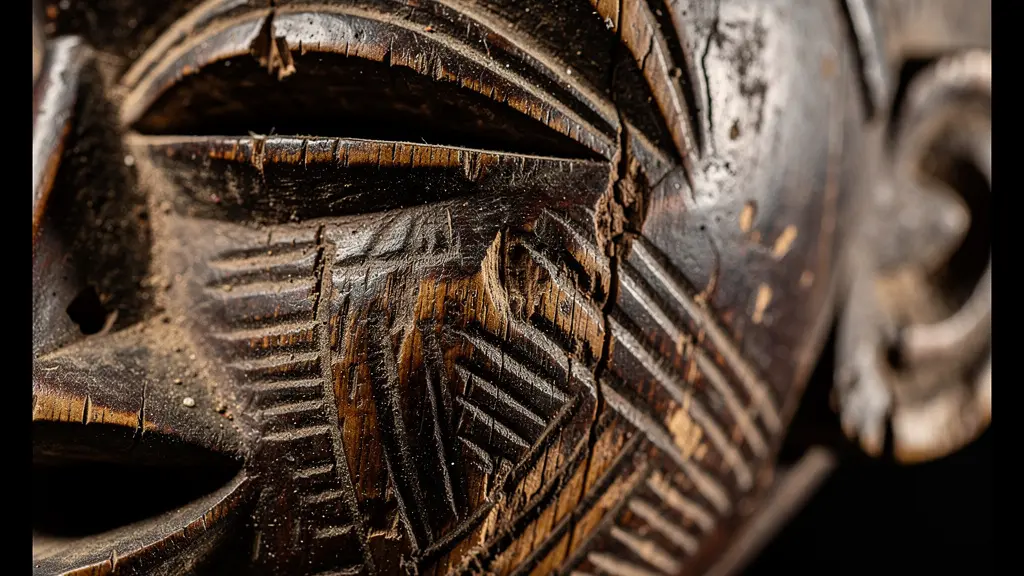
This macro view of a mask’s surface reveals the story. You are looking for the subtle, rhythmic patterns of a traditional adze, not the sterile, smooth finish of modern power sanders. The patina should be layered and complex, built up over years of handling and exposure, not a uniform, single-layer coat of stain. This detailed examination is your most powerful tool against forgery.
Forensic Checklist: Identifying Authentic Masks
- Examine wear patterns: Look for patina from sweat on the inside and handling on the outside in logical places.
- Inspect wood oxidation: Cracks should contain aged, dust-filled wood, not fresh, white wood.
- Perform a smell test: Truly old masks (30+ years) lose their distinct wood scent; artificial agers often have chemical or polish odors.
- Analyze tool marks: Identify the rhythmic, concave marks of a traditional adze versus the flat, sterile surface left by power tools.
- Assess patina consistency: Authentic patina is layered and varied, not a uniform, painted-on coat.
Natural Patina vs. Artificially Aged Wood: Which Tells the Truth?
Patina is the soul of an antique object, a delicate accumulation of history, handling, and environment. In African art, it is one of the most critical—and most frequently faked—indicators of authenticity and age. A natural patina tells the truth about an object’s life, while an artificial one tells a story of deception. Understanding the difference is not just an academic exercise; it has immense financial implications. The value of a genuinely old and used mask can be astronomical, as evidenced when a Double Baulé Nda Mask from Ivory Coast sold for €6,605,000 at Christie’s. This value is directly tied to its authenticated, natural patina.
An authentic patina is a complex surface built up over decades. It’s composed of layers of oils from human hands, sacrificial materials, smoke from ceremonial fires, and fine dust that has settled into the wood’s grain. It is never uniform. It will be darker and thicker in crevices, smoother and more worn on high points that were frequently touched. An artificial patina, by contrast, is an application. It’s a single layer of paint, shoe polish, motor oil, or stain applied to make a new carving look old. It often has a consistent, even finish and may have a tell-tale chemical smell. One of the clearest giveaways is damage: if a chip or crack reveals fresh, light-colored wood underneath, the “aging” is almost certainly fake.
The following table breaks down the key characteristics to help you distinguish between a history earned over time and a history that has been manufactured for the market. Scrutinizing these details is a core skill for any serious collector.
| Natural Patina | Artificial Aging |
|---|---|
| Layered buildup over time | Uniform application |
| Varied in different areas based on use | Even distribution across surface |
| Fills crevices naturally | Applied with shoe polish or motor oil |
| No chemical smell | Detectable chemical odors |
| Patina over traditional tool marks | Aging mixed with carving marks |
| Oxidized wood in cracks | Fresh wood visible in damaged areas |
The Legal Mistake That Can Get Your African Art Seized at Customs
Beyond authenticity, the single greatest risk for a collector is navigating the complex web of international and national laws governing cultural property. The most significant legal framework is the 1970 UNESCO Convention on the Means of Prohibiting and Preventing the Illicit Import, Export and Transfer of Ownership of Cultural Property. The critical mistake a collector can make is assuming that a “private sale” exempts them from these laws. It does not. If a mask was illicitly removed from its country of origin after that country ratified the convention, it can be seized by customs and you could face legal consequences, regardless of whether you purchased it in good faith.
This international treaty is not just a symbolic document. As of early 2025, the 1970 UNESCO Convention has been ratified by 147 states, creating a global network for the protection and repatriation of cultural artifacts. Countries enact this treaty through their own national laws and bilateral agreements, which have real teeth. A collector must be diligent about an object’s “ethical provenance”—its complete ownership history, from its creation to the present day. You must have documentation proving it was legally exported from its country of origin or that it was outside its country of origin before the convention was enacted.

The goal of ethical collecting is to build a collection that could stand up to the scrutiny of a museum curator. This means prioritizing objects with clear, documented provenance. Without this paper trail, you are not only risking the seizure of your art but are also potentially supporting the black market that continues to strip Africa of its cultural heritage.
Case Study: The US-Nigeria Cultural Property Agreement
In January 2022, the United States and Nigeria signed a significant bilateral cultural property agreement. This pact directly implements the 1970 UNESCO Convention by giving U.S. customs authorities the power to enforce Nigerian export restrictions. Under this agreement, any undocumented Nigerian artifact that appears on a protected list is subject to seizure upon import into the U.S. This demonstrates how international frameworks are actively enforced, creating clear legal lines and severe penalties for collectors who ignore provenance, while protecting those who adhere to the law.
How to Protect Wood and Raffia Masks From Humidity and Pests?
Once you have ethically acquired an authentic mask, your role as a custodian truly begins. These are not inert objects; they are made of organic materials like wood, raffia, fiber, and natural pigments that are vulnerable to the environment. The primary threats are fluctuations in humidity, pests, and light exposure. Your first duty is to create a stable and controlled environment. Avoid displaying masks in bathrooms, kitchens, or near windows and heat sources. Extreme changes in temperature and humidity cause wood to expand and contract, leading to cracks and pigment loss.
Pest control is another critical responsibility. Wood-boring insects can turn a masterpiece into dust. However, using chemical insecticides can cause irreversible damage to the delicate patina and fibers. The museum-grade approach is anoxic treatment, which involves placing the object in a sealed bag and removing the oxygen, safely suffocating any pests without chemicals. For handling, always use clean, dry hands or cotton gloves to prevent the transfer of oils that can stain and degrade the surface over time. As expert dealer David Norden advises, preservation is often about what you *don’t* do.
Stay away from harsh cleaning products or water—many pieces have a natural finish or patina that’s best preserved by avoiding chemical treatments.
– David Norden, Buy African Antiques
Finally, create a condition report for each piece. Take detailed photographs from all angles and note any existing cracks, insect holes, or areas of fragility. This baseline document will allow you to monitor for any changes over time and intervene before minor issues become major damage. This diligent practice of preventative conservation is the ultimate expression of responsible custodianship, ensuring the object’s survival for future generations.
Why Context Matters When Displaying Sacred Cultural Artifacts at Home?
Displaying a sacred artifact is an act of translation. You are taking an object from a rich, dynamic ceremonial context and placing it into a static, domestic one. How you manage this translation determines whether your display is respectful or merely decorative. Context is everything. Placing a powerful Dan mask next to a generic decorative vase trivializes its history and spiritual significance. The goal of a custodian is to create a display that honors the object’s original purpose and provides a window into its cultural world.
This means going beyond simply hanging it on a wall. An ethical display provides context that educates the viewer. A simple, museum-quality label detailing the people who created it (e.g., Baule, Igbo), the region, its ceremonial function (e.g., harvest festival, funerary rite), and the materials used can transform the viewing experience. It shifts the focus from “what a beautiful object” to “what a fascinating story.” This approach turns your home into a private micro-museum, a space for learning and reflection rather than just aesthetic appreciation.
The Minneapolis Institute of Art provides an excellent model for collectors. For their African art exhibits, they not only provide detailed labels but also use digital companions like QR codes that link to academic resources or videos of similar masks in use. This multi-sensory approach helps restore some of the lost context. As a private collector, you can adopt this “curator-collector” model. Dedicate a specific wall or corner to your collection, giving each piece breathing room. Create a digital folder for each mask with your research, provenance documents, and links to relevant academic papers or videos. When you have guests, you can share not just the object, but its story, thereby fulfilling your role as an educator and a true custodian of culture.
Craft or Fine Art: How Different Cultures Draw the Line Differently?
In the Western art market, the line between “craft” and “fine art” is often drawn based on originality, aesthetic innovation, and the artist’s intent to create a unique visual statement. However, applying this framework to traditional African masks is a categorical error. In many African cultures, the value of a mask was not in its originality but in its spiritual effectiveness and its adherence to established tradition. A carver’s skill was judged by their ability to faithfully reproduce a sacred form that was known to be powerful and effective in ritual, not by their ability to invent a new one.
This fundamental difference in value systems is where many collectors misunderstand the objects they acquire. The Western concept of the individual “artist” as a singular genius is often secondary to the role of the master craftsman working within a community lineage. The elevation of African masks to “fine art” in the West was largely initiated in the early 20th century by artists like Pablo Picasso, who were captivated by their powerful abstract forms. This “discovery” transformed them from ethnographic artifacts into high-value commodities in galleries, a shift that fundamentally altered their cultural and market categorization.
As a collector, it’s vital to recognize these two parallel value systems. The mask in your collection exists in both worlds simultaneously. For the community that created it, its power might lie in its ritual function. For the art market, its value might lie in its visual impact and provenance. The following table highlights this cultural divide, which is essential for any collector to understand.
| African Traditional View | Western Art Market View |
|---|---|
| Spiritual effectiveness (Yoruba ‘Ashe’) | Aesthetic originality |
| Adherence to tradition | Individual artistic expression |
| Ritual functionality | Visual impact |
| Community ownership | Private collection value |
| Sacred power object | Fine art investment |
| Master craftsman lineage | Artist signature/attribution |
Key Takeaways
- Ethical collecting prioritizes an object’s story and cultural context over its aesthetic appeal.
- Authenticity is proven through forensic examination of wear, tool marks, and natural patina, not just appearance.
- Collectors are custodians responsible for the legal provenance, conservation, and respectful display of cultural artifacts.
How to Distinguish True Craftsmanship From Mass Production in Art Objects?
Ultimately, the most profound difference between an authentic ritual object and a mass-produced tourist item lies in the hands that made it. True African carving is not a hobby; it is a highly respected skill passed down through generations. As noted by Contemporary African Art, master carvers undergo years of specialized apprenticeship until they achieve a level of mastery that is deeply revered within their community. This tradition of generational knowledge is embedded in the final object, and a trained eye can see it.
Mass-produced objects, often made in workshops with modern tools, prioritize speed and quantity. The carvings are often shallow, hesitant, and lifeless. They lack the “dynamic balance” and virtuosity of a master’s work. A master carver has an intimate understanding of the wood and works with it, not against it. They use traditional tools like the adze, which leaves a distinctive, rhythmic pattern of slightly concave marks—a signature of hand-carving. Power sanders used in mass production create a sterile, uniform smoothness that erases all traces of the human hand.
Look for signs of virtuosity. Are the features deeply undercut, creating dramatic shadows and a sense of volume? Are the walls of the mask confidently thin, showing a mastery of the material? Minor asymmetries and imperfections are not flaws; they are the signatures of handmade work. A mass-produced object is often perfectly symmetrical and sterile. True craftsmanship celebrates the vitality of the material and the skill of the artist. By learning to recognize these signs of mastery—the tool marks, the confident forms, the anatomical care—you are not just authenticating an object; you are paying tribute to a lineage of artistic genius.
By embracing the principles of ethical provenance, forensic analysis, and respectful custodianship, you transform the act of collecting. It becomes a meaningful engagement with global cultures, a preservation of artistic history, and a personal journey of learning. The ultimate goal is not to possess, but to understand and protect.