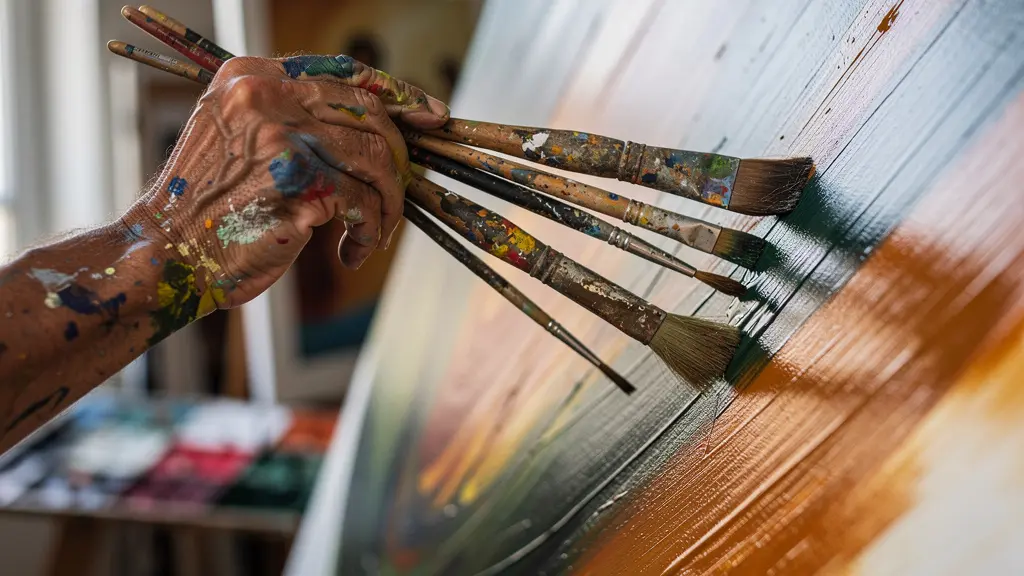
The solution to a generic painting style isn’t found in buying more brushes, but in mastering the intentional, physical rhythm of your mark-making.
- Expressive brushwork creates a direct emotional connection with the viewer through a process called kinesthetic empathy.
- Developing a signature style involves conscious choices about texture, speed, and pressure, turning every stroke into a deliberate decision.
Recommendation: Shift your focus from merely depicting a subject to conveying an emotion through the energy and texture of each brushstroke.
If you’re an intermediate painter, you might know the frustration. Your technical skills are solid—you can mix colors, understand perspective, and render a subject accurately. Yet, when you step back, the work feels… stiff. It looks like a painting, but it lacks a soul, a distinct voice that makes it unmistakably yours. Many artists believe the solution is to simply “practice more” or to “copy the masters,” but this often leads to more imitation, not innovation.
The problem isn’t a lack of skill, but a disconnect between your internal feeling and your external mark. You might have a vast collection of brushes and paints, but your work still feels generic. The truth is, a signature style isn’t something you find; it’s something you build. It’s a physical language developed through conscious, deliberate practice where every stroke carries intent and emotion.
But what if the key wasn’t in the tools themselves, but in how you physically and mentally approach the canvas? This guide will reframe your approach to brushwork. We won’t just list techniques; we’ll explore the ‘why’ behind them. We will delve into how to translate your inner rhythm into visible energy, how to make your breath a tool for fluidity, and how to use color to amplify the emotional story your brushstrokes are telling. It’s time to stop painting what you see and start painting how you feel.
This article provides a structured path to discovering your unique artistic voice. We will explore the psychological impact of your marks, the specific tools for texture, and the physical rhythms that transform a competent painter into a memorable artist.
Summary: Developing a Recognizable and Expressive Painting Style
- Why Does Aggressive Brushwork Convey More Emotion Than Smooth Blending?
- Hog Bristle or Sable: Which Brush Creates the Texture You Need?
- Thick Impasto or Thin Glaze: Which Technique Builds More Depth?
- The Over-Blending Habit That Makes Painting Look Like Plastic
- When to Paint Fast vs. When to Paint Slow for Maximum Impact?
- How to Synchronize Your Breathing With Your Brush for Fluid Lines?
- Why Do Impressionist Shadows Look Blue Instead of Black?
- How to Use Color Theory to Evoke Specific Emotions in Your Viewers?
Why Does Aggressive Brushwork Convey More Emotion Than Smooth Blending?
A perfectly smooth, blended surface shows technical skill, but it hides the artist’s hand. It erases the story of its own creation. Aggressive, visible brushwork, in contrast, is a record of energy, movement, and decision. When a viewer looks at a painting with dynamic marks, they don’t just see an image; they feel the action that created it. This phenomenon is known as kinesthetic empathy, a subconscious mirroring of the artist’s physical gestures.
The brain of the viewer simulates the movements required to make those strokes. A fast, energetic slash of paint feels exciting, while a soft, dabbed mark feels calm. This is why a signature style is so powerful. It’s not just a visual quirk; it’s an emotional broadcast. According to recent neuroscience research, over 87% of viewers report experiencing motor-sensory resonance when looking at paintings with dynamic brushwork. They are, in a sense, re-living the act of painting.
Case Study: Van Gogh’s Nervous Energy
Consider the paintings of Vincent van Gogh. His signature style is defined by its “nervous energy.” The thick, choppy strokes on a face or the swirling, busy brushwork in a sky are not just stylistic flair; they are a direct transmission of his emotional state. An analysis of his work reveals that these features “produce affect in spectators,” creating a powerful and direct emotional connection that transcends the subject matter itself. The viewer feels the urgency and intensity because the evidence of it is baked into the paint.
By leaving your marks visible, you invite the viewer into the process. You are sharing not just a final image, but the very energy you invested in its creation. Smooth blending creates a window to another world; expressive brushwork makes the canvas itself the world.
Hog Bristle or Sable: Which Brush Creates the Texture You Need?
Your brush is not just a tool for applying paint; it’s the primary instrument for creating your textural vocabulary. Many intermediate painters own dozens of brushes but only use them to fill in shapes. To develop a signature style, you must think of each brush as having its own unique voice. The choice between a coarse hog bristle and a fine sable is not about “good” or “bad” but about intent. Are you aiming for raw, visible energy or refined, quiet detail?
A hog bristle brush is stiff and rugged. It picks up a lot of paint and leaves distinct, grooved marks. It’s the perfect tool for creating impasto effects and conveying a sense of immediacy and force. A sable brush, by contrast, is soft and flexible. It holds a fine point, allows for smooth blending, and creates a seamless surface. It speaks of control, precision, and delicacy. Mastering a signature style involves knowing when to shout with a hog bristle and when to whisper with a sable.
This macro photograph shows the distinct physical differences in brush types. The coarse, uneven nature of the hog bristle on the left contrasts sharply with the fine, uniform sable, highlighting how each tool is designed to leave a unique textural imprint on the canvas.
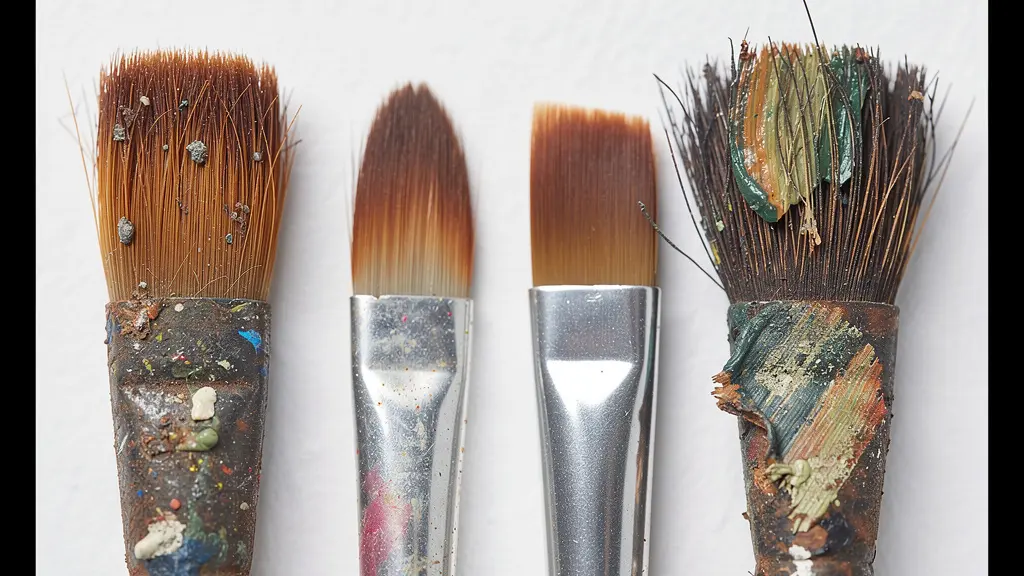
As the image demonstrates, the physical structure of the brush directly translates into the texture of your mark. To build your signature, you must build a library of marks. Spend time with each brush, not to paint a picture, but simply to see what kind of marks it can make. Drag it, stipple with it, twist it. The table below, based on an analysis of brush types, can serve as your guide.
| Brush Type | Best For | Texture Created | Control Level |
|---|---|---|---|
| Hog Bristle | Impasto, rough textures | Visible brush marks, character | Lower control, more ‘accidents’ |
| Sable | Fine details, smooth blending | Smooth, refined surfaces | High precision control |
| Synthetic Flat | Bold blocks of color | Sharp edges, clean shapes | Medium control |
| Fan Brush | Natural textures | Organic, scattered marks | Variable control |
Thick Impasto or Thin Glaze: Which Technique Builds More Depth?
Depth in a painting is not just about linear perspective; it’s about physical and optical presence. Two opposing techniques, impasto and glazing, offer different paths to achieving this. Your preference between them will become a cornerstone of your signature style. Impasto is the technique of applying paint so thickly that it stands out from the surface, creating a three-dimensional texture. This physical depth catches light and creates real shadows on the canvas itself.
Impasto involves applying thick layers of paint to create textured surfaces that stand out from the canvas. Vincent van Gogh was a master of this technique, using it to give depth and three-dimensionality.
– Ying McLane, Mastering the Art of Oil Painting Brush Strokes
On the other end of the spectrum is glazing and its cousin, scumbling. Glazing involves applying thin, transparent layers of paint over a dry underpainting, creating depth through light and color. Scumbling is similar but uses a thin, opaque layer applied with a dry brush, allowing parts of the color below to show through. These techniques create an optical depth—a luminous, atmospheric quality where light seems to emanate from within the painting.
Case Study: Rembrandt’s Luminous Scumbling
Rembrandt was a master of creating depth with minimal means. In works like ‘Self-Portrait with Two Circles,’ he used scumbling to achieve a subtle, mysterious play of light. By dragging a thin, light, opaque layer of paint over darker dried areas, he created soft transitions and an ethereal effect. This shows that depth isn’t always about adding physical mass; it can be about letting light travel through and reflect off of multiple, delicate layers.
The choice is fundamental: do you want your painting to have a physical, sculptural presence (impasto), or an atmospheric, luminous one (glazing and scumbling)? Experimenting with both will reveal which method resonates most with the emotions you want to convey.
The Over-Blending Habit That Makes Painting Look Like Plastic
One of the most common habits holding intermediate painters back is over-blending. Driven by a fear of making a “wrong” mark or a desire for photorealistic smoothness, artists endlessly fuss over transitions until all energy is gone. The result is a sterile, plastic-like surface where every stroke has been polished into oblivion. This habit kills your signature style before it has a chance to be born. A signature is built from confident, deliberate marks, not from hesitant fiddling.
Breaking this habit requires a mental shift from “correcting” to “committing.” You must learn to trust your initial stroke and let it live. Each mark, even if imperfect, has more character and energy than a flawlessly blended gradient. An authentic creative voice requires persistence and the courage to let go of control. As one artist who transitioned from digital to physical media notes, the process itself is a lesson in commitment.
I’ve abandoned creative projects when they didn’t get immediate results. But I’ve committed to staying with this work because authentic creative expression requires persistence through the tough parts. Painterly style teaches the same lesson. When you make a loose brushstroke that doesn’t look ‘right,’ you don’t abandon the painting.
To build this confidence, you need a structured exercise that forces decisiveness. The following plan is designed to retrain your brain and hand to make bold, committed strokes and resist the urge to blend.
Your Action Plan: The 5-Stroke Rule Exercise
- Choose a simple subject like an apple or a cube.
- Load your brush with a generous amount of paint—no thinning allowed.
- Render the entire form using exactly five deliberate, distinct strokes.
- Resist the powerful urge to blend, smooth, or “correct” the strokes. Let each one stand as a statement.
- Repeat this exercise daily with different simple subjects to build confidence in decisive mark-making.
When to Paint Fast vs. When to Paint Slow for Maximum Impact?
Developing a signature style is also about mastering rhythm. It’s not about always painting fast for a “loose” style or always painting slow for “realism.” It’s about knowing when to use each speed for maximum impact. A dynamic painting often contains a mix of both: broad, energetic areas laid down quickly and small, focal points rendered with slow, deliberate precision. This contrast creates visual interest and guides the viewer’s eye.
A useful guideline is the 80/20 rhythm rule. Analysis shows that in many professional paintings, roughly 80% of the painting’s area is executed with speed and economy, establishing the overall composition, values, and color harmony. This is the “block-in” stage, where energy and gesture are paramount. The remaining 20% of the effort is spent on slow, precise work in the focal areas—the highlight in an eye, the sharp edge of a collar, the most saturated color note. This is where you slow down and place your marks with surgical care.
This approach prevents you from getting bogged down in detail too early and ensures the final painting retains a sense of life and spontaneity. The fast, broad strokes provide the music, while the slow, careful marks provide the lyrics. Your signature style will emerge from how you balance these two rhythms. Do you favor bold, gestural canvases with only a tiny point of focus, or do you prefer highly rendered works with just a few areas of loose, suggestive brushwork?
Varying the pressure within a single stroke is another way to control rhythm. Starting a stroke with heavy pressure and gradually lightening it creates a mark that is both bold and delicate, full of dynamic energy. This level of control turns your brush into a truly expressive instrument.
How to Synchronize Your Breathing With Your Brush for Fluid Lines?
The ultimate source of rhythm in your painting is your own body. Often, a shaky, hesitant line is not a failure of the hand, but a reflection of shallow, anxious breathing. To achieve truly fluid and confident brushwork, you must connect the movement of your brush to the cadence of your breath. This is a practice used by masters in fields from calligraphy to martial arts, and it is profoundly effective for painters.
When your breath is calm and steady, your body is relaxed, and your arm can move freely from the shoulder, producing long, graceful strokes. When you hold your breath or breathe erratically, your body tenses, and you begin to “draw” with your wrist, resulting in tight, controlled, and lifeless marks. As artist Katie Swatland explains, this connection is fundamental.
Every painting is built one brushstroke at a time and one breath at a time—with the rise and fall of each breath corresponding to the movement of the brush. The connection of the breath with the brush holds great power. When I run into trouble, I can trace it back to my breath becoming shallow.
– Katie Swatland, Brushwork and the Breath
To turn this concept into a practical tool, you can practice a simple “Breathing Kata” for artists. Before you even touch the canvas, stand for a moment and focus on your breath. The exercise is simple: inhale slowly while you mix and load your color. Pause for a second at the top of the breath, visualizing the mark you intend to make. Then, exhale completely and steadily as you execute the single, fluid brushstroke. Pause again before the next cycle. This practice transforms painting from a series of anxious dabs into a calm, meditative dance.
Practicing this for just a few minutes each day builds powerful muscle memory. It synchronizes your mind, body, and brush, making fluid, confident lines a natural extension of your physical rhythm rather than a forced effort.
Why Do Impressionist Shadows Look Blue Instead of Black?
Your brushwork signature is defined by your marks, but it is amplified by your color choices—especially in the shadows. Many intermediate painters instinctively reach for black or grey to darken an area, which can lead to dull, lifeless shadows. The Impressionists offered a revolutionary alternative: they painted what they *saw*, not what they *knew*. They observed that shadows on a sunny day are not devoid of color; they are filled with the reflected light of the blue sky.
This is why Impressionist shadows often have a blue or violet tint. By using a cool color for the shadow instead of a neutral dark, they achieved a look that was more vibrant, airy, and true to life. This choice—to paint shadows with color—is a powerful element of a signature style. It infuses the entire painting with light and atmosphere. A blue shadow feels cool and fresh, while a deep umber shadow feels warm and earthy. Neither is “correct,” but your consistent choice helps define your artistic voice.
This decision places you within a historical tradition of “shadow philosophy.” Your approach to shadows says a lot about the mood you want to create. Are you a Tenebrist like Caravaggio, using deep, dramatic darks for intense mystery? Or are you a Luminist like Monet, using colored, atmospheric shadows to create an optimistic, airy feel? The table below compares these approaches.
| Approach | Shadow Treatment | Emotional Impact | Master Example |
|---|---|---|---|
| Luminist | Colored, atmospheric | Optimistic, airy | Monet |
| Tenebrist | Deep, dramatic darks | Mysterious, intense | Caravaggio |
| Impressionist | Blue/purple tints | Vibrant, lively | Renoir |
| Realist | Neutral grays | Objective, calm | Courbet |
Choosing your shadow philosophy is a key step. It moves your color choices from reactive mixing to a proactive, stylistic decision that supports the emotional tone of your brushwork.
Key Takeaways
- A signature style is born from deliberate, conscious mark-making, not from a specific tool or technique.
- Visible brushwork creates an emotional connection (kinesthetic empathy) by allowing viewers to feel the artist’s creative energy.
- Mastering a few brushes and understanding their textural vocabulary is more effective than using many superficially.
How to Use Color Theory to Evoke Specific Emotions in Your Viewers?
Your brushwork provides the energy, but your color palette provides the emotion. A signature style reaches its full potential when your marks and your colors work in harmony. As Renee Phillips notes, “We all recognize a painting by Vincent van Gogh because of his signature style characterized by intense brushwork and expression.” That expression is a marriage of his frantic, thick strokes and his bold, often non-naturalistic color choices. The two are inseparable.
Using color theory to evoke emotion goes beyond the simple “blue is sad, yellow is happy.” It’s about creating a cohesive color harmony that supports the story you’re telling. Here are three key strategies:
- Dominant Temperature: Does your painting feel predominantly warm (reds, oranges, yellows) or cool (blues, greens, violets)? A warm-dominant palette can feel energetic, passionate, or comforting, while a cool-dominant palette can feel calm, melancholic, or distant. Your consistent preference for one over the other is a powerful stylistic marker.
- Saturation as Emphasis: A common mistake is to make everything in a painting equally bright. A more sophisticated approach is to use saturation strategically. You can create a largely desaturated, near-monochromatic painting and use a single, small area of pure, saturated color as a powerful focal point. This control over color intensity demonstrates confidence and intent.
- Analogous vs. Complementary Harmony: An analogous color scheme (using colors next to each other on the color wheel, like blue and green) creates a sense of peace and unity. A complementary scheme (using opposite colors, like blue and orange) creates high contrast, tension, and visual excitement. Your choice will dramatically alter the mood of your work, regardless of the subject.
Think of your color palette as the soundtrack to your painting. Your energetic brushwork might be a fast-paced drumbeat, but is the soundtrack a triumphant orchestral score (bright, complementary colors) or an introspective piano piece (muted, analogous colors)? When your color choices become as deliberate as your brushstrokes, your signature style solidifies into an unmistakable artistic voice.
Now that you understand the individual components—from the psychology of the mark to the rhythm of your breath and the emotion of color—the final step is integration. Developing a signature style is a journey, not a destination. It’s about committing to a process of deliberate, mindful practice where every painting is an opportunity to strengthen your unique voice. Begin today by choosing one exercise from this guide and making it a consistent part of your routine.