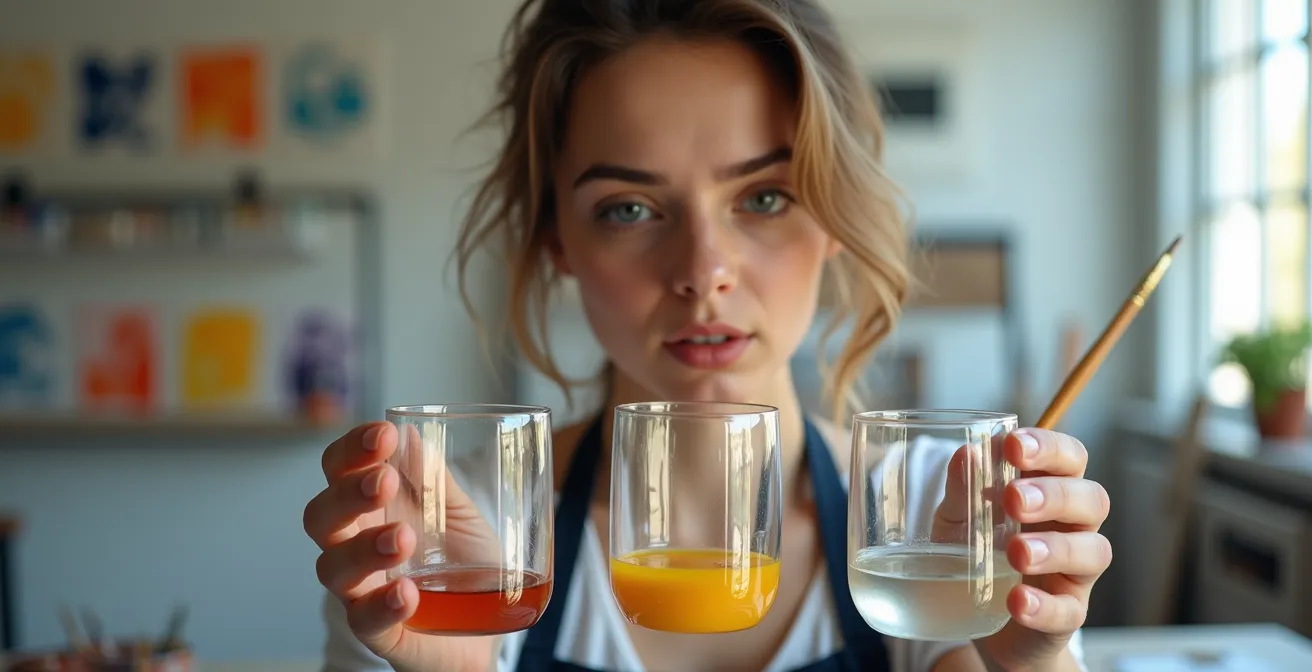
The right paint for you goes beyond technical properties; it’s about finding a creative partner that matches your personal workflow and lifestyle.
- Oils offer slow-drying forgiveness for patient, methodical painters but require specific safety and layering knowledge.
- Acrylics provide fast-drying versatility for spontaneous, decisive artists, and are ideal for travel and quick studies.
- Watercolors demand a minimalist approach and reward those who embrace transparency and unpredictability.
Recommendation: Assess your patience, available workspace, and travel habits first. This will narrow your choice more effectively than any technical comparison.
Walking into an art supply store for the first time is a rite of passage, but it can also be overwhelming. Rows of oils, acrylics, and watercolors gleam under the lights, each promising a world of creative possibility. Most guides will tell you the basics: oils are slow, acrylics are fast, and watercolors are tricky. This advice, while true, misses the most crucial factor in your decision: your own personality. The choice isn’t just about paint; it’s about finding a medium whose inherent characteristics—its “workflow DNA”—resonate with your own.
You might think the decision hinges on what you want to paint, but it’s more about how you want to paint. Are you a meticulous planner or a spontaneous creator? Do you have hours to lose yourself in a piece, or do you need to work in short bursts? Do you value the ability to endlessly correct, or do you thrive on decisive marks? The common wisdom often simplifies the debate to toxicity or drying times, but modern innovations like water-mixable oils have changed the game entirely.
This guide reframes the question. Instead of asking “Which paint is best?” we will ask, “Which paint is best for me?” We will move beyond surface-level comparisons to explore how each medium aligns with different temperaments, lifestyles, and even long-term goals. By understanding the practical footprint and material empathy required for each, you won’t just choose a tube of paint; you’ll choose a true creative partner for your artistic journey.
This article will delve into the practical realities of each medium, from health considerations and true costs to portability and the science behind paint quality. By exploring these facets, you’ll be equipped to make a choice that feels right for you.
Summary: Oil, Acrylic, or Watercolor: A Personality-Based Guide to Choosing Your Paint
- Why Choosing Water-Mixable Oils Might Save Your Lungs?
- Tube for Tube: Which Medium Is Actually Cheapest for Large Works?
- Fast or Slow: How Drying Time Dictates Your Painting Style?
- The “Fat Over Lean” Mistake That Cracks Oil Paintings
- How to Pack the Perfect Travel Kit for Each Medium?
- Why Cheap Materials in Modern Art Will Cost You Double in Restoration?
- How to Organize a Plein Air Kit That Weighs Less Than 5kg?
- Why Does One Tube of Red Paint Cost $5 and Another $40?
Why Choosing Water-Mixable Oils Might Save Your Lungs?
The classic image of an oil painter’s studio often involves the distinct, sharp smell of turpentine or mineral spirits. For decades, these toxic solvents were a non-negotiable part of the process, used for thinning paint and cleaning brushes. For artists working in small apartments, with pets or children, or with respiratory sensitivities, this chemical reality was a significant barrier to entry. This practical footprint made oils seem daunting and unhealthy, pushing many beginners toward acrylics by default.
However, a quiet revolution has been underway: water-mixable oil paints. These are genuine oil paints, formulated so their molecules can bind with water instead of requiring harsh solvents. This innovation fundamentally changes the health and safety equation. According to manufacturers, these paints allow artists to enjoy the rich texture and slow-drying benefits of oils with virtually zero Volatile Organic Compounds (VOCs) released from solvents. Cleanup is as simple as soap and water.
This makes the choice less about health risks and more about creative preference. You can still use traditional oil mediums to alter consistency, but the need for a well-ventilated, dedicated studio space is drastically reduced. It’s even possible to mix water-mixable oils with up to 30% traditional oils and retain their water-solubility. This “best of both worlds” approach provides a bridge for artists who want the feel of classic oils without the solvent headache, proving that your health doesn’t have to be compromised for your art.
Tube for Tube: Which Medium Is Actually Cheapest for Large Works?
A common platitude is that acrylics are the budget-friendly choice for beginners. Tube for tube, a student-grade acrylic is often cheaper than its oil counterpart. However, this simple comparison overlooks a critical factor, especially when working on large canvases: paint waste. The fast-drying nature of acrylics, while a benefit for speed, can become a financial drain if not managed carefully.
Once squeezed onto the palette, acrylic paint begins to dry immediately. Stay-wet palettes and misting bottles can help, but a certain amount of paint inevitably becomes unusable rubbery skin. In contrast, oil paint remains workable on the palette for days, sometimes even weeks if covered. This means an artist can step away from a large project and return to the exact same color mixes without having to squeeze out fresh paint. The financial impact of this difference is significant.
A study comparing paint usage found that the fast-drying nature of acrylics leads to significant waste. The analysis revealed that artists often waste approximately 15-20% of their acrylic paint as it dries on the palette. Oil painters, by contrast, only wasted 5-10% because they could preserve and reuse their paints between sessions. For a large-scale painting requiring substantial amounts of color, this difference in waste can easily negate the initial lower cost of acrylic tubes. The “cheaper” option may end up costing more in the long run due to its unforgivingly rapid drying time.
Fast or Slow: How Drying Time Dictates Your Painting Style?
Drying time is perhaps the most defining characteristic of any paint medium, and it directly shapes your creative process, or your “workflow DNA.” It’s not just a technical detail; it’s the clock you’re working against. Choosing a medium with a drying time that complements your natural temperament is crucial for avoiding frustration and finding your flow.
Acrylics are for the decisive and the impatient. They can be touch-dry in minutes, allowing for rapid layering of opaque colors. This is ideal for artists who work quickly, build up compositions with bold shapes, or need to transport their work soon after finishing. If your personality thrives on momentum and you prefer to make a mark and move on, acrylics will feel like a natural partner. However, this speed makes soft, subtle blending (like that of a sky or skin tones) very challenging without special mediums or techniques.
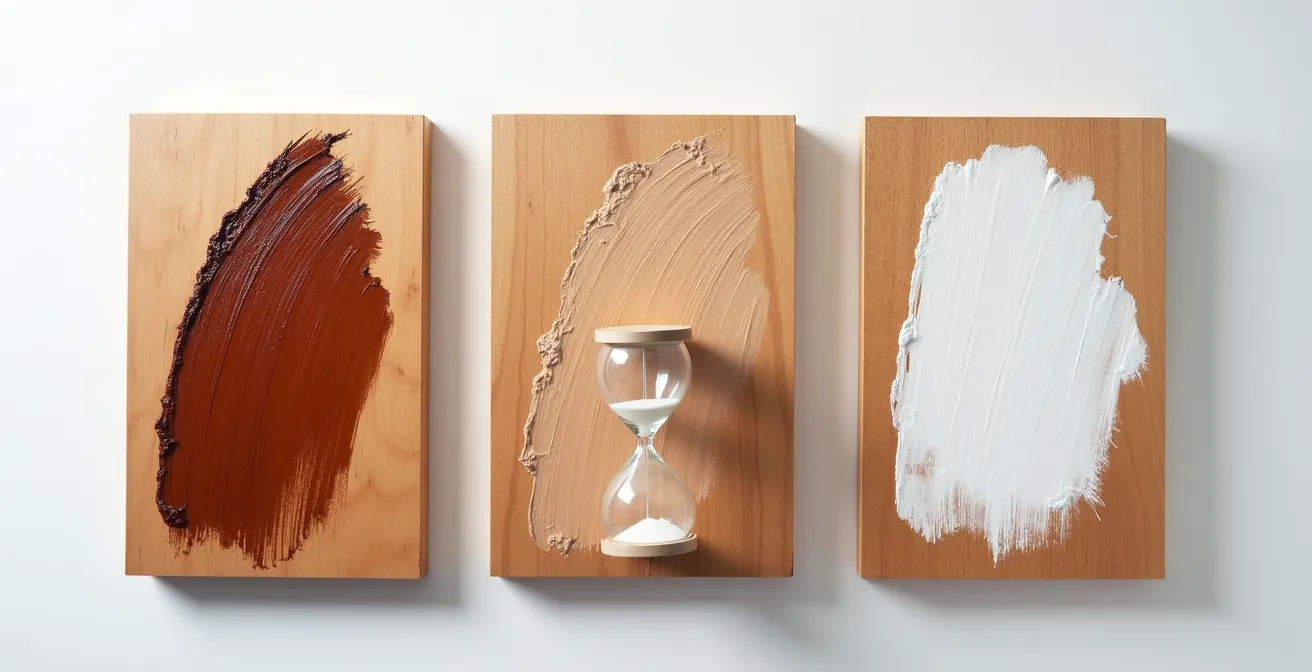
Oils, on the other hand, are for the patient and the contemplative. Drying over days or weeks, they offer a luxurious window for blending, editing, and “pushing the paint around.” This forgiveness is perfect for artists who love to model form with soft transitions and for beginners who want the freedom to correct mistakes. If you are someone who likes to ponder decisions and refine details over multiple sessions, the slow-drying nature of oil is a powerful ally. Watercolors are the fastest of all, drying as the water evaporates, but their transparency means every mark is relatively permanent, rewarding confident and minimalist artists.
The “Fat Over Lean” Mistake That Cracks Oil Paintings
While oils are forgiving in their blending time, they are strict in their chemistry. Ignoring one fundamental rule can lead to a heartbreaking outcome years down the line: a cracked and delaminated painting. This rule is known as “fat over lean,” and it’s a non-negotiable principle of archival oil painting that every beginner must understand. It is a prime example of where material empathy—working with the paint’s nature—is essential.
The principle is based on drying times. “Lean” paint is paint with a lower oil content, either straight from the tube or thinned with a solvent. It dries faster. “Fat” paint has a higher oil content, achieved by adding mediums like linseed or stand oil, and it dries slower. The rule dictates that each subsequent layer of paint must be more “fat” (contain more oil) than the one beneath it. If you apply a fast-drying lean layer over a slow-drying fat layer, the top layer will dry and become rigid while the layer underneath is still moving and oxidizing. This tension will inevitably cause the top layer to crack.
To follow the rule, you should build your painting in stages of increasing oil content. A good practice is to start with an underpainting thinned with solvent, then move to paint straight from the tube, and finally add oil mediums in subsequent layers. As a guideline, some experts recommend keeping oil medium below 30% of the paint volume to ensure structural integrity. This methodical approach is part of the oil painting discipline and suits a patient, process-oriented artist. It’s a trade-off: infinite blending time in exchange for careful chemical consideration.
How to Pack the Perfect Travel Kit for Each Medium?
Your artistic practice doesn’t have to be confined to a studio. For many, painting is a way to connect with the world, and that means taking your tools on the road. The medium you choose will have a massive impact on the size, weight, and complexity of your travel kit. This is where your lifestyle—whether you’re a weekend hiker, an international traveler, or an urban sketcher—plays a huge role in your decision.
Watercolor is the undisputed champion of portability. A small tin of pans, a couple of water brushes (which hold water in the handle), and a sketchbook can fit in a jacket pocket. Acrylics are also excellent for travel, especially with their fast drying times and water-based cleanup. A limited palette of tubes, a few brushes, and a plastic container for water form a lightweight and efficient kit. Oils, traditionally, are the most cumbersome due to the need for solvents, mediums, and a way to transport wet canvases safely. However, with water-mixable oils and clever gear like a pochade box (a compact, portable easel and palette), oil painters can also venture into the field with surprising ease.
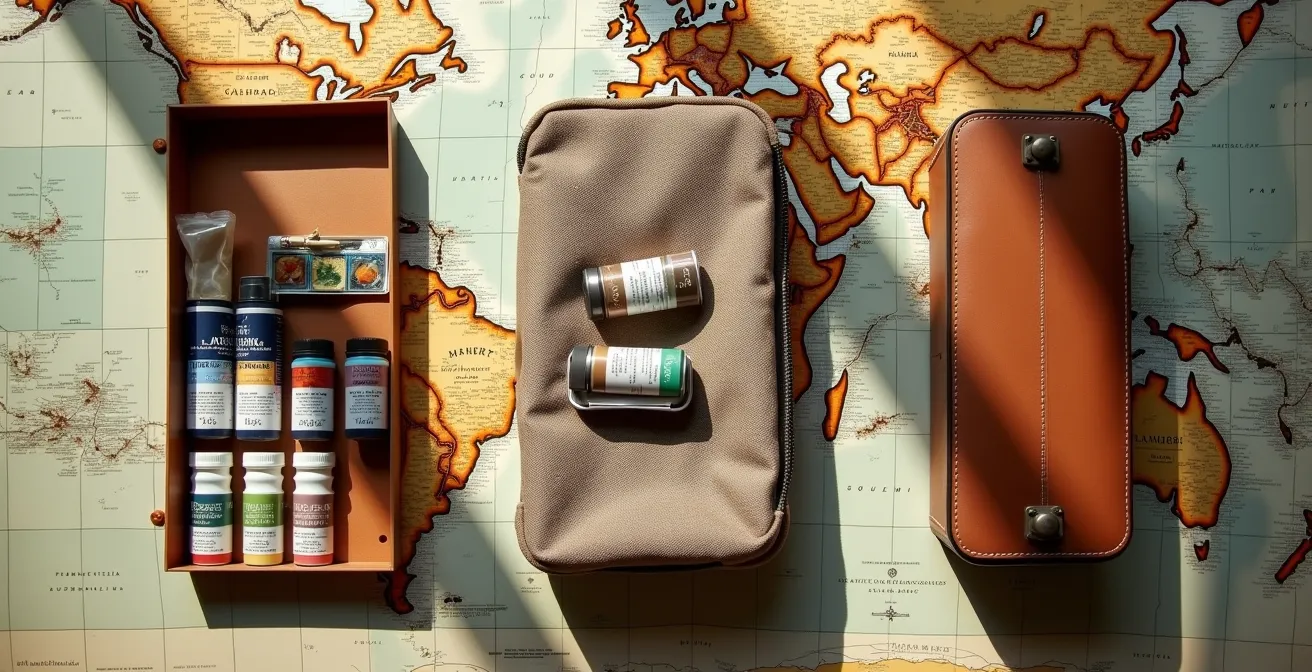
The key is to match the kit to the activity. For quick, spontaneous sketches while on the move, nothing beats watercolor’s minimalism. For more substantial studies in a park or on a day trip, acrylics offer a robust and quick-drying solution.
Case Study: Michael Alford’s Ultra-Light Plein Air Setup
Illustrating the peak of portability, professional artist Michael Alford has refined his kit for maximum mobility. He developed a pocket-sized watercolor setup that fits entirely within a small Muji box. It includes an ArtGraf sepia watercolor block, a water brush, Pentel brush pens, and a tiny 3.5×5.5 inch sketchbook. The entire kit weighs under 200 grams, allowing him to create quick, atmospheric sketches while undertaking demanding hikes like the GR5 in the French Alps. This demonstrates how a minimalist watercolor kit can enable art-making in even the most remote locations.
Why Cheap Materials in Modern Art Will Cost You Double in Restoration?
When you’re starting out, it’s tempting to reach for the cheapest materials available. The logic seems sound: why invest in expensive paints when you’re just learning? While student-grade paints are perfect for practice, understanding the difference in quality is vital for any work you intend to keep or sell. The price difference on the shelf can translate into a much larger cost down the line—the cost of conservation and restoration.
The primary difference between student-grade and professional-grade paint is pigment load. Professional paints contain a higher concentration of pure, high-quality pigment and less filler or binder. This results in more vibrant, lightfast (resistant to fading), and permanent colors. Student paints use cheaper, synthetic pigments and more fillers, which can lead to colors shifting, dulling, or fading over time. An artwork created with fugitive pigments may look great today but could be a faded ghost in a few decades.
This has a real financial implication. While it’s true that professional-grade paints can be 3-8 times more expensive than student-grade versions, the cost of restoring a painting that has begun to degrade is exponentially higher. Furthermore, there’s a market perception, particularly in traditional galleries, that has historically valued oil paintings more highly than acrylics, partly due to oil’s longer history and association with the old masters. Using high-quality materials from the start is an investment in the longevity and perceived value of your work. It’s an act of respect for your own creative output.
How to Organize a Plein Air Kit That Weighs Less Than 5kg?
For the artist drawn to the outdoors, the term “plein air” (painting outside) is a call to adventure. However, that adventure can quickly become a struggle if you’re weighed down by heavy gear. The challenge is to create a setup that is comprehensive enough to be functional but light enough to carry to your chosen location. Aiming for a total kit weight of under 5kg (about 11 lbs) is a great goal that keeps your setup manageable for walks and short hikes.
The choice of medium is the first and most significant weight decision. As noted, watercolor is inherently the lightest. A professional plein air watercolor package, including an easel, can weigh as little as 3.86kg, as seen with the Traveler Series package. For oil and acrylic painters, the weight comes from the tubes of paint, the easel, and any necessary liquids (solvents for oils, water for acrylics). Here, intelligent choices and multi-purpose items are your best friends. A heavy wooden French easel can be replaced with a lightweight camera tripod and a pochade box adapter. Glass jars can be swapped for collapsible plastic bottles.
The most effective strategy, however, is to ruthlessly edit your palette. Instead of carrying 20 different colors, learn to mix what you need from a limited palette of 4-6 essential colors (e.g., a warm and cool version of each primary, plus white). This alone can drastically reduce the weight and bulk of your paint tubes. Every gram counts when you’re hiking to find the perfect view.
Your Action Plan: Lightweight Plein Air Kit
- Limit Your Palette: Choose a limited palette of just 4-6 essential colors to dramatically reduce the number of paint tubes you need to carry.
- Rethink Your Easel: Ditch heavy, bulky easels in favor of a lightweight camera tripod fitted with a pochade box adapter or a panel holder.
- Use Lightweight Containers: Replace heavy glass jars for water or solvents with cut plastic bottles or specialized, lightweight collapsible containers.
- Select Multi-Purpose Tools: Pack tools that serve multiple functions, such as a palette knife that can be used for mixing, applying paint, and scraping the palette clean.
- Decant Your Paints: For shorter trips, transfer paint from large, heavy tubes into small, lightweight travel containers or even contact lens cases.
Key Takeaways
- Your choice of paint medium is a personal decision that should align with your workflow, patience, and lifestyle.
- Modern innovations like water-mixable oils have made health concerns about solvents largely optional.
- The “cheapest” paint isn’t always the most economical; consider waste from drying times and the long-term value of pigment quality.
Why Does One Tube of Red Paint Cost $5 and Another $40?
As you stand in the art store, one final mystery confronts you: the wild variation in price, even within the same medium. Why does one tube of Cadmium Red cost $40, while a “Cadmium Red Hue” next to it is only $5? The answer lies in the heart of the paint itself: the pigment. This is the final and most important lesson in material empathy—understanding what you are actually paying for.
The cost of a tube of paint is almost entirely determined by the cost of the pigment it contains. Expensive pigments are typically derived from rare, difficult-to-process, or historically significant materials. Genuine Cadmium, for example, is a heavy metal that requires complex and highly regulated processing to be made into a safe, stable pigment. It is prized for its exceptional opacity and vibrant, clean mixing properties. The cheaper “hue” version, on the other hand, uses a modern, synthetic organic pigment like Naphthol to approximate the color. It’s a good color, but it lacks the specific handling properties and absolute permanence of the genuine article.
This distinction between single, genuine pigments and mixed “hues” exists across the color spectrum. Earth tones like Burnt Sienna are inexpensive because the iron oxide pigments are abundant and easy to process. Blues made from genuine Cobalt or Lapis Lazuli are among the most expensive for the opposite reason. As a beginner, you don’t need to start with the most expensive pigments, but understanding this difference empowers you to make informed choices. You are not just buying a color; you are buying a specific chemical with unique properties of opacity, tinting strength, and lightfastness.
The following table breaks down the difference using the Cadmium Red example, but the principles apply to many other colors in a professional paint line.
| Factor | Cadmium Red (Genuine) | Cadmium Red Hue |
|---|---|---|
| Pigment Source | Rare heavy metal | Synthetic Naphthol |
| Processing Cost | Complex, regulated | Simple, mass-produced |
| Health Safety | Requires special handling | Generally safer |
| Color Properties | Superior opacity, mixing | Good but less vibrant |
| Typical Price | $30-40 per tube | $5-10 per tube |
Ultimately, there is no single “best” paint. The best paint is the one that gets out of your way and lets you create. By understanding your own personality, habits, and goals, you can confidently select a creative partner that will support your artistic journey for years to come. Now, you can walk into that art store not with confusion, but with the confidence of an informed artist ready to make their mark.