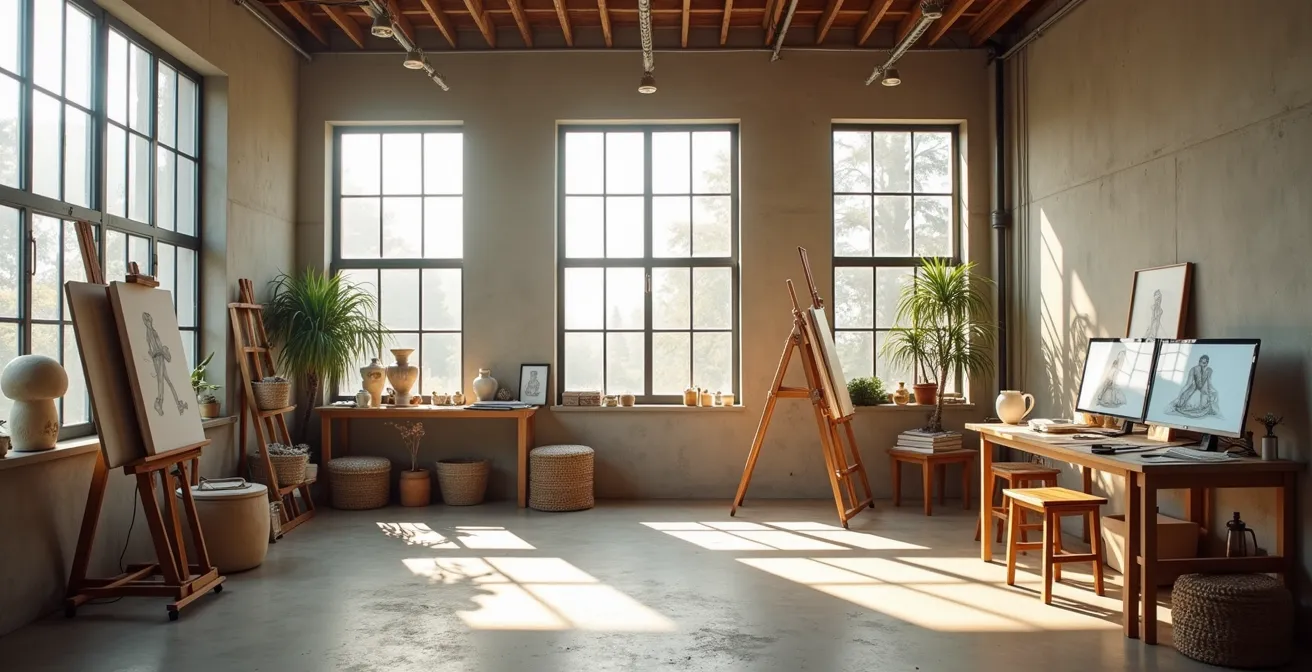
The best path to technical mastery isn’t about a degree versus no degree; it’s about choosing the learning system that matches your cognitive style.
- Art school provides an external, structured framework but often comes with immense debt and methodological rigidity.
- Self-teaching offers flexibility and lower costs but requires you to build your own “cognitive scaffolding” with immense discipline.
Recommendation: Use the self-assessment in this guide to determine if you learn better through systematic construction or direct observation before committing to a path.
The question looms over every aspiring artist: should you invest in a formal art school education, or can you forge your own path? The internet is filled with debates weighing the obvious pros and cons—the crippling debt of a BFA versus the daunting discipline required for self-study, the value of an institutional network against the freedom of a personal curriculum. These discussions are valid, but they often miss the most crucial point. They focus on the external circumstances rather than the internal process of learning.
The real difference between these two paths lies not in the diploma, but in the fundamental learning systems they employ. Each approach is designed to wire an artist’s brain in a profoundly different way. Art school provides what can be called cognitive scaffolding—a pre-built structure of exercises, critiques, and historical context designed to systematically build skill. The self-taught route demands you become your own architect, sourcing materials and designing a curriculum from scratch. This isn’t just a choice between a classroom and a studio; it’s a strategic decision about which methodology best aligns with how you think, see, and solve visual problems.
But what if the true key to artistic growth wasn’t about the institution, but about consciously choosing the specific, time-tested techniques that build technical fluency? This guide moves beyond the surface-level debate. We will deconstruct the core methodologies of academic training, compare the cognitive impact of different drawing methods, provide a pragmatic cost-benefit analysis of a fine arts degree, and offer a concrete framework for building a self-directed curriculum that actually works. It’s time to stop asking “where” you should learn and start focusing on “how.”
This article will guide you through the critical decisions that shape an artist’s technical foundation. By understanding the underlying principles of each educational model, you can make an informed choice that serves your long-term artistic goals.
Summary: Self-Taught vs. Art School: A Method-Based Decision Guide
- Why Do Academies Force Students to Copy Old Masters for Years?
- Sight-Size or Constructive Anatomy: Which Drawing Method Fits Your Brain?
- Is a Fine Arts Degree Worth the Debt for a Technical Painter?
- The “Style First” Mistake That Stunts Artistic Growth for Years
- How to Structure a Self-Directed Art Curriculum That Actually Works?
- Viewing Art vs. Making Art: Which Is More Effective for Stress Relief?
- How Did the Quest for Perfect Naturalism Stifle Creativity for Centuries?
- How to Develop a Unique Brushwork Signature That Collectors Recognize?
Why Do Academies Force Students to Copy Old Masters for Years?
The practice of copying old masters is a cornerstone of academic art training, often perceived by outsiders as a tedious and uncreative exercise. However, this tradition is not about mindless imitation. It is a highly strategic method for downloading a proven technical vocabulary. When a student meticulously reproduces a work by Sargent or Rembrandt, they are reverse-engineering centuries of solutions to complex problems in composition, color harmony, value structure, and edge control. It’s a direct-line apprenticeship with the greatest minds in art history.
This process forces the student to slow down and analyze every decision the master made. Why was this edge lost and this one found? How was this illusion of light achieved with such a limited palette? It’s an active dialogue with the past. As a study from NYU’s Gallatin School highlights, the context of this practice deeply influences its learning value. The analysis divides copyist experiences into different quadrants, noting that copying an original painting in a museum provides the highest level of learning and prestige, as it involves direct observation of surface texture and scale. In contrast, copying from digital reproductions offers different cognitive benefits, allowing for easier analysis of composition and value at the expense of understanding material properties.
Ultimately, the goal of master copies is not to produce a clone of the original painting. The goal is to internalize the master’s decision-making process. By deconstructing their work, you build your own internal library of techniques and aesthetic choices. This “borrowed” knowledge becomes the cognitive scaffolding upon which you can later build your own unique artistic voice. It ensures your creative explorations are built on a solid foundation of proven principles rather than guesswork.
Sight-Size or Constructive Anatomy: Which Drawing Method Fits Your Brain?
At the core of technical drawing are two primary, and often competing, methodologies: Sight-Size and Constructive Anatomy. The choice between them is not merely a matter of preference; it reflects two fundamentally different ways of seeing and processing the world. Understanding which method aligns with your natural cognitive style is a critical step in choosing your educational path, whether formal or self-directed.
The Sight-Size method is an observational approach. The artist places their drawing paper next to the subject and steps back to a specific vantage point where both appear to be the same size. The process then becomes a meticulous act of comparison, transferring measurements and shapes directly from subject to paper. It is a right-brained, intuitive process that excels at capturing accurate likenesses and proportions with great fidelity. It teaches the eye to see shapes and value relationships purely, bypassing the brain’s symbolic interpretation. It’s about drawing what you *see*, not what you *know*.
In contrast, Constructive Anatomy is a conceptual, left-brained approach. Instead of copying what is seen, the artist builds the figure from the inside out, using a deep knowledge of skeletal structure, muscle groups, and geometric forms (spheres, boxes, cylinders). It’s about understanding the “why” behind the surface forms. This method allows an artist to draw figures from imagination, invent poses, and create believable forms even without a direct reference. It creates a powerful internal model of the subject, providing the freedom to manipulate and stylize it.
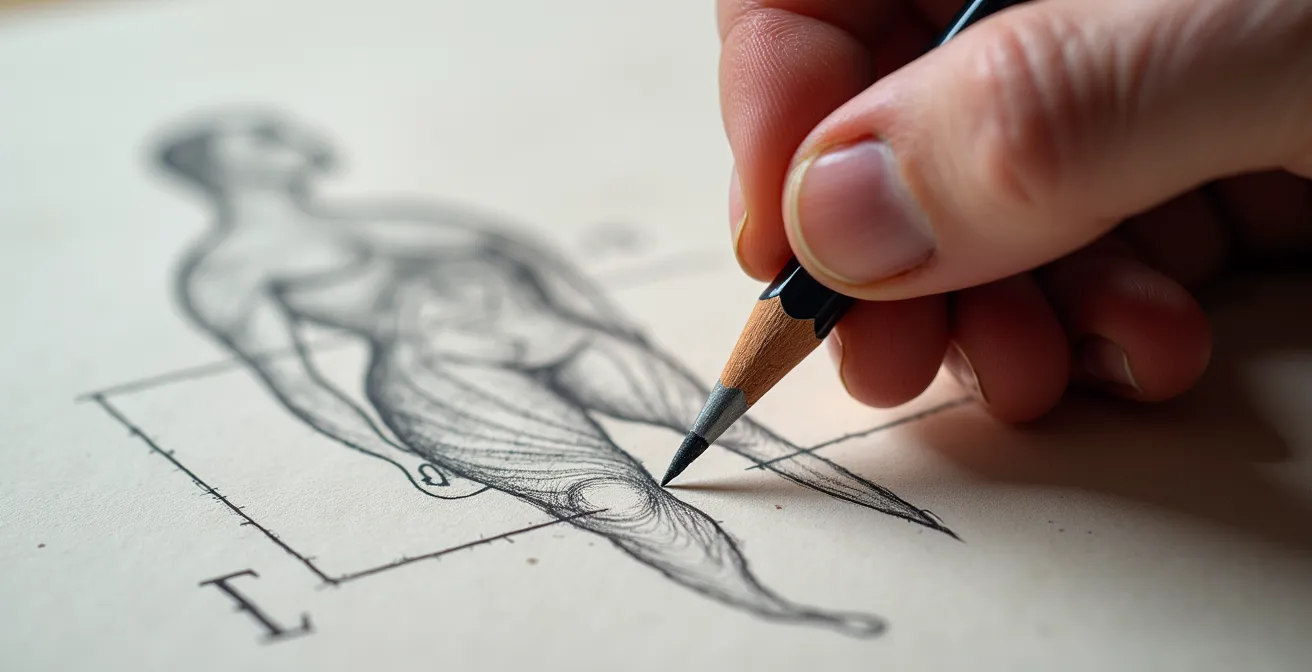
As the image above illustrates, the constructive method involves building up complex forms from simpler, underlying structures. Neither method is inherently superior, but they build different mental muscles. Sight-Size trains observational precision, while Constructive Anatomy develops conceptual understanding and imaginative power. The most effective artists often learn to integrate both, using a constructive foundation to inform their observational work. The key is to identify your natural inclination and begin there.
Your Action Plan: Finding Your Natural Drawing Method
- Test Your Preference: Draw the same object twice. First, using only your eye to measure and match shapes (Sight-Size). Second, by breaking it down into simple geometric forms (Constructive).
- Analyze Your Process: Which attempt felt more natural? Did you enjoy the precision of matching or the logic of building? Document your workflow and feelings.
- Experiment with Digital Tools: Use layers in a program like Photoshop or Procreate. Create a constructive skeleton on one layer and an observational line drawing on another. See how they can work together.
- Track Your Progress: Dedicate 30 days to practicing both methods on alternate days. Review your work to identify which approach yields stronger results and feels more intuitive for you.
- Plan Your Curriculum: Based on your findings, prioritize learning resources that cater to your dominant method while supplementing with exercises from the other to create a well-rounded skill set.
Is a Fine Arts Degree Worth the Debt for a Technical Painter?
For any aspiring artist considering a formal education, the financial question is unavoidable and often paralyzing. A Bachelor of Fine Arts (BFA) degree from a prestigious institution represents a significant investment of both time and money. While it offers undeniable benefits like structured curriculum, access to facilities, and a built-in network, it’s crucial to approach this decision with a pragmatic, clear-eyed view of the return on investment, especially for a painter focused on technical skill.
The costs are staggering. A formal degree is often the single largest expenditure an artist will ever make on their education. This financial reality must be weighed against the actual outcomes. As the research collective BFAMFAPhD highlights, the path is far from guaranteed:
66 percent of recent art school graduates are carrying substantial debt, and two years after graduation, ninety-percent of art students are no longer working in the field.
– BFAMFAPhD Research Collective, Artists Report Back 2014
This data forces a hard question: is the “cognitive scaffolding” provided by an institution worth the high price and uncertain career prospects? For some, the answer is yes. The immersive environment and dedicated mentorship can accelerate growth in a way that is difficult to replicate alone. However, it’s essential to compare this path with viable, and far more affordable, alternatives.
The following table, based on data from industry analysis, puts the numbers in perspective. It compares the traditional four-year degree with a self-directed path using online courses and workshops, as well as a hybrid model. This comparison allows for a more informed financial decision, moving the conversation from a vague sense of “value” to a concrete cost-benefit analysis. As shown in an art education investment analysis, the financial gap is immense.
| Investment Option | Average Cost | Typical Outcome | Time Frame |
|---|---|---|---|
| 4-Year Art School (RISD example) | $245,816 | BFA degree, institutional network | 4 years |
| Self-Directed Learning Package | $25,000-40,000 | Online courses, workshops, equipment | 2-4 years flexible |
| Hybrid Approach | $60,000-80,000 | Community college + workshops + online | 3-5 years |
The “Style First” Mistake That Stunts Artistic Growth for Years
One of the most common and damaging traps for aspiring artists, particularly those on a self-taught path, is the premature pursuit of a personal “style.” In an age dominated by social media, the allure of a recognizable, marketable look is powerful. Artists see a particular aesthetic trending on Instagram and rush to emulate it, hoping to quickly gain followers and validation. This “style-first” approach is a critical mistake that puts the cart before the horse and can stunt technical and creative growth for years.
A true artistic style is not something you choose or design; it’s the natural, inevitable byproduct of years of dedicated, fundamental practice. It is the sum of your technical habits, your aesthetic preferences, and your unique way of solving visual problems. Trying to develop a style without first mastering the fundamentals—drawing, value, color, composition, and anatomy—is like trying to write poetry without knowing grammar and vocabulary. The result is often a shallow, derivative aesthetic that lacks substance and adaptability.
This pressure to conform is amplified by algorithms that reward consistency and trend-chasing, creating a feedback loop that can trap artists in a creative cul-de-sac.
Case Study: The Instagram Algorithm’s Impact on Artist Development
An analysis of artist development in the social media era reveals a stark contrast between trend-followers and those focused on fundamentals. Artists who chase algorithmic trends often develop ephemeral, derivative styles that quickly become dated. They find their growth plateaus because their technical foundation is too weak to support further exploration. Conversely, artists who ignore trends and dedicate themselves to a fundamental-first approach develop a more robust and lasting artistic voice. Their style emerges organically from a deep well of technical knowledge, allowing them to adapt, evolve, and create work with enduring appeal, independent of passing fads.
The antidote to the “style-first” mistake is a disciplined commitment to what can be called the 80/20 framework for style development. This means dedicating 80% of your practice time to rigorous, objective fundamental drills (like figure drawing, value studies, and color mixing) and reserving just 20% for experimental “play” sessions without a predetermined outcome. This disciplined split ensures that your technical skills are constantly improving, while still allowing space for your unique voice to emerge naturally and authentically over time.
How to Structure a Self-Directed Art Curriculum That Actually Works?
Choosing the self-taught path means taking on the role of student, teacher, and dean of your own one-person art academy. It offers unparalleled freedom but comes with the immense responsibility of building your own curriculum from the ground up. Without the external structure of an institution, it’s easy to drift aimlessly, dabbling in tutorials without making real progress. The key to success is to create a structured, sequential learning plan—your own internal cognitive scaffolding—that guides you from foundational principles to advanced execution.
A successful self-directed curriculum is not a random collection of YouTube videos. It must be organized around a core progression, typically starting with the most fundamental skill: drawing. From there, it should branch into the other pillars of visual art: value, color, composition, and perspective. For each pillar, you must find high-quality resources (books, online courses, workshops) and design specific, measurable projects to test your understanding. For example, after studying value, you might assign yourself a project to paint a still life using only five distinct values.
This structured approach may seem counterintuitive to the “freedom” of being self-taught, but it’s the very thing that makes freedom productive. It provides direction and a means of measuring progress, preventing the frustration of feeling stuck. Furthermore, the notion that a formal degree is the only path to a career in the arts is a misconception. In fact, data shows that a staggering 93% of fine arts graduates ultimately work in fields outside of being a traditional artist, proving that the diploma is no guarantee of a specific career outcome.

The image above perfectly captures the mindset required: organized, intentional, and focused. A successful curriculum requires you to define clear goals, set realistic timelines, establish a consistent practice schedule, and, most importantly, create a feedback loop. This can involve finding a mentor, joining a peer critique group online, or simply learning to critically evaluate your own work against the masters you study. Discipline and structure are not the enemies of creativity; they are the framework that sets it free.
Viewing Art vs. Making Art: Which Is More Effective for Stress Relief?
The question of whether viewing art or making it is more effective for well-being often comes up, but for the aspiring technical artist, the answer has a deeper implication. While passively viewing art in a gallery can be calming, the act of making art is a far more potent tool, not just for stress relief but for cognitive development. The deep focus required for drawing or painting induces a “flow state,” a meditative condition where time seems to fade away, which is a powerful antidote to stress. But the benefits go much further.
When you are actively engaged in creating art, you are performing a complex series of problem-solving tasks. You’re analyzing relationships, making decisions about color and value, and coordinating your hand and eye. This is not a passive activity; it is a full-brain workout. As neuroscience research indicates, active art-making engages executive functions, strengthens problem-solving skills, and improves working memory in ways that passive viewing simply cannot. For the artist-in-training, every moment spent making art is a moment spent sharpening the mind and building technical facility.
This doesn’t mean viewing art is without value. On the contrary, it is an essential part of an artist’s education. However, it must be transformed from a passive experience into an active one. Strategic art viewing means visiting a museum not just for enjoyment, but for research. It’s a field trip for your artistic brain. Instead of simply looking, you analyze. This turns every gallery visit into a productive learning session that directly feeds your own practice.
Here are some ways to practice strategic art viewing:
- Analyze Composition: Identify the focal points in a painting. Trace the path your eye takes through the work and try to understand how the artist guided you.
- Study Value Relationships: Mentally convert the artwork to grayscale. Analyze how the artist used light and dark to create form, mood, and a clear visual hierarchy.
- Practice Active Sketching: Bring a small sketchbook and make quick compositional thumbnails while observing. Don’t try to copy the work; just capture its essential structure and energy.
- Conduct Palette Studies: Pay close attention to the specific color combinations used. Note how the artist achieved harmony or created tension, and how they handled warm and cool colors.
How Did the Quest for Perfect Naturalism Stifle Creativity for Centuries?
To understand the modern debate between formal training and self-education, we must look back to its historical roots. For centuries, Western art was dominated by the academic tradition, a system with a singular, overriding goal: the achievement of perfect naturalism. The pinnacle of artistic skill was the ability to render the world with photographic precision. This quest, while producing works of breathtaking technical mastery, eventually created a system so rigid that it began to stifle the very creativity it was meant to foster.
The academic system was built on a strict, hierarchical progression of skills. Students would spend years drawing from plaster casts before being allowed to draw a live model, and only after mastering drawing could they begin to paint. This created a powerful but inflexible methodological friction. While it built an incredibly strong technical foundation, it often discouraged experimentation, personal expression, and any deviation from the established ideal. The “right” way to paint was prescribed, and innovation was often seen as a failure to adhere to the rules.
This entire paradigm was shattered by a single technological invention: the camera. Suddenly, the artist’s primary role as a documentarian of reality was made obsolete. This crisis, however, was also a liberation. It forced artists to ask a new, more profound question. As author Catherine Gillen notes, this shift was pivotal:
The academic pursuit of perfect realism became redundant with photography, forcing painters to explore what painting could do that a camera couldn’t – emotion and abstraction.
– Catherine Gillen, The Brownston Gallery Interview
This shift gave rise to modern art movements like Impressionism, Post-Impressionism, and Abstract Expressionism. Artists, many of whom were self-taught or broke away from academic conventions like Vincent van Gogh, were now free to explore the inner world of emotion and the outer world of subjective perception. The focus shifted from pure representation to expression, color, and form. This historical break is the reason the “self-taught vs. art school” debate even exists; it created a legitimate alternative to the once-unquestionable dominance of the academy, proving that great art could flourish outside of its rigid walls.
Key Takeaways
- Fundamentals First, Style Later: A unique artistic voice is the natural result of mastering drawing, value, and color—not a stylistic choice made in advance.
- Choose Your Learning System: The most important decision is not school vs. no-school, but which method (observational or constructive) aligns with how your brain works.
- Practice with Intention: Success depends on a structured, disciplined curriculum with clear goals and feedback, whether that structure is provided by a school or built by you.
How to Develop a Unique Brushwork Signature That Collectors Recognize?
After years spent mastering the fundamentals—whether in an academy or a self-designed curriculum—the final frontier for a painter is the development of a unique artistic signature. This is the elusive quality that makes a painting instantly recognizable as *yours*. More than just subject matter or color palette, a key component of this signature lies in your brushwork: the character, energy, and texture of every mark you make. A distinctive brushwork signature is not something you can fake; it is an honest expression of your physical and emotional connection to the paint.
Developing this signature requires moving beyond simply applying paint to a canvas and into a phase of deep, intentional practice with your materials. It’s about exploring the full potential of your tools and understanding how they respond to your hand. This means experimenting with different brushes (flats, filberts, rounds), varying paint consistency (thick impasto vs. thin glazes), and even altering the way you hold the brush (a tight pencil grip for detail vs. a loose, expressive grip from the shoulder).
The goal is to build a rich mark-making vocabulary. Just as a writer has a range of sentence structures, a painter must have a range of marks—from bold, confident strokes to delicate, scumbled textures. This vocabulary allows you to convey not just form and light, but also emotion and energy. To build this range, dedicate specific practice sessions to pure mark-making experiments:
- One-Brush Challenge: Complete an entire painting using only a single brush size. This forces you to discover incredible mark variety out of necessity.
- Speed-Painting Sessions: Set a 15-minute timer for a small study. The time pressure encourages economical, decisive brushwork and prevents overthinking.
- Palette Knife Studies: Alternate between using a brush and a palette knife. This introduces a completely different set of textures and edges into your work.
- Grip Variations: Consciously practice switching between a close, detail-oriented grip and a long, gestural grip to feel the difference in the marks you produce.
Over time, through thousands of hours of this intentional practice, certain habits and preferences will emerge. You will find the marks that feel most natural and expressive to you. This is the birth of your signature. It is an authentic fingerprint in paint, a testament to your unique journey and a quality that collectors and connoisseurs will come to recognize and value.
Your path to becoming a skilled artist starts not with an application form, but with a deliberate choice about how you want to learn. Use the insights and tools from this guide to analyze your own cognitive style, weigh the practical realities, and begin building your artistic future with purpose and intention. Start structuring your personal curriculum today.