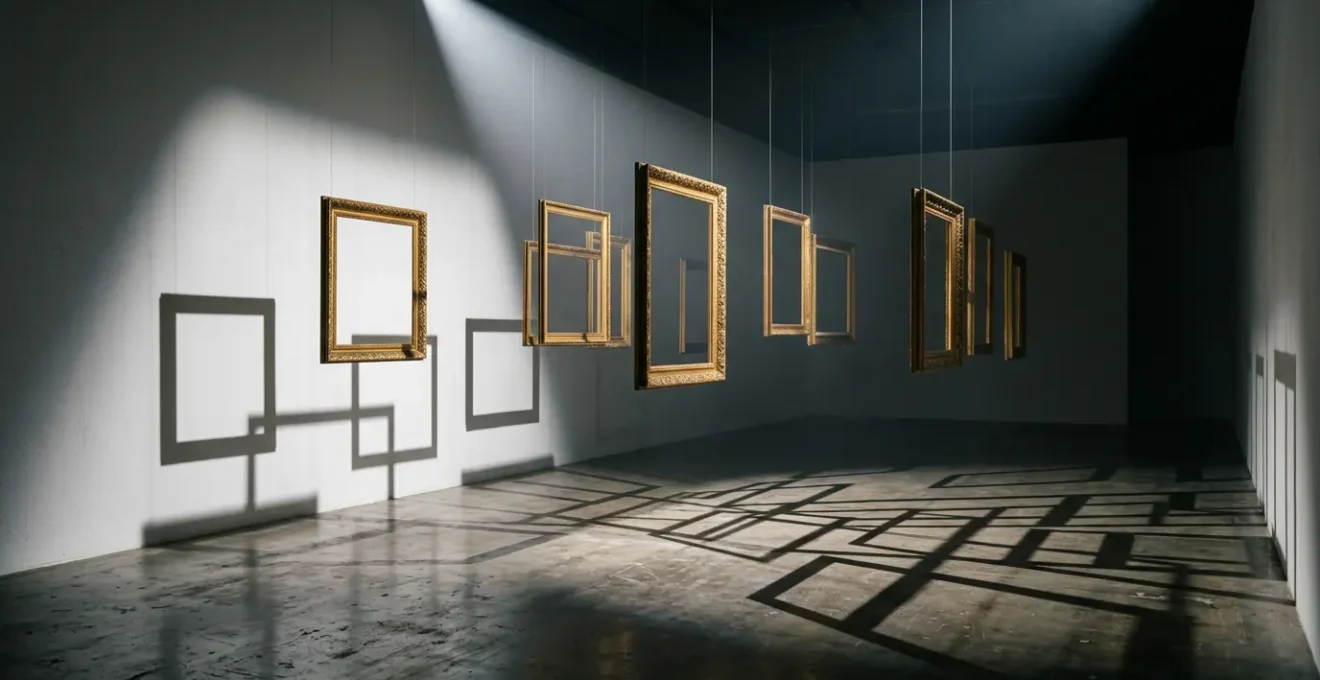
A “masterpiece” is not an inherent quality of a painting but a social and economic construct, manufactured by a network of historical accidents, market forces, and institutional power that we can actively deconstruct.
- Media narratives, like the coverage of the Mona Lisa’s theft, can create fame far more effectively than aesthetic quality alone.
- The art canon is heavily skewed by Western institutional biases, systematically excluding non-Western works and artists from “universal” masterpiece status.
Recommendation: Approach your next museum visit not as a passive consumer of “greatness,” but as a critical investigator, questioning the story behind why each work is on the wall.
We’ve all felt it. Standing in a crowded museum, jostling for a glimpse of the same 20 or so paintings we’ve seen on postcards, tote bags, and TV shows our entire lives. We are told these are the “masterpieces,” the pinnacle of human creativity. The question that hangs in the air, often unasked, is simple: why these? Who made that decision? The common answer often involves vague notions of “timeless beauty,” “unparalleled skill,” or the mysterious spark of “genius.” We are led to believe that these works possess an intrinsic, almost magical quality that guarantees their place in the pantheon of great art.
But what if that’s the wrong way to look at it? As a cultural sociologist, I argue that the concept of a masterpiece is not discovered, but constructed. It is not a property inherent in the canvas and pigment, but a status bestowed upon it by a complex and often messy web of forces. These forces include historical accidents, the immense power of money, media myth-making, and the subtle yet powerful biases of the very institutions that claim to be neutral guardians of culture. The idea of the lone, divinely inspired genius is a romantic and compelling story, but it often obscures a much more interesting reality.
This article will deconstruct the very notion of the masterpiece. Instead of accepting its definition, we will dissect the mechanisms that create it. We will explore how a crime can make a painting famous, how a billion-dollar price tag can manufacture value, why the art you see in major museums represents a fraction of global creativity, and how the “lone genius” is often a marketing invention. By understanding these systems, you will no longer be a passive viewer; you will become a critical observer, equipped to see the invisible architecture of power that shapes what we call “great art.”
This exploration will take us through the specific case studies and hidden histories that reveal how the art canon is formed. The following sections break down the key mechanisms that elevate a work to masterpiece status.
Summary: Unpacking the Mechanisms of Artistic Canonization
- Why Did the Theft of the Mona Lisa Make It a Masterpiece?
- Why Are So Few Non-Western Works Considered “Global” Masterpieces?
- Does a $450 Million Price Tag Make “Salvator Mundi” a Masterpiece?
- The Merchandise Trap: Does Putting Art on Mugs Ruin Its Meaning?
- How to Prioritize the Louvre’s 35,000 Works in a 2-Hour Visit?
- The Bias Trap That Can Skew the Historical Accuracy of a Show
- Is She Happy or Sad: How Does Your Brain Process the Mona Lisa Smile?
- How Did Verrocchio’s Workshop Shape Leonardo da Vinci’s Genius?
Why Did the Theft of the Mona Lisa Make It a Masterpiece?
Before 1911, the Mona Lisa was a respected Renaissance portrait, but it was far from the global icon it is today. It was its absence, not its presence, that catapulted it to superstardom. When handyman Vincenzo Peruggia stole the painting from the Louvre, he inadvertently triggered one of the most effective marketing campaigns in art history. The theft was not just a crime; it was a media event. Newspapers transformed the story into a serialized detective thriller, capturing the public’s imagination across the globe.
The institutional failure of the Louvre—taking over 24 hours to even notice the painting was missing—paradoxically amplified its value, framing it as an irreplaceable treasure that the world had lost. This media-driven narrative created a new kind of value, one based on fame and notoriety. As NPR’s analysis of the event notes, the publicity made the painting “too hot to hock,” its image now instantly recognizable. When the museum reopened, thousands of people flocked to see the empty space on the wall where it once hung, a testament to the power of myth-making.
This episode serves as a primary case study in how a masterpiece is constructed by external forces. The painting’s value was no longer contained within its sfumato technique or enigmatic smile; it was now mediated through a public story of crime, mystery, and national pride upon its recovery. The theft detached the Mona Lisa from its quiet, art-historical context and embedded it into popular culture, ensuring its status not just as a great painting, but as the most famous painting in the world.
Why Are So Few Non-Western Works Considered “Global” Masterpieces?
The canon of “global” masterpieces is remarkably narrow, dominated by a lineage that runs from Renaissance Italy to modern New York. This is not a reflection of where great art was made, but of who has held the power to write its history. The exclusion of non-Western art from the highest echelons of the canon is a direct legacy of colonialism and the institutional gatekeeping of Western museums, galleries, and universities. These institutions have historically framed their own artistic traditions as universal, while treating the art of other cultures as anthropological artifacts or “ethnic crafts.”
This bias is not just ideological; it is embedded in the data. A stark 2019 study of major US museum collections found that 85% of the artists are white and 87% are men. This staggering lack of diversity reveals a system that has historically equated “masterpiece” with a very specific demographic. The architecture of the museum itself often reinforces this hierarchy, with European art displayed in grand, sanctified galleries while works from Africa, Oceania, or the Americas are relegated to wings that frame them as cultural specimens rather than works of individual genius.
This is a systemic issue of narrative control. As one academic thesis on the subject explains, the West has positioned its art as speaking to a “universal human condition,” while non-Western art is seen as merely expressing local traditions or rituals. This creates a false dichotomy where one is “art” and the other is “artifact.”
Westerners have historically treated the arts of the West as speaking to a universal human condition, while the artifacts of non-Western societies have been represented, by Westerners, as merely the expression of the traditions, rituals, and practices of those societies, the historical domination of the West over the Rest becomes apparent.
– Museum studies scholars, Non-Western Art and the Musée du Quai Branly
This conceptual image highlights the structural nature of this exclusion. Deconstructing the masterpiece, therefore, requires us to recognize that the very category is built on a foundation of colonial power dynamics and institutional exclusion. The canon is not a neutral list of “the best,” but a testament to a specific, and biased, version of world history.
Does a $450 Million Price Tag Make “Salvator Mundi” a Masterpiece?
In the contemporary art world, no mechanism is more powerful in constructing masterpiece status than the auction block. The case of Leonardo da Vinci’s “Salvator Mundi” is the ultimate example. When it was sold at Christie’s for a record-shattering $450.3 million in 2017, it became the most expensive painting ever sold. This price tag did more than just transfer ownership; it manufactured a new level of cultural significance, a phenomenon we can call economic velocity.
The story of “Salvator Mundi” is one of value creation through controversy and marketing, not scholarly consensus. The painting, heavily restored and with a debated attribution, was declined by major institutions like the Getty and the Hermitage before 2013. Yet, Christie’s brilliant marketing strategy—branding it as “The Last Da Vinci” and placing it in a contemporary art sale to attract a different class of billionaire buyers—transformed these doubts into an aura of mystique. The controversy over its authenticity, which continues to this day with institutions like the Prado downgrading its attribution, did not diminish its status. Instead, it fueled the media narrative and amplified its fame.
This demonstrates a fundamental shift in how masterpieces are made. The price tag becomes the headline, and the headline becomes the story. The work is famous not necessarily for what it is, but for what it cost. It is a perfect illustration of how the modern art market, a largely unregulated financial system, has become a primary arbiter of cultural value. The unprecedented sum paid for the painting made it, as Britannica notes, “the most controversial painting of the 21st century,” and in today’s attention economy, controversy is a powerful form of cultural capital.
The Merchandise Trap: Does Putting Art on Mugs Ruin Its Meaning?
Once a painting achieves masterpiece status, it enters a new, paradoxical phase: mass reproduction. Its image is endlessly replicated on mugs, T-shirts, posters, and phone cases. This phenomenon raises a crucial question first posed by the philosopher Walter Benjamin: what happens to a work of art in the age of mechanical reproduction? In his seminal 1935 essay, Benjamin argued that reproduction destroys a work’s “aura”—its unique presence in time and space, its authenticity rooted in its physical existence.
Even the most perfect reproduction of a work of art is lacking in one element: Its presence in time and space, its unique existence at the place where it happens to be.
– Walter Benjamin, The Work of Art in the Age of Mechanical Reproduction
A photograph of the Mona Lisa, or the image on a coffee mug, can never replicate the experience of standing before the original artwork with its cracked varnish and subtle textures. In this sense, the merchandise trap seems to devalue the art, turning a sublime object into a common commodity. However, the reality is more complex. Benjamin also noted that reproduction “emancipates the work of art from its parasitical dependence on ritual,” giving it new life through social and political exhibition.
In our digital age, this paradox intensifies. The millions of reproductions of a masterpiece create a distributed cultural presence that, ironically, reinforces its canonical status. Every mug, every meme, every social media post acts as an echo, solidifying the work’s place in our collective consciousness. The souvenir from the museum gift shop is no longer just a cheap copy; it becomes a personal token of a cultural pilgrimage, transforming passive viewers into active participants in the ongoing construction of the masterpiece’s fame. The decay of the aura through reproduction is precisely what fuels its celebrity.
How to Prioritize the Louvre’s 35,000 Works in a 2-Hour Visit?
The Louvre in Paris is the quintessential temple of the masterpiece. It houses over 35,000 works of art, yet the vast majority of visitors follow a well-trodden path between three works: the Mona Lisa, the Venus de Milo, and the Winged Victory of Samothrace. This “masterpiece triangle” is a physical manifestation of canonization, a route dictated by decades of guidebooks and popular culture. To have a two-hour visit and only see these three works is to let the established canon dictate your experience entirely.
A deconstructive approach to visiting the Louvre, or any major museum, requires a conscious strategy to break free from this curated path. Instead of asking “What am I supposed to see?” ask “What question do I want to answer?” This transforms the museum from a checklist of famous objects into a vast database for personal investigation. Rather than being a passive recipient of pre-packaged “greatness,” you become an active researcher, using the collection to build your own understanding.
This means rejecting the algorithm of fame and creating your own. Instead of heading straight for the Mona Lisa, you might trace a theme across cultures and centuries. By consciously choosing an alternative route, you are challenging the very notion of a hierarchy of art and reclaiming your own agency as a viewer. The goal is not just to see art, but to see the system that organizes it.
A Sociologist’s Checklist for Navigating the Museum
- The Power Portraiture Path: Follow how rulers from Ancient Egypt to Napoleon used art to build authority, deliberately ignoring the most crowded galleries.
- The Material Innovation Route: Track technological breakthroughs in art-making—from pigments to canvas to casting techniques—to see how craft enables canonical status.
- The Hidden Margins Strategy: Actively explore transitional hallways, stairwells, and secondary galleries where institutional algorithms haven’t directed foot traffic. What is deemed “less important,” and why?
- The Question-Led Investigation: Formulate a specific question before entering (e.g., “How did different cultures depict the underworld?”) and use the collection as primary source material to find answers.
- The Provenance-First Approach: For a few key objects, ignore the aesthetic and focus only on the label. Where did it come from? Who owned it? How did it get here? This reveals the object’s social life.
The Bias Trap That Can Skew the Historical Accuracy of a Show
Our understanding of art history is fundamentally skewed by a powerful cognitive bias: survivorship bias. We build our histories based on what has survived, forgetting that what we have is a tiny, non-random sample of everything that was ever created. The masterpieces we celebrate are, by and large, the works that were made for, and preserved by, the rich and powerful—the church, monarchies, and wealthy patrons. Art made from perishable materials, or by marginalized communities, or that was simply deemed unimportant by those in power, has largely vanished.
This creates a distorted view of history. We study the grand oil paintings and marble sculptures because they are what remain, and we mistakenly assume they represent the totality of artistic production of their time. This bias is not a passive accident; it is actively reinforced by curatorial choices within museums. The way an object is displayed—its lighting, its placement, the information on its label—is a form of narrative construction. It tells us what is important and how we should feel about it.
The Metropolitan Museum’s Michael Rockefeller Wing, for example, has been analyzed for how it frames non-Western artifacts. Objects are often presented with the “reverence of high art,” placed on dramatic pedestals under spotlights, which detaches them from their original ritual functions and reframes them through a Western aesthetic lens. Furthermore, by often omitting or downplaying the often-violent colonial histories of their acquisition, the museum presents a sanitized narrative. The curatorial gaze doesn’t just present art; it actively constructs its meaning and status. What we see in a museum is not a neutral history, but a carefully edited show.
Key Takeaways
- Masterpiece status is not an inherent quality but a status constructed by external forces like media, money, and institutional power.
- The art canon is deeply flawed by historical biases (survivorship, colonial) that systematically favor Western, male artists.
- In the modern era, economic value and media controversy can manufacture cultural importance more effectively than scholarly consensus.
Is She Happy or Sad: How Does Your Brain Process the Mona Lisa Smile?
While sociology and economics explain much of a masterpiece’s status, there can also be an underlying neurological component to its power. The Mona Lisa’s fame isn’t just due to its theft; it’s also rooted in the very way our brains are wired to perceive it. Leonardo’s masterful use of the sfumato technique—creating soft, hazy edges—is not just an aesthetic choice. It is a brilliant neurological hack.
The blurred lines around the corners of the mouth and eyes provide ambiguous visual signals that the brain cannot definitively resolve. When you look directly at her mouth, the smile seems to vanish, as your central vision tries to resolve the details. When you look at her eyes, the smile reappears in your peripheral vision, which is better at picking up shadows. This constant shifting creates a neurological indecision: is she happy or is she sad? This unresolvable ambiguity functions as a “cognitive hook,” compelling our brains to engage for longer, trying to solve a puzzle that has no single answer.
Furthermore, the “perceiver effect” comes into play. Your own emotional state influences your interpretation, making you a co-creator of the smile’s meaning. This interactive quality, happening at a subconscious level, makes the viewing experience deeply personal and memorable. Finally, there’s a cognitive shortcut at work. When we are told we are looking at a “masterpiece,” our brain may accept this pre-labeled status to conserve mental energy, short-circuiting a deeper critical analysis. The painting’s power is thus a potent combination of artistic technique, neurological engagement, and the powerful suggestion of its own fame.
How Did Verrocchio’s Workshop Shape Leonardo da Vinci’s Genius?
The final pillar supporting the concept of the masterpiece is the myth of the lone, solitary genius. We love the story of an artist, touched by divine inspiration, creating world-changing art in isolation. Leonardo da Vinci is often the archetype for this myth. However, the historical reality is far more collaborative and commercial. Leonardo honed his skills not in isolation, but within the bustling, entrepreneurial workshop of Andrea del Verrocchio in Florence. This was less a quiet school and more of a Renaissance “startup incubator.”
Verrocchio’s studio was a collaborative enterprise where apprentices and employees contributed to the “Verrocchio” brand. Leonardo was a key team member, and his genius emerged from this network of artists, engineers, and thinkers. This reality is often obscured by foundational myths designed to elevate the individual. As art historians trace the very concept of the masterpiece, they often point to one key figure:
At first, it was the guilds that made the call about what work was good enough, but then we really have the field of art history to blame. The person often considered art history’s founder was Giorgio Vasari, who wrote the 1550 book, The Lives of the Most Excellent Painters, Sculptors, and Architects.
– Art historians, PBS Art Assignment
Vasari was a master storyteller, and his “Lives” is filled with anecdotes that function as retrospective marketing. The famous story of Verrocchio quitting painting forever after seeing the superior angel Leonardo painted in “The Baptism of Christ” is likely more myth than fact. It serves to retroactively establish Leonardo’s “divine” talent, separating him from the collaborative environment that actually produced him. This deconstruction of the genius myth is the final step in our process. It reveals that even the most celebrated individuals are products of a network, their status cemented by skilled storytellers who became the first true institutional gatekeepers.
By understanding that masterpieces are made—through media events, market forces, institutional biases, and clever myth-making—you are empowered. The next time you stand before a famous painting, you can look beyond the gold frame and see the complex, fascinating, and deeply human machinery that put it there.