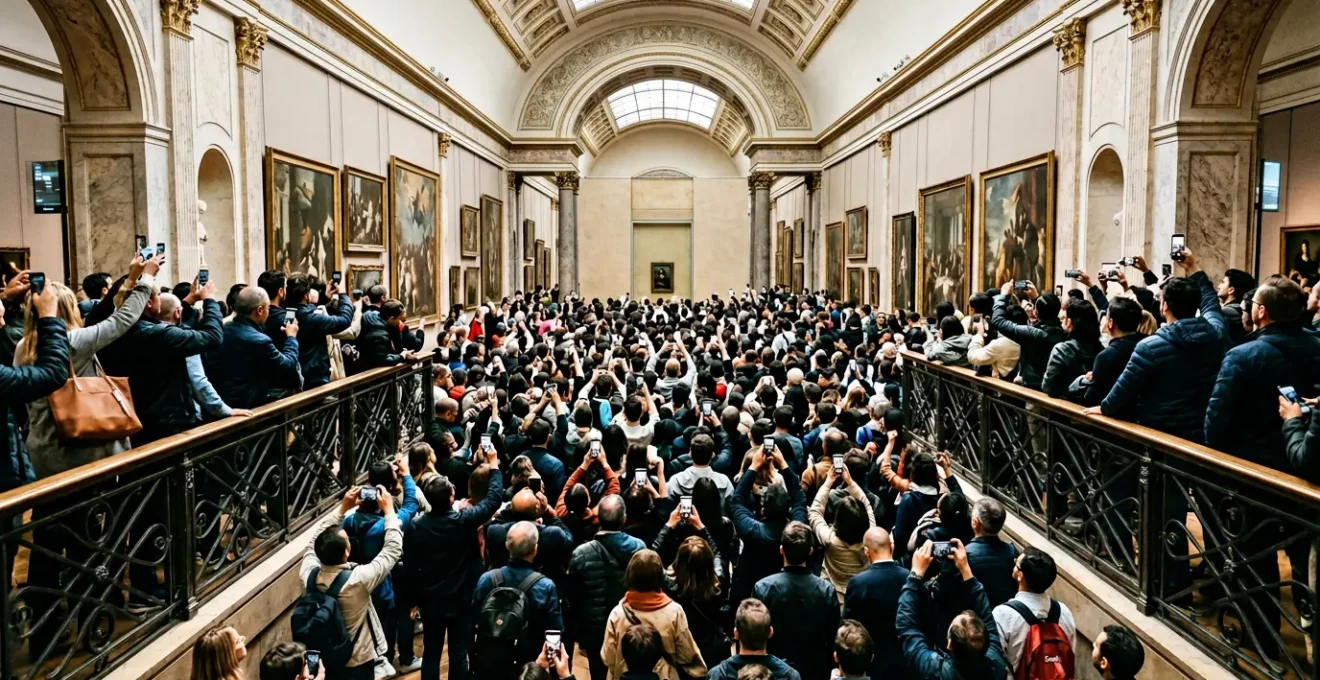
Most believe the Mona Lisa’s fame stems purely from its artistic merit. The truth is far more fascinating. Its global celebrity is a modern social phenomenon, a perfect storm of revolutionary psychological art, a history-making theft that triggered mass media amplification, and a powerful feedback loop of tourism where the challenging viewing experience itself becomes part of a global ritual.
There’s an undeniable gravitational pull to Room 711 of the Louvre. It’s a force that draws nearly 10 million people a year, funnelling them into a dense, expectant crowd. They come from every corner of the globe, phones held aloft, craning their necks for a glimpse of her. But what are they truly here to see? Is it a 16th-century portrait of a Florentine merchant’s wife, or is it something else entirely—an icon, a myth, a cultural pilgrimage site? As a sociologist fascinated by tourism, the question isn’t just “Is she a masterpiece?” but “How did this specific painting become the global phenomenon it is today?”
The easy answers are well-known: Leonardo da Vinci was a genius, her smile is mysterious. These are true, but they are insufficient. They don’t explain why other, equally brilliant Renaissance works don’t command the same relentless queue. To understand the Mona Lisa effect, we must look beyond the canvas. We must dissect the perfect convergence of artistic innovation, historical accident, and human psychology. It’s a story about how an object becomes a symbol, how absence can create presence, and how our collective expectations can shape reality.
This exploration will decode the layers of the Mona Lisa’s fame. We will move from the microscopic genius of her creation to the macroscopic forces of her celebrity, uncovering the mechanisms that transform a piece of painted poplar wood into one of the most powerful magnets on Earth. This is the sociology of a masterpiece.
Summary: Decoding the Mona Lisa Phenomenon
- Is She Happy or Sad: How Does Your Brain Process the Mona Lisa Smile?
- Bridge and Rocks: Where Is the Real Location Behind the Mona Lisa?
- Glass and Crowds: Is It Worth Seeing the Mona Lisa in Person?
- Soup and Cake: Why Is the Mona Lisa the Target of So Many Attacks?
- Why Is Everyone Disappointed by How Small the Mona Lisa Is?
- Why Does the Softening of Edges Make the Face Look Alive?
- Why Did the Theft of the Mona Lisa Make It a Masterpiece?
- How Did Da Vinci Change Portraiture From Status Symbol to Psychology?
Is She Happy or Sad: How Does Your Brain Process the Mona Lisa Smile?
The smile is the epicenter of the Mona Lisa myth. Is it happy, melancholic, or smug? The fascinating truth is that it is all of these and none of them, an effect engineered by Leonardo and processed by your brain’s unique wiring. This isn’t art-history hyperbole; it’s a function of perceptual ambiguity. Your brain, when faced with uncertain visual data, actively tries to fill in the gaps, and its conclusion changes depending on where you look and from how far away.
When you look directly at her eyes, your peripheral vision picks up the subtle shadows at the corners of her mouth, suggesting a smile. When you look directly at her mouth, the smile seems to vanish. This visual trickery is a masterclass in exploiting the differences between your central (foveal) and peripheral vision. Recent research confirms this phenomenon; a 2024 study in Scientific Reports found that 10 out of 10 observers perceived a discernible variation in her expression when viewing the painting from different distances. The smile is not a static feature on the canvas but a dynamic event that occurs inside the viewer’s mind.
Furthermore, the expression itself is psychologically complex. It’s an “unchimerical” smile, meaning it’s asymmetrical and lacks the activation of upper cheek muscles (a Duchenne smile) that we associate with genuine happiness. This lack of clear emotional signaling forces our brains into a state of interpretive flux. We project our own feelings onto her, making the experience deeply personal and endlessly debatable. The Mona Lisa doesn’t just look at you; she makes you look at yourself.
Bridge and Rocks: Where Is the Real Location Behind the Mona Lisa?
While the sitter’s identity is largely settled as Lisa Gherardini, the ethereal landscape behind her remains one of art history’s most compelling puzzles. This is not a mere backdrop; it’s a “fantasy” landscape, a composite of different geological features that likely don’t exist in one single place. This deliberate ambiguity serves a powerful purpose: it lifts the subject out of a specific, identifiable time and place, giving her a timeless and universal quality.
For centuries, art sleuths and historians have been on a quest to pinpoint the real-world inspirations. One prominent theory points to the landscape around Bobbio, a small town in northern Italy, where a 15th-century bridge, the Ponte Gobbo, bears a striking resemblance to the one over Mona Lisa’s left shoulder. Other researchers have made compelling cases for locations in Tuscany, such as the area near Laterina, citing unique rock formations known as “balze” that match the painting’s terrain.
However, the power of the background lies not in finding its real-world twin but in understanding its artistic function. Leonardo was a master of geology and natural sciences. He constructed this landscape to create atmospheric perspective, where distant objects appear hazier, bluer, and less detailed. This technique enhances the illusion of depth and makes the space feel vast and mysterious. The two sides of the landscape also famously don’t line up, a subtle discontinuity that adds to the painting’s unsettling, dreamlike atmosphere. The mystery of the location is not a flaw to be solved but a deliberate feature that contributes to the painting’s enduring allure.
Glass and Crowds: Is It Worth Seeing the Mona Lisa in Person?
For many, the first encounter with the Mona Lisa is an exercise in managing expectations. According to Louvre data, a staggering 80% of the museum’s visitors come primarily to see this one painting. This transforms the viewing from a quiet moment of art appreciation into a modern-day secular pilgrimage, complete with crowds, distance, and a thick layer of bulletproof glass. The experience is often described as overwhelming and even anticlimactic.
The reality of the encounter is a frantic jostle for position. Those who make it to the front are rewarded with a fleeting moment before the pressure of the crowd behind them pushes them onward. In fact, a survey revealed the stark reality of this cultural ritual: the average viewing time for a visitor is a mere 50 seconds. This brief, mediated encounter through protective glass can feel profoundly disconnected from the intimate, psychological portrait Leonardo created.
So, is it worth it? From a purely observational standpoint, perhaps not. You can see a higher-resolution image on your screen at home. But from a sociological perspective, absolutely. To stand in that room is to participate in the phenomenon itself. You are not just looking at a painting; you are witnessing a global cultural ritual in action. The crush of people, the raised phones, the shared sense of purpose—this *is* the Mona Lisa experience in the 21st century. It’s a testament to her power that millions are willing to undertake this often-frustrating journey for just a few seconds in her presence.
Your Action Plan for a Meaningful Mona Lisa Encounter
- Points of contact: Acknowledge the experience involves the room, the crowd, the glass, and the painting. Don’t just focus on the canvas.
- Collecte: Before you go, spend time with a high-resolution digital image. Familiarize yourself with the details you want to see (the hands, the veil, the cracks).
- Cohérence: Frame your visit as a sociological observation. Your goal is not just to see the art, but to witness the phenomenon of people seeing the art.
- Mémorabilité/émotion: When you get your 50 seconds, ignore the urge to take a perfect photo. Instead, try to make direct eye contact and notice how her expression seems to shift.
- Plan d’intégration: After your viewing, step to the side of the room. Watch the crowd. Observe the dynamic. This meta-experience is often more memorable than the direct viewing itself.
Soup and Cake: Why Is the Mona Lisa the Target of So Many Attacks?
From thrown rocks and acid in the 1950s to the more recent protests involving cake and soup, the Mona Lisa has a long history of being a target. This isn’t random; it’s a direct consequence of her unparalleled fame. To attack the Mona Lisa is to attack more than just a painting; it’s to attack a potent symbol of Western culture, history, and the art establishment itself. For those looking to make a statement, there is no bigger or more immediate stage in the world.
In recent years, climate activists have used her as a backdrop to draw attention to their cause. The logic is simple: an attack on the world’s most famous artwork guarantees global media coverage, thus amplifying their message. The act is purely symbolic. Thanks to her state-of-the-art protective glass, the painting is never in any real danger. The goal is not destruction but communication, using the painting’s immense cultural capital as a broadcast tower for their own agenda.
However, the effectiveness of this strategy is highly debatable. Far from galvanizing public support, using a beloved cultural icon as a prop can backfire spectacularly. A survey from the Penn University Center for Science, Sustainability & The Media revealed that 46% of respondents report such protests decrease their support for climate change efforts, while only 13% report an increase. This suggests that while the attacks succeed in gaining attention, they may alienate the very public they seek to persuade. The Mona Lisa, in her silent, protected state, thus becomes a focal point for a complex debate on the ethics and efficacy of modern protest.
Why Is Everyone Disappointed by How Small the Mona Lisa Is?
One of the most common refrains from first-time viewers is a sense of surprise, even disappointment, at the painting’s size. Conditioned by a lifetime of seeing her reproduced on giant posters, book covers, and movie screens, we build a monumental image in our minds. The reality is far more intimate. The physical dimensions reveal that the Mona Lisa measures just 77 cm tall and 53 cm wide (about 30 x 21 inches)—smaller than a standard piece of carry-on luggage.
This phenomenon is known as expectation disparity, the psychological gap between our mental representation of an object and its physical reality. The Mona Lisa may be the world’s most extreme example of this. Her fame is colossal, her cultural footprint is global, yet her physical presence is modest. This disconnect is so powerful that a 2024 analysis of over 18,000 online reviews by CouponBirds found that nearly 4 in 10 reviewers deemed her the “world’s most disappointing masterpiece.”
But this “disappointment” is, in itself, a crucial part of the modern Mona Lisa story. It generates conversation, fuels debate, and manages the expectations of future visitors. The surprise at her smallness has become a canonical part of the pilgrimage. It’s a reminder that her power isn’t derived from sheer scale, but from the dense concentration of genius, mystery, and history packed within that small frame. In a world that often prizes size, she is a quiet testament to the monumental impact of the intimate.
Why Does the Softening of Edges Make the Face Look Alive?
The Mona Lisa feels alive in a way few portraits do. This is not an accident but the result of a revolutionary technique Leonardo pioneered and mastered: sfumato. The word, Italian for “vanished” or “evaporated,” perfectly describes its effect. It is the technique of softening the transition between colors and tones, eliminating hard outlines and allowing light and shadow to blend seamlessly.
Da Vinci himself described the goal of the technique in his notebooks. As he wrote about his studies of optics and shadow:
Light and shade should blend without lines or borders, in the manner of smoke.
– Leonardo da Vinci, Leonardo’s notebooks on optics and shadow
This technique is most evident at the corners of the eyes and mouth. Because there are no sharp lines defining the expression, our brain struggles to lock it into a single state. The features appear to be in a constant, subtle state of flux, mimicking the micro-movements of a living human face. It creates an illusion of a captured moment, a breath held. While other artists of the time painted static, clearly defined figures, Leonardo painted a psychological presence. The *sfumato* is the technical engine behind the painting’s famous ambiguity and its uncanny sense of life.
Why Did the Theft of the Mona Lisa Make It a Masterpiece?
Before 1911, the Mona Lisa was a respected Renaissance painting, but she was far from a global icon. She was known to art connoisseurs but not to the general public. That all changed on August 21, 1911. The story of her transformation into a household name is not a story of art history, but a story of crime, media, and the power of absence.
Case Study: The 1911 Theft and Mass Media Amplification
When Vincenzo Peruggia, a Louvre employee, hid in a closet and stole the painting, its initial absence went unnoticed for a surprisingly long time; historical records show that 26 hours elapsed before anyone realized she was missing. But once the alarm was raised, the story exploded. For the first time, newspapers around the world, from Paris to New York, printed her image on their front pages. The painting’s absence created an unprecedented level of global presence. For 28 months, she was the world’s most famous missing person. When the Louvre reopened, thousands flocked not to see art, but to stare at the empty space on the wall where she used to be—a testament to her newfound celebrity.
This event was the single most important catalyst in the Mona Lisa’s journey to superstardom. The theft and the subsequent media frenzy lifted her out of the museum and into the public consciousness. She became a symbol of stolen national treasure, a detective story, and a global sensation. When she was finally recovered and returned, she was no longer just Lisa Gherardini; she was “La Joconde,” the celebrity. The theft gave her a story, and that story is inseparable from the fame she holds today.
Key Takeaways
- The Mona Lisa’s fame is a product of social and historical forces, not just artistic genius.
- Technical innovations like sfumato create a psychological effect of ambiguity that engages the viewer directly.
- The 1911 theft was the key event that transformed the painting into a global media icon through mass media amplification.
How Did Da Vinci Change Portraiture From Status Symbol to Psychology?
Before Leonardo da Vinci, the primary purpose of a portrait was to document. It was a record of status, wealth, and lineage. Subjects were often painted in stoic profile, adorned with fine clothes and jewelry, their expressions flat and their inner lives inaccessible. Leonardo shattered this tradition. He wasn’t interested in simply painting a person’s likeness; he wanted to paint their soul.
This revolutionary approach was driven by his quest to capture what he called “moti mentali”—the motions of the mind. As art historians analyzing his humanist philosophy note, this pursuit represented a profoundly humanist goal, shifting art’s focus from social status to the human soul. The Mona Lisa is the ultimate expression of this ambition. She is not defined by her clothes or her possessions. In fact, her attire is remarkably simple for the wife of a wealthy merchant. All of the painting’s energy is directed toward her face and her complex, inscrutable inner state.
He achieved this through a combination of groundbreaking techniques. The three-quarter pose, which creates a more intimate and engaging relationship with the viewer; the relaxed, natural position of her hands, a departure from the stiff gestures of earlier portraits; and, of course, the *sfumato* that gives her expression its living, breathing quality. By stripping away the external markers of status and focusing entirely on the internal world of his subject, Leonardo transformed the portrait from a social document into a psychological exploration. Every portrait painted since owes a debt to this monumental shift.
The next time you find yourself in front of a cultural icon, whether it’s a painting, a building, or a piece of music, look beyond the object itself. Ask what social forces, historical accidents, and human stories conspired to create its legend. In doing so, you’ll discover a story far richer than the one contained within the frame.