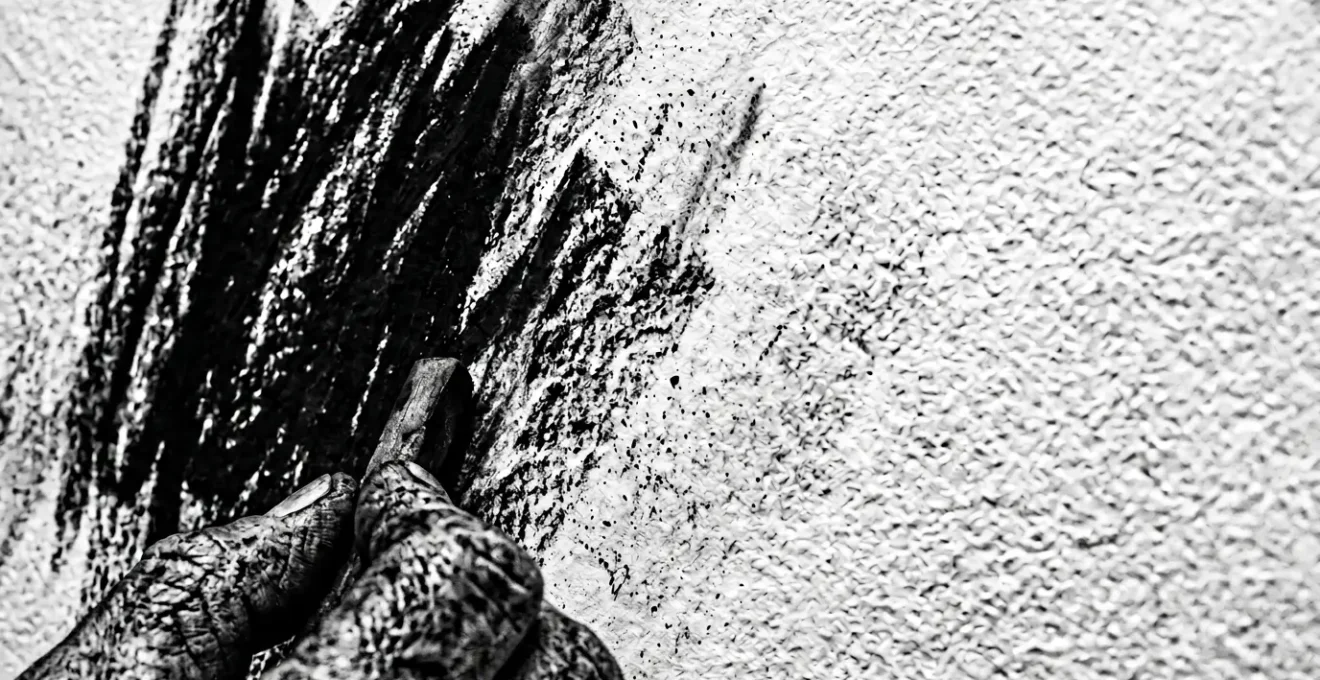
Picasso’s choice of a black and white palette for Guernica was not merely for mood; it was a deliberate strategy to transform the painting into a piece of stark, irrefutable evidence. By rejecting the aesthetic distraction of color, especially blood-red, he stripped the atrocity of any heroic romanticism. The monochrome turns the canvas into a forensic document, mimicking the journalistic immediacy of a newspaper photograph to present the cold, hard proof of the bombing to the court of world opinion.
When we imagine a painting of war’s carnage, our mind’s eye instinctively pictures the color red. It is the color of violence, of sacrifice, of life spilled. Yet, when confronted with Pablo Picasso’s monumental masterpiece, Guernica, the most powerful anti-war statement in modern art, there is a profound and unsettling absence. The screaming figures, the gored horse, the shattered bodies—all are rendered in a stark, brutal palette of black, white, and grey. Why, in a depiction of a bloody massacre, is there no blood?
The common explanations are well-known: the monochrome mimics the look of newspaper photographs, lending it a sense of journalistic truth, or that it creates a somber, funereal mood. While true, these interpretations only scratch the surface of a far more radical and calculated decision. As a historian who has studied the deep wounds of the Spanish Civil War, I see this choice not as passive, but as an act of aggression. Picasso weaponized the absence of color to perform a specific function.
But what if the key to understanding Guernica lies not in what it looks like, but in what it *does*? This was not meant to be a simple depiction of an event. It was conceived as a forensic document, a piece of visual evidence presented against the perpetrators. By systematically draining the color, Picasso de-romanticized the conflict, refusing to grant the violence the aesthetic dignity of a history painting. He presented the horror not as a dramatic tragedy, but as a cold, hard fact.
This article will deconstruct the layers behind this monumental choice. We will explore how the painting’s symbolism, its very scale, and its documented creation process all contribute to its function as a monochromatic testimony. By analyzing its journey through the world and its continued power to disrupt, we will understand why its black-and-white reality is more harrowing than any shade of red could ever be.
Summary: The Stark Truth of Guernica’s Monochrome Palette
- Bull or Fascism: What Do the Animals in Guernica Really Represent?
- Mural Size: How Does the Scale of Guernica Physically Affect the Viewer?
- How Did Guernica’s World Tour Help Fund the Spanish Resistance?
- The Tapestry Cover-Up: Why Was Guernica Covered at the UN in 2003?
- Dora Maar’s Photos: How Did the Painting Change Over the 35 Days?
- Why Did Cubists Reject the Single Perspective Used for 500 Years?
- Why Is Ambiguity the Artist’s Best Defense Against Censors?
- Why Was “Les Demoiselles” Called the Most Ugly Painting in Paris?
Bull or Fascism: What Do the Animals in Guernica Really Represent?
The world of Guernica is a nightmare populated by silent screams and contorted bodies, dominated by two powerful animals: the bull and the horse. Their meaning has been debated since the mural’s creation, and this very ambiguity is central to the work’s power as a piece of evidence. When pressed, Picasso himself was famously enigmatic, stating of the bull that it meant brutality and darkness, but leaving the final interpretation to the viewer. This was not an evasion; it was a strategy. By refusing to assign a single, simple meaning, he forces us to look beyond allegory and confront the raw, universal suffering depicted.
The most common interpretation, as art historians have analyzed, suggests the bull symbolizes the onslaught of Fascism or the unfeeling brutality of the attack, impassively watching the chaos it has wrought. The horse, disemboweled and screaming in agony, is often seen as representing the innocent people of Guernica, a symbol of noble suffering. Yet, other interpretations exist, some casting the bull as a symbol of Spanish identity and endurance, a bewildered witness rather than a perpetrator. This intentional lack of a clear narrative key prevents the viewer from settling on a simple story of good versus evil.
This ambiguity serves the painting’s purpose as a forensic document. In a court of law, evidence is presented, and interpretations may vary, but the core facts of the crime remain. Here, the undeniable fact is the agony. Whether the bull is Franco or Spain, the result is the same: chaos, death, and despair. Picasso’s refusal to provide easy answers denies us the comfort of a resolved narrative, leaving us instead with the unsettling and irrefutable evidence of pain itself, rendered in the cold, hard language of black and white.
Mural Size: How Does the Scale of Guernica Physically Affect the Viewer?
Guernica is not a painting you simply look at; it is an environment you enter. Its power is not just in its imagery, but in its physical dominance over the viewer. The canvas is a colossal structure, a wall of grief that confronts you with its sheer presence. Official records state that the mural measures an imposing 3.49 meters (11 ft 5 in) tall and 7.76 meters (25 ft 6 in) wide. These are not arbitrary dimensions. They were chosen to match the scale of historical epic paintings, but instead of celebrating a glorious victory, Picasso uses this monumental format to document a modern atrocity, giving it the weight and permanence of history.
Standing before it, the viewer is dwarfed, unable to take in the entire scene at once. You are forced to scan the canvas as if reading a harrowing text, your eyes moving from the screaming mother on the left to the figure trapped in a burning building on the right. This physical act of engagement makes the experience immersive and deeply personal. The lack of color enhances this effect. Without the distraction of chromatic hues, the scale and the stark, graphic lines of the composition become overwhelming. You are not a distant observer of a historical event; you are a witness standing in the rubble, engulfed by the visual evidence of the chaos.
This scale transforms the painting from a political statement into a physical memorial. It is an architectural space of mourning. Picasso uses the monumental tradition not for glorification, but for accusation. The size ensures you cannot ignore it, you cannot domesticate it, and you cannot escape the feeling of being implicated in its tragedy. The monochromatic wall of images becomes a public indictment, its size demanding a public response.
How Did Guernica’s World Tour Help Fund the Spanish Resistance?
Guernica was never intended to be a private work of art confined to a gallery. From its inception, it was a piece of public testimony, a traveling witness for the Spanish Republic’s cause. After its initial, and somewhat underwhelming, debut at the 1937 Paris International Exposition, the painting began its true mission. It was sent on an international tour, not merely for exhibition, but as a potent tool for propaganda and fundraising. The Republican government, desperate for international support against Franco’s fascist forces, understood the power of Picasso’s stark, visual reportage.
According to historical accounts of the tour, after leaving Paris, the painting traveled to Scandinavia and England, where it served as a backdrop for rallies and fundraising events to raise awareness and desperately needed funds for Spanish war relief. When it arrived in the United States in 1939, its purpose was explicit: to aid the Spanish Refugee Relief Campaign. For nearly two decades, under the stewardship of the Museum of Modern Art (MoMA), Guernica toured the country, its fame growing with every stop. It became the face of anti-fascist art, transforming Picasso into a household name and introducing Cubism’s fractured perspectives to a mass audience.
The choice of monochrome was critical to its success as a traveling ambassador. As one analysis notes, “The discarding of color intensifies the drama, producing a reportage quality as in a photographic record.” This journalistic immediacy made the horror of a distant war in a small Basque town universally understandable. It didn’t need translation. The painting was a silent, rolling headline broadcasting the brutality of modern warfare. Every admission fee, every donation made in its presence, was a direct contribution to the resistance, fueled by the cold, monochromatic fury captured on the canvas.
The Tapestry Cover-Up: Why Was Guernica Covered at the UN in 2003?
For decades, a full-size tapestry reproduction of Guernica, commissioned by Nelson Rockefeller in 1955, hung at the entrance to the UN Security Council chamber. It served as a constant, stark reminder to the world’s most powerful diplomats of the horrific consequences of war. But on February 5, 2003, as US Secretary of State Colin Powell prepared to make his case for the invasion of Iraq, the tapestry was quietly concealed behind a large blue curtain. The image of screaming women and shattered bodies was deemed an inappropriate backdrop for an argument for war.
UN officials initially claimed the cover-up was for purely technical reasons, suggesting the stark black and white composition was visually too confusing for television cameras. However, this explanation was widely dismissed. As reported by diplomats at the time, the US delegation had exerted pressure to hide the artwork. They understood, implicitly, that arguing for military action in front of the world’s most potent anti-war symbol would create a jarring and damning visual contradiction. The act of hiding the painting was a tacit admission of its enduring power as a forensic document against state-sanctioned violence.
This incident, nearly 70 years after the painting’s creation, is perhaps the most compelling evidence of its success. The raw, monochromatic testimony was still so potent, so accusatory, that it had to be censored on the world’s highest diplomatic stage. As a cultural analysis in Slate at the time noted, “The continuing sensitivity to Guernica…may remind us that modern art is poor in images glorifying just military action, though rich in images of the horrors and injustices of war.” The blue curtain could not hide the truth; it only amplified it, proving that Picasso’s black-and-white indictment of brutality remains timeless and profoundly uncomfortable for those who would wage war.
Dora Maar’s Photos: How Did the Painting Change Over the 35 Days?
The creation of Guernica was an act of frantic, furious energy, completed in just over a month. We have an unparalleled window into this process thanks to Picasso’s partner at the time, the photographer and artist Dora Maar. She was granted exclusive access to document the painting’s evolution, capturing each stage of its creation in a series of powerful black-and-white photographs. These images are more than just a historical record; they are a key piece of evidence in understanding the deliberate choice of a monochrome palette.
As Maar photographed the work-in-progress, she provided Picasso with a real-time reflection of his composition, but filtered through the lens of her own medium. He could see his painting as a photograph before it was even finished. This feedback loop was crucial. Art historian John Richardson argued that Maar’s photographs “helped Picasso to eschew color and give the work the black-and-white immediacy of a photograph.” Seeing his work transformed into a stark, graphic document reinforced the power of this aesthetic. The journalistic truth he sought was being validated with every click of Maar’s shutter.
The photographs document a painting in flux. Elements appeared, shifted, and vanished. A clenched fist holding a flower was painted over; a weeping woman’s features were re-arranged for maximum anguish. But through it all, the commitment to monochrome only solidified. The photographic documentation was not a passive observer of the process; it was an active participant. It affirmed that the way to translate the horror of the news reports from Guernica was to adopt their very visual language: the stark, evidentiary, and undeniable reality of a black-and-white image. The painting became its own newsprint.
Why Did Cubists Reject the Single Perspective Used for 500 Years?
To fully grasp Guernica‘s visual language, one must understand Cubism, the revolutionary style Picasso co-invented decades earlier. For 500 years, Western art was dominated by linear perspective—the idea of creating a realistic illusion of three-dimensional space on a two-dimensional surface from a single, fixed viewpoint. The Cubists saw this as a lie. Our experience of the world is not static; we see objects and people from multiple viewpoints simultaneously as we move through space. Cubism sought to paint this truer, more complex reality.
Cubism shatters objects into geometric planes and reassembles them, showing the front, side, and back all at once. It rejects a single, authoritative viewpoint in favor of a fragmented, multifaceted truth. In his early works, this was a formal, intellectual exercise. In Guernica, it becomes a weapon. The bombing of Guernica was not a clean, singular event; it was a maelstrom of chaos, terror, and simultaneous destruction. A single, orderly perspective could never capture the disorienting horror of bombs falling, buildings collapsing, and bodies being torn apart all at once. The fractured, multi-perspective view of Cubism was the only visual language capable of conveying this pandemonium.
The monochrome palette works in concert with this Cubist structure. As one analysis notes, Guernica “combines Cubist structures with a monochrome palette which renders the painting more realistic.” This seems paradoxical, but it’s key. Color would have grounded the fragmented shapes in a more familiar, decorative reality. By removing it, Picasso emphasizes the structural violence of the scene. The sharp, jagged lines and overlapping planes are not softened by color. They become the primary vehicle for conveying pain. The shattered perspective of Cubism mirrors the shattered lives on the ground, and the black-and-white palette ensures we see it with the cold clarity of a forensic report.
Why Is Ambiguity the Artist’s Best Defense Against Censors?
In a totalitarian state, speaking truth to power is a dangerous act. An artist creating a work of protest must often walk a fine line, embedding their message in symbols and allusions to avoid the censor’s heavy hand. In Guernica, Picasso masterfully uses ambiguity as a shield. As scholarly analysis reveals, interpretations of the painting’s key symbols, the bull and the horse, vary widely and often contradict one another. Is the bull Fascism, or the stoic spirit of Spain? This very uncertainty allowed the work to be displayed and discussed, as no single, treasonous message could be definitively proven.
However, while the symbols are ambiguous, the emotional tone is not. There is no doubt that this is a work about immense suffering. Picasso achieves this undeniable clarity precisely through his rejection of color. As scholar Beverly Ray states, “Picasso uses black, white, and grey paint to set a somber mood and express pain and chaos.” The lack of color is the one element of the painting that is utterly unambiguous. It is a universal signifier of mourning, of newsprint, of stark reality, and of death. It is the artist’s direct accusation, stripped of any symbolic veils.
This creates a powerful duality. The symbolic language (the *what*) is open to interpretation, providing a defense against censorship. But the aesthetic language of the monochrome (the *how*) is a direct and irrefutable statement of horror. He allows for debate over the details to ensure the work survives, while delivering the core message of atrocity with a force that no one can mistake. It’s a masterclass in political art: protect the message with a layer of ambiguity, but deliver the emotional payload with absolute, devastating clarity.
Your Action Plan: How to Decode a Work of Protest Art
- Context: Research the specific historical event, political climate, or social injustice that prompted the artwork.
- Symbolism: Identify recurring figures, objects, or animals and investigate their potential meanings within that culture and time.
- Aesthetics: Analyze the core artistic choices (color, style, scale, medium) and ask why the artist chose them over other options.
- Reception: Investigate how the work was received by the public, critics, and authorities at the time of its creation.
- Legacy: Trace the artwork’s influence and how its meaning has been re-interpreted or used in later social or political contexts.
Key Takeaways
- Guernica’s monochrome is not just aesthetic; it’s a deliberate choice to mimic the factual, evidentiary nature of newsprint photography.
- By rejecting color, especially red, Picasso de-romanticized the violence, presenting the bombing as a cold, brutal fact, not a heroic battle.
- The painting’s immense scale and touring exhibition transformed it from an artwork into a traveling piece of political testimony against fascism.
Why Was “Les Demoiselles” Called the Most Ugly Painting in Paris?
Long before Guernica, Picasso had already established himself as an artist willing to shatter aesthetic conventions. In 1907, his painting Les Demoiselles d’Avignon shocked the Parisian art world. Its jagged forms, distorted faces inspired by Iberian and African masks, and aggressive confrontation with the viewer led even his closest friends and patrons to deem it ugly and barbaric. But with Demoiselles, Picasso proved he was willing to sacrifice conventional beauty in the pursuit of a new, more potent form of expression. He was breaking art to remake it.
He brought this same revolutionary disregard for aesthetic pleasure to Guernica, but this time it was infused with political fury. The final, damning piece of evidence for the purpose behind the monochrome comes from the painting’s own creation. As art historical documentation reveals, Picasso did, in fact, briefly consider using color. “Originally, he’d painted a red tear on the woman’s face but ultimately decided not to keep it.” This small detail is monumental. He tried red—the color of blood, of passion, of life—and he actively rejected it. It was a conscious act of removal, a decision that he did not want to aestheticize or beautify the pain in any way.
A red tear would have been poignant, even beautiful in its tragedy. But Picasso wanted none of it. He was not creating a romantic lament; he was filing a legal brief. He was presenting a forensic report on an atrocity. The removal of that single red tear is the moment the painting solidifies its purpose as a stark, monochromatic testimony. The horror had to be cold, factual, and absolute, unadorned by the sentimentality of color. This artistic choice is grounded in the horrific reality of the event itself; the devastating attack resulted in casualties numbering from an estimated 126 victims to the Basque government’s report of 1,654 people killed.
Ultimately, Guernica is black and white because war is not a beautiful tragedy. It is a brutal, chaotic, and soul-crushing fact. By stripping the scene of color, Picasso forces us to confront this truth without the comforting filter of aesthetics. To understand his choice is to move beyond art history and into the realm of human testimony, viewing his masterpiece not just as a painting, but as enduring evidence against the darkness of which we are capable.