The charge of “ugliness” leveled against Les Demoiselles d’Avignon completely misses the point; the painting was never meant to be beautiful, it was engineered as an assault.
- Picasso deliberately shattered Renaissance perspective to demolish the safe distance between the art and its audience.
- By removing the original male figures, he forced the viewer into the role of the client, making them the direct target of the figures’ confrontational gaze.
Recommendation: Stop trying to “like” the painting. Instead, appreciate it as a weapon—a calculated act of aesthetic violence that blew the doors off modern art.
For over a century, the verdict on Pablo Picasso’s Les Demoiselles d’Avignon has been filtered through a single, misleading lens: that it was shockingly “ugly.” Critics and even friends recoiled from its jagged forms, its dead-eyed stares, and its brutal rejection of feminine grace. The work was deemed a monstrous failure, a perverse joke. But this entire line of critique is built on a flawed premise. It assumes Picasso’s goal was beauty, and that he somehow missed the mark. The truth is far more radical and unsettling.
The painting wasn’t a failed attempt at a masterpiece. It was a successful act of aggression. Picasso wasn’t trying to charm or delight; he was looking for a fight. He systematically dismantled every sacred rule of Western art—perspective, proportion, narrative—not out of ignorance, but with the cold precision of a demolitions expert. He wasn’t just painting women in a brothel; he was weaponizing the canvas itself, turning a passive viewing experience into an uncomfortable, face-to-face confrontation from which there is no escape. This was not an evolution; it was a detonation.
This article will deconstruct the strategic violence of Les Demoiselles. We will explore how Picasso used African masks not as homage but as armament, how his rivalry with Matisse fueled the work’s ferocity, and crucially, how the removal of two key figures transformed the painting from a story you could observe into an accusation you must endure. Forget ugly. It’s time to understand the work for what it is: a declaration of war.
Summary: Why Les Demoiselles d’Avignon Was a Declaration of War
- Appropriation or Homage: How Did Trocadero Masks Shape the Faces?
- Avignon Street: Why Is the Title of the Painting Misleading?
- Flatness: How Did Picasso Destroy the Renaissance Window in One Painting?
- Matisse vs. Picasso: How Did Rivalry Fuel the Creation of this Work?
- Why Did Picasso Remove the Two Male Figures From the Final Version?
- Why Is Hanging a Ritual Mask on a Wall Controversial for Some?
- Collage or Fracture: Which Phase of Cubism Changed Design Forever?
- How to “Read” a Cubist Painting Without Feeling Confused?
Appropriation or Homage: How Did Trocadero Masks Shape the Faces?
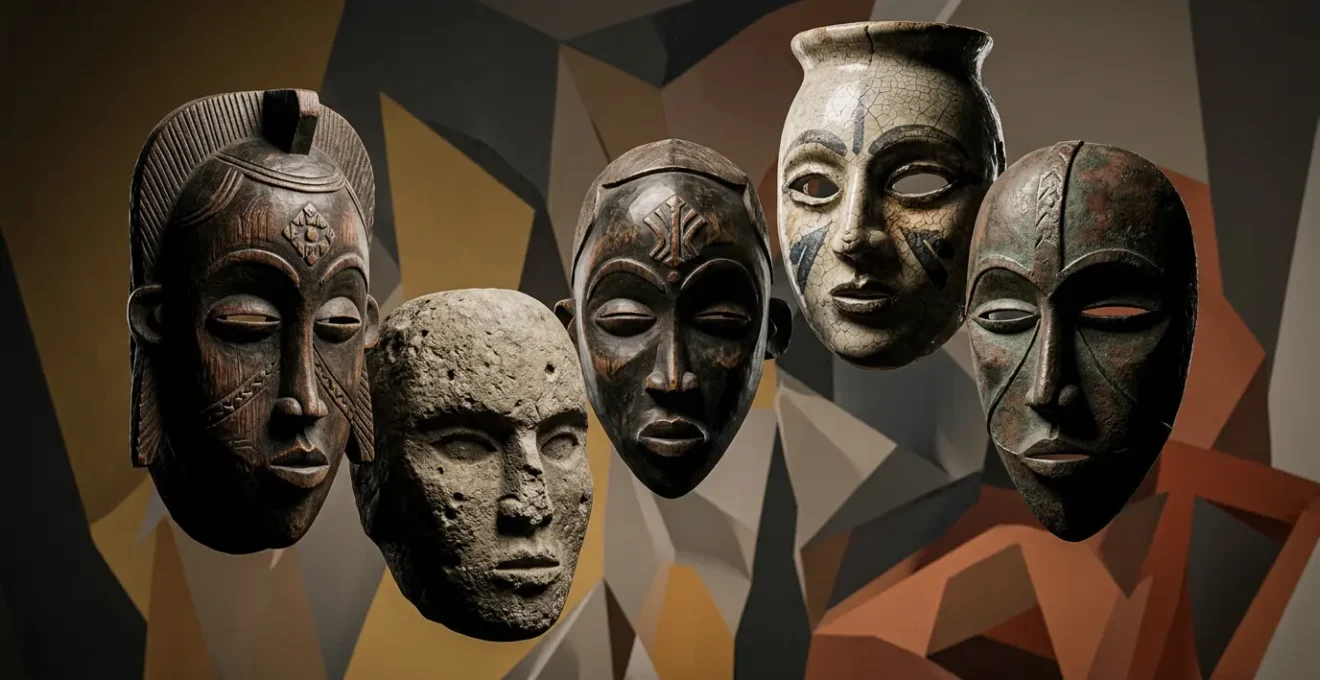
The most immediate assault in Les Demoiselles is on the human face itself. The two figures on the right are not merely distorted; they are violently remade, their features fractured and reassembled into something primeval and unnerving. This wasn’t an abstract exercise. It was a direct result of Picasso’s “discovery” of African and Iberian art at Paris’s Trocadéro ethnographic museum. He saw in these ritual objects not exotic curiosities, but a raw, magical power that European art had lost. He saw a way to express a spiritual intensity, an aesthetic violence that could jolt the viewer out of complacency.
These were not portraits but appropriations of power. Picasso wasn’t interested in the cultural context of the masks; he was interested in their formal aggression—the sharp geometric planes, the concave surfaces, the brutal simplification of features. As art historian Suzanne Blier notes, Picasso was always “absorbing, appropriating, and transforming.” He hijacked their spiritual force to serve his own revolutionary purpose: to make the viewer feel something other than passive admiration. This act of borrowing remains deeply controversial, with contemporary Ugandan artist Francis Nnaggenda famously retorting, “People tell me my work looks like Picasso, but they have it wrong. It is Picasso who looks like me, like Africa.”
Avignon Street: Why Is the Title of the Painting Misleading?
The painting’s title, Les Demoiselles d’Avignon, is a polite fiction, a piece of marketing that papers over a much grittier reality. The “Avignon” in question is not the papal city in France but the Carrer d’Avinyó, a street in the heart of Barcelona’s red-light district, home to a brothel Picasso knew well. The original title he preferred was far more blunt: Le Bordel d’Avignon (The Brothel of Avignon). The final title was a later invention by the critic André Salmon, intended to make the work more palatable for public exhibition—an exhibition that wouldn’t happen for years.
This delay is perhaps the most potent evidence of the work’s confrontational power. After its completion in 1907, the painting was so universally condemned by Picasso’s innermost circle—including patrons and fellow artists like Georges Braque—that it was rolled up and hidden away. In fact, the painting remained hidden in Picasso’s studio for nine years, unseen by the public until 1916. This was not a work that was misunderstood; it was a work that was understood all too well. It was a monster, an act of aesthetic terrorism that even the avant-garde wasn’t ready for.
The polite title is a red herring. It distracts from the raw, transactional nature of the scene Picasso originally envisioned. The “Demoiselles” are not ladies; they are commodities staring back at their consumer. The nine-year quarantine is proof that Picasso had succeeded in creating something so potent and disturbing that it had to be contained. The painting wasn’t just ahead of its time; it was a threat to it.
Flatness: How Did Picasso Destroy the Renaissance Window in One Painting?
Since the 15th century, Western painting had been dominated by a single, powerful illusion: the canvas as a “window onto the world.” Through the mathematics of linear perspective, artists created a believable, three-dimensional space that the viewer could look into from a safe, fixed viewpoint. With Les Demoiselles, Picasso took a sledgehammer to that window. He didn’t just bend the rules of perspective; he demolished the very concept of a single, coherent space.
The figures are a collision of viewpoints. A nose is seen in profile while the face is frontal. The squatting figure on the right is seen from the front and back simultaneously. The background, a mess of ambiguous drapery, pushes forward, crowding the figures and refusing to recede. This is the birth of the shattered space of Cubism. There is no depth, no comfortable place for the eye to rest. The space is as fractured and aggressive as the figures themselves. This was not incompetence; it was a radical redefinition of reality. As the critic Jacques Rivière argued in 1912, this use of multiple perspectives allows “greater truth and accuracy” than the traditional style by presenting an object as it is known, not just as it is seen from one angle in one moment.
By collapsing space, Picasso destroyed the barrier between the viewer and the viewed. The figures aren’t *in* a room; they are pressed up against the picture plane, invading our space. You are not looking through a window; you are locked in a room with them. This rejection of comfortable illusion is, as the critic John Berger stated, “a revolution in the visual arts as great as that which took place in the early Renaissance.” Picasso didn’t just change the picture; he changed the entire relationship between the painting and its audience.
Matisse vs. Picasso: How Did Rivalry Fuel the Creation of this Work?
Les Demoiselles was not created in a vacuum. It was a direct, aggressive response to Picasso’s greatest rival: Henri Matisse. Just a year earlier, in 1906, Matisse had scandalized and then captivated Paris with his monumental work, Le Bonheur de Vivre (The Joy of Life). Matisse’s painting was a pagan paradise, a symphony of flowing lines and sensuous, vibrant color. While radical, it was ultimately a vision of harmony and Arcadia. For Picasso, it was a challenge that had to be answered, not with more harmony, but with discord.
Where Matisse used color to express joy, Picasso used form to express a raw, violent energy. Where Matisse’s nudes lounge languidly in a mythical landscape, Picasso’s stand rigid and confrontational in a claustrophobic room. Matisse, born in 1869, was twelve years Picasso’s senior, the established leader of the avant-garde. Les Demoiselles was the younger artist’s audacious attempt to usurp him. Art historian John Golding put it best when he said that if Le Bonheur de Vivre is a landmark, Les Demoiselles “changed its very course.” It was Picasso’s gambit to out-radical the king of the radicals.
Matisse himself was reportedly furious, viewing the painting as a barbaric assault and a personal mockery of his work. He was right. Les Demoiselles is the anti-Bonheur de Vivre. It’s a painting fueled by professional jealousy and a burning desire to create something so new and so shocking that it would make everything else—even Matisse’s masterpiece—look tame and decorative by comparison. It was a declaration of artistic war, and Picasso won.
Why Did Picasso Remove the Two Male Figures From the Final Version?
The single most decisive act in the creation of Les Demoiselles was not an addition, but a subtraction. Early sketches for the painting included two male figures: a sailor seated among the women, and a medical student entering from the left, holding a book or a skull. Their presence would have created a traditional narrative scene—a *memento mori* or an allegory of vice and virtue. The viewer would have been a spectator to this story. By removing them, Picasso executed his most brilliant and aggressive move.
Evolution from Narrative to Confrontation: The Male Figures’ Removal
In earlier preparatory sketches, Picasso included a male medical student holding a skull (a symbol of mortality) and a sailor client. After creating hundreds of studies, he made the crucial decision to eliminate both male figures from the final composition. This act of removal was transformative. It shifted the painting from a traditional narrative scene, which viewers could observe from a safe, external distance, into a direct and unsettling confrontational experience. Without the male figures acting as intermediaries, the viewer themselves becomes the implicated presence, forced to stand in the position of the client and face the women’s unashamed, direct stares without the buffer of a story.
With the men gone, a vacuum is created, and the viewer is pulled into it. You are no longer watching a scene in a brothel; you have just walked into one. The women now stare directly at *you*. The viewer becomes the voyeur, the client, the intruder. The fourth wall is not just broken; it is annihilated. This is the source of the painting’s enduring power and discomfort. It implicates its audience. We are caught in the act of looking, and the subjects of our gaze look back with an unnerving lack of shame or invitation. They are simply there, confronting our presence.
This is the masterstroke that transforms the painting from a revolutionary image into a psychological event. Picasso didn’t just paint prostitutes; he engineered an encounter, forcing anyone who stands before the canvas into an active, uncomfortable role. The “ugliness” is not in the forms, but in the reflection the painting forces upon us.
Why Is Hanging a Ritual Mask on a Wall Controversial for Some?
Picasso’s use of African masks as a formal weapon ripped them from their original context. In their native cultures, these objects were not “art” to be hung on a wall. They were functional, ritualistic items imbued with specific spiritual power, meant to be used in performances and ceremonies. Displaying a mask in a museum or a collector’s home is an act of decontextualization—it strips the object of its purpose and turns it into a purely aesthetic artifact.
Art historian Hal Foster critiqued this process, stating, “The founding act of this recoding is the repositioning of the tribal object as art. This aestheticization allows the work to be both decontextualised and commodified.” Picasso was a key agent in this recoding. He saw the formal power but disregarded the cultural meaning, a practice that sits at the heart of the debate around “primitivism” and cultural appropriation. For many, this represents a colonialist mindset, where a dominant culture plunders the artifacts of another for its own aesthetic gain, without acknowledgment or understanding.
The Northeast Louisiana Delta African-American Heritage Museum puts it succinctly: “The key difference between influence and appropriation is acknowledgment.” Had Picasso named his sources, had he credited the specific cultures from which he borrowed so heavily, the history of modern art—and the discourse around Les Demoiselles—might be very different. The controversy persists because the act of hanging a ritual mask on a wall, just as Picasso did in his studio, is to prioritize its aesthetic appeal over its soul, turning a living piece of culture into a silent trophy.
Key Takeaways
- Les Demoiselles d’Avignon was not a failed attempt at beauty, but a successful act of aesthetic aggression.
- Picasso shattered Renaissance perspective to eliminate the viewer’s safe distance from the artwork.
- By removing the original male figures, he made the viewer the direct, uncomfortable subject of the women’s confrontational gaze.
Collage or Fracture: Which Phase of Cubism Changed Design Forever?
The “aesthetic violence” unleashed in Les Demoiselles did not end with the painting. It became the foundational language of Cubism, a movement that would permanently alter the DNA of 20th-century art and design. The first phase, Analytical Cubism (roughly 1908-1912), directly evolved from the fractured space of Les Demoiselles. Artists like Picasso and Braque continued to dissect objects and figures, breaking them down into geometric planes and showing them from multiple viewpoints at once, typically using a muted, monochromatic palette.
This initial phase of fracture gave way to Synthetic Cubism (1912 onwards), which took the revolutionary step of introducing non-art materials directly onto the canvas. Scraps of newspaper, wallpaper, and labels were incorporated, giving birth to collage as a serious art form. This phase was less about deconstructing a visible reality and more about constructing a new one from disparate elements. Both phases, however, shared a core principle inherited from Les Demoiselles: the rejection of a single, unified illusion in favor of a fragmented, multi-layered reality.
The impact was seismic. The new language of fracture, collage, and multiple perspectives broke out of the fine art gallery and infected everything. As noted by Artlex, Cubism directly influenced at least six major twentieth-century art and design movements, including Futurism, Surrealism, and De Stijl. Designers like A.M. Cassandre and Edward McKnight Kauffer adapted its angular dynamism for posters and typography, forever changing the look of commercial communication. The visual revolution that began as a declaration of war in a Barcelona brothel became the new world order.
How to “Read” a Cubist Painting Without Feeling Confused?
Facing a Cubist painting for the first time can feel like being asked to read a language you’ve never seen. The familiar rules of representation are gone, leaving many viewers feeling confused or alienated. The key is to abandon the expectation of a photographic snapshot. You are not looking at a single moment in time, but a synthesis of many moments, memories, and viewpoints compressed into one frame. This requires a different way of looking, an active participation rather than passive reception.
Instead of trying to instantly recognize a complete object, look for clues. A curved line might be the edge of a guitar, a series of parallel lines the strings, a block of text a fragment of a newspaper headline. These are not meant to be literal depictions, but visual triggers that suggest the presence of an object within the fractured composition. It’s a visual puzzle, and the pleasure lies in assembling the fragments in your own mind. The goal is not a single “correct” interpretation but an engagement with the artist’s process of seeing and thinking.
Ultimately, learning to read a Cubist work involves letting go of the need for immediate clarity and embracing a more fluid, multi-layered understanding of reality. It’s about appreciating the rhythm of shapes and the harmony of tones as much as it is about identifying the subject matter.
Action Plan: How to Approach a Cubist Artwork
- Embrace Multiple Viewpoints: Recognize that you are seeing the same object from several angles at once, compressed into a single image. Don’t look for a single, frozen moment.
- Hunt for Visual Clues: Look for fragments—curves, letters, shapes, textures—that hint at real-world objects rather than expecting a photographic representation.
- Focus on Composition: Pay attention to the rhythm and harmony of shapes, lines, and tonal relationships, almost as if you were listening to abstract music.
- Accept Ambiguity: Understand that Cubist works are intentionally open-ended. They invite multiple interpretations rather than offering one single, correct reading.
Now that you are equipped to face the canvas, you can move beyond the initial shock and engage with the work not as an “ugly” picture, but as one of the most intellectually ambitious and influential objects ever created. The next step is to put this knowledge into practice.