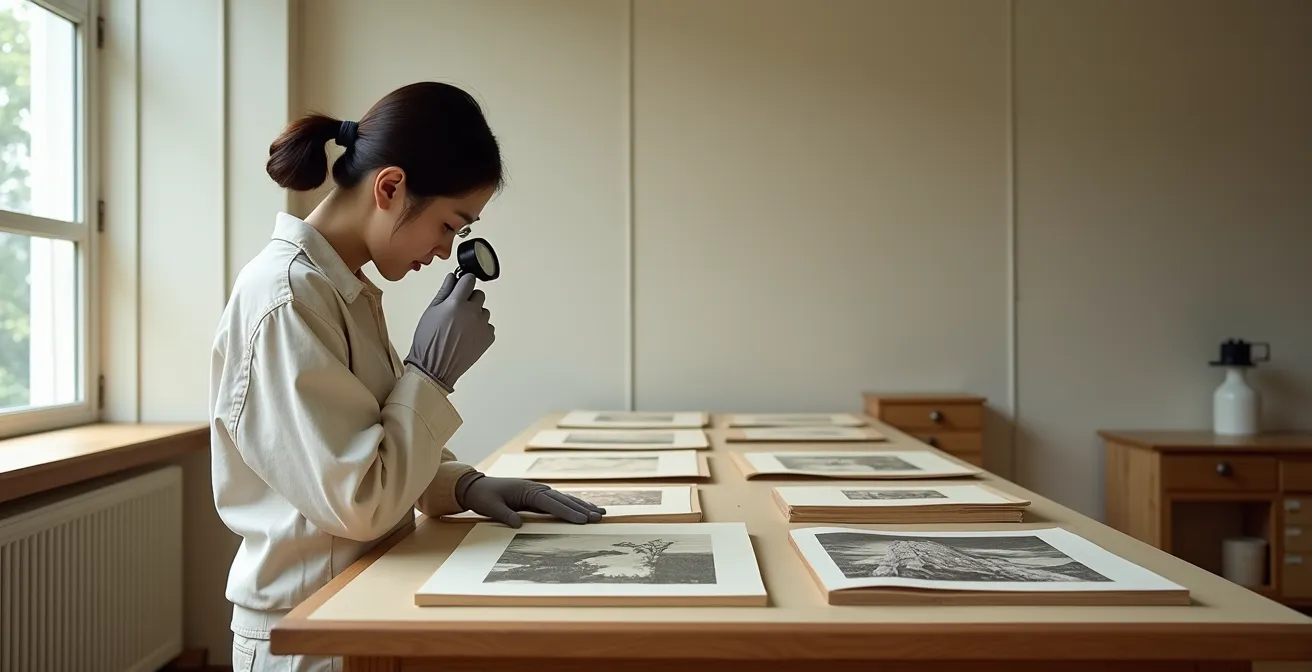
Contrary to popular belief, building a valuable Ukiyo-e collection isn’t about chasing famous names or spending a fortune on Edo-period prints.
- The true art lies in understanding market cycles, where today’s undervalued artists like Kunisada or the Shin-hanga masters become tomorrow’s treasures.
- A pristine Meiji-era reprint or a Shin-hanga landscape often holds more long-term value than a poorly preserved, “original” Edo-period work.
Recommendation: Shift your focus from “what is famous” to “what is excellent but overlooked.” This is the secret to acquiring masterpieces on a modest budget.
The allure of Japanese woodblock prints is undeniable. You’ve likely seen it: Hokusai’s “Great Wave” crashing with its iconic foam claws, or one of Hiroshige’s quiet, rain-swept landscapes. The dream of owning a piece of this history, of holding that delicate paper in your hands, feels both powerful and, for many, impossibly distant. The common advice often reinforces this barrier. You’re told to hunt for the big names, that “condition is everything,” and that true value lies only in rare, first-edition prints from the Edo period. For a new collector with a modest budget, this path leads mostly to frustration or, worse, a poor investment in a damaged piece.
But what if the established wisdom is incomplete? As a dealer who has handled thousands of these prints, I can tell you that the most successful collectors are not always the wealthiest. They are the most knowledgeable. They understand that the art market moves in cycles and that true value is often found where others are not looking. This guide is built on a different premise: building a fine art collection on a budget is not about finding “cheap” art, but about mastering the principles of aesthetic arbitrage—identifying prints whose artistic quality far exceeds their current market price.
We will move beyond the common platitudes to explore the hidden dynamics of the Ukiyo-e world. You will learn why a four-artisan system is the bedrock of quality, why a later reprint can be a smarter investment than an original, and how shifts in taste create incredible buying opportunities. By the end, you won’t just be a buyer; you’ll be a collector with a strategist’s eye, ready to build a portfolio of beautiful, meaningful, and valuable art.
This article will guide you through the essential knowledge needed to navigate the world of Ukiyo-e collecting with confidence. The following sections break down the key concepts, from production and authentication to market trends and preservation, providing a clear roadmap for your journey.
Summary: A Budget Collector’s Guide to Japanese Woodblock Prints
- Why Does It Take Four Artisans to Make One Woodblock Print?
- Edo Period or Meiji Reprint: Which Is Worth the Investment?
- How Did “Japonisme” Change the Composition of Van Gogh’s Art?
- The Display Error That Fades a Woodblock Print in Less Than 5 Years
- When Did Hasui Prints Become More Expensive Than Hiroshige?
- Plein Air Sketch or Studio Finish: Which Approach Suits Your Style?
- Why Victorian Art Is Losing Value While Mid-Century Modern Skyrockets?
- How to Build a Fine Arts Portfolio With a $50,000 Starting Budget?
Why Does It Take Four Artisans to Make One Woodblock Print?
Before you can judge the value of a print, you must first appreciate the symphony of skill required to create it. A single Ukiyo-e print is not the work of one person but the final product of a collaborative system known as the “ukiyo-e quartet.” This division of labor was the engine of the entire industry, ensuring both quality and consistency. Understanding these four roles is the first step to developing an eye for a well-made print, regardless of its age or artist.
The process is a delicate and sequential chain of mastery:
- The Artist (Eshi): This is the master designer, the Hokusai or Utamaro you know by name. They would create the original black-and-white ink drawing (shita-e) that served as the blueprint for the entire piece.
- The Carver (Horishi): A craftsman of incredible precision. The carver would paste the artist’s design onto a block of cherry wood and painstakingly carve away the wood, leaving only the artist’s lines in relief. A separate block was required for each color, demanding immense foresight and skill.
- The Printer (Surishi): The master of color. The printer would apply the pigments to the carved blocks and, using a hand-held tool called a baren, rub the paper against the block to transfer the ink. Aligning the different color blocks perfectly (a process called kento) was a mark of their expertise.
- The Publisher (Hanmoto): The orchestrator and financier. The publisher was the venture capitalist of the Edo period, commissioning the artist, hiring the artisans, and managing the quality control and distribution. Their seal on a print is a crucial mark of its origin and quality.
This system, perfected over centuries, is not merely a historical footnote. It remains the gold standard for authentic Japanese woodblock printmaking today, proving its timeless efficiency and artistic integrity.
David Bull’s Modern Workshop: Preserving the Four-Artisan System
A contemporary master, David Bull, has revived this collaborative system at his Mokuhankan workshop in Tokyo. As he explained in an interview with Tricycle magazine, his studio has grown to include nearly two dozen people working as carvers, printers, and support staff. This modern example demonstrates that the “ukiyo-e quartet” is a living tradition, essential for producing high-quality prints that honor the craft’s legacy.
Edo Period or Meiji Reprint: Which Is Worth the Investment?
For a new collector, the distinction between an “Edo original” and a “Meiji reprint” can be daunting. The common wisdom dictates that older is always better, but this is a dangerous oversimplification. The truth is far more nuanced. An original print is one made during the artist’s lifetime, under their supervision. A reprint uses the original blocks (or recarved ones) but is produced later, often after the artist’s death. While originals from the Edo period (1603-1868) can command high prices, many budget-friendly and high-quality prints were produced during the Meiji era (1868-1912).
The key for a savvy collector is understanding that condition can trump age. A damaged, faded, or trimmed Edo original can be worth significantly less than a pristine, vibrant Meiji reprint of the same design. In fact, a pristine shin-hanga print by a 20th-century master like Hasui can easily exceed the value of a damaged Edo-period print by a minor artist. It’s about buying the best possible example of a print you can afford, not just the oldest.
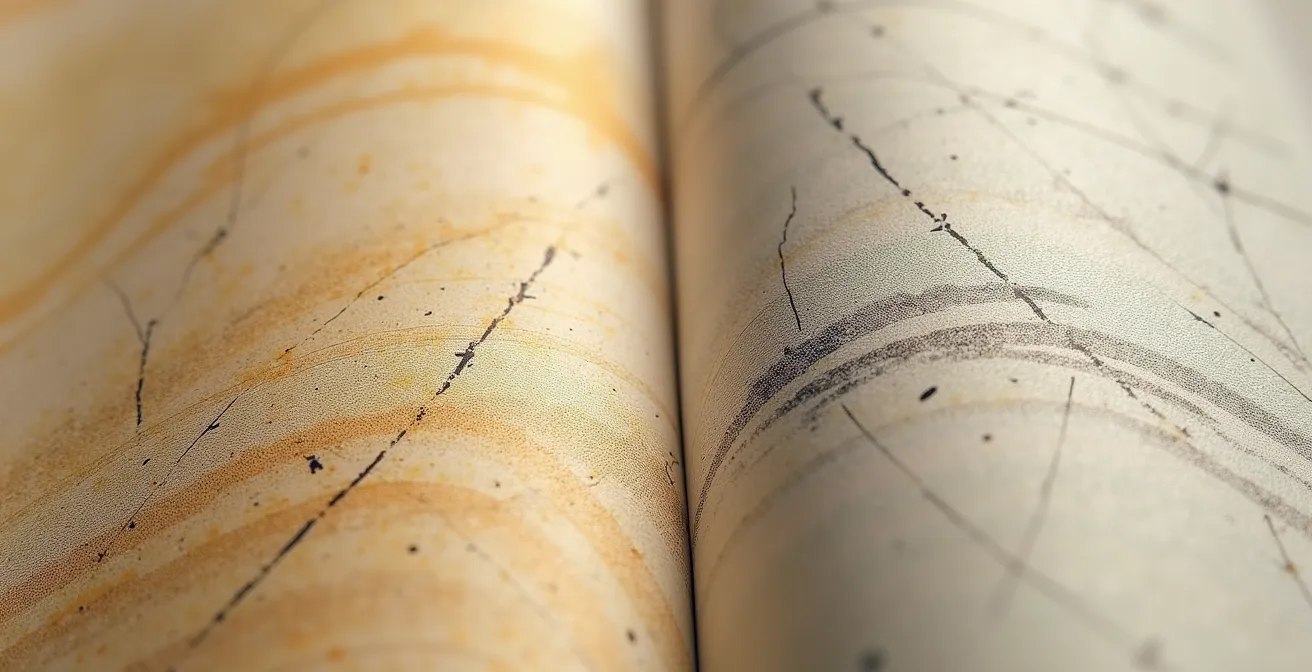
The differences are often subtle, visible in the paper fibers, the sharpness of the lines, and the quality of the color gradation (bokashi). The following table breaks down the key investment criteria for a budget-conscious collector.
| Criteria | Edo Original | Meiji Reprint |
|---|---|---|
| Typical Price Range | $500-$5,000+ | $100-$1,500 |
| Condition Impact | Critical (damaged = up to 70% value loss) | Important but less severe |
| Authentication Difficulty | High (requires expertise) | Moderate |
| Investment Potential | High if pristine | Steady appreciation |
How Did “Japonisme” Change the Composition of Van Gogh’s Art?
The story of Ukiyo-e is not confined to Japan. In the late 19th century, when Japan opened to the West, these vibrant prints flooded into Europe and ignited a creative firestorm known as Japonisme. Artists like Van Gogh, Monet, Degas, and Whistler were captivated by a visual language so radically different from their own academic traditions. They began collecting Ukiyo-e fervently, not as exotic trinkets, but as profound artistic lessons.
Hiroshige I was a woodblock print artist known for his landscape and considered as one of the greatest Japanese artists in ukiyo-e history to have influenced impressionists, such as Van Gogh and Monet.
– Japanese Gallery Kensington, Japanese Art Collection Overview
This was not mere imitation; it was an absorption of a new “compositional DNA.” Western artists learned to use asymmetrical compositions, dramatic cropping (as if taking a snapshot), flattened perspectives, and bold, dark outlines. Look at Van Gogh’s “Bridge in the Rain (after Hiroshige),” and you see more than a copy; you see an artist deconstructing and internalizing a new way of seeing the world. This cross-cultural dialogue adds a fascinating layer for collectors. Owning a print by Hiroshige is not just owning a piece of Japanese history, but also a piece of the story that reshaped all of Western modern art.
The Reverse Investment Strategy: Collecting Japonisme-Influenced Prints
Understanding this connection creates a unique collecting strategy. Instead of only seeking famous Japanese names, one can collect the very prints that influenced the giants of Impressionism. As noted by art historians, the subtle effects in the landscapes of works by Utagawa Hiroshige directly influenced Van Gogh’s techniques. These prints, which embody a pivotal moment in global art history, are often more affordable than his most famous series, yet carry immense cultural significance.
The Display Error That Fades a Woodblock Print in Less Than 5 Years
Acquiring a beautiful print is only half the battle; preserving it is the other. The tragic irony for many new collectors is that their love for a piece can lead to its destruction. The single biggest mistake is improper display. The delicate vegetable-based dyes used in traditional Ukiyo-e are highly fugitive, meaning they fade rapidly when exposed to light, particularly the UV spectrum. Leaving a print in a brightly lit room or, even worse, in direct sunlight, is a death sentence. It can cause irreversible fading in as little as a few years.
To put this in perspective, conservation experts recommend displaying prints at no more than 50 lux, the standard used in museums for works on paper. A typical well-lit living room can easily exceed 400-500 lux, while direct sunlight can be over 50,000 lux. Protection isn’t a passive activity; it requires a proactive strategy.
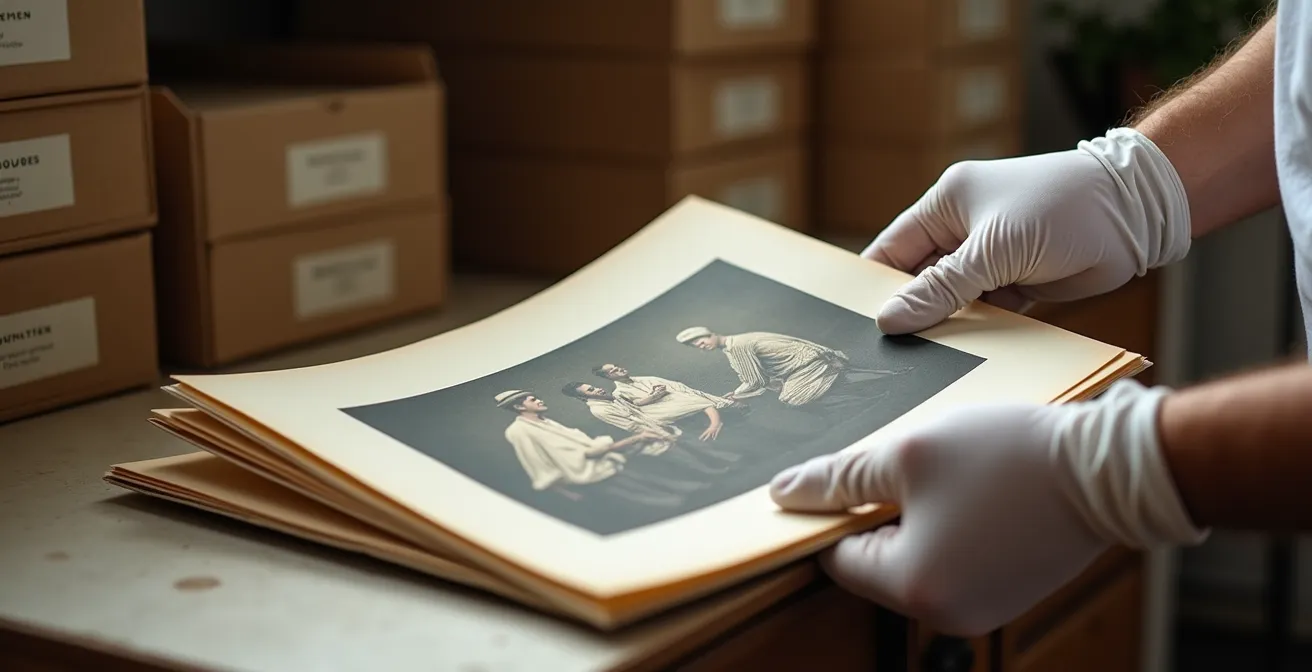
The best practice, borrowed from museum curators, is a system of archival rotation. This means you should never have your entire collection on display at once. Instead, you rotate which pieces are framed and which are kept in safe, dark storage. This not only protects your most valuable works but also allows you to enjoy and rediscover your collection over time. The following checklist outlines the core principles of this strategy.
Your Action Plan: Implementing the Archival Rotation Strategy
- Set a Display Schedule: Limit the display time for any single print to a maximum of 3 months per year to minimize cumulative light exposure.
- Invest in Archival Storage: When not on display, store prints flat in acid-free, lignin-free folders or museum-quality archival boxes.
- Use Protective Glazing: Frame your prints using UV-filtering glass or acrylic (often marketed as “museum glass”). Note that its effectiveness wanes and it should be replaced every 5-10 years.
- Control the Environment: Keep prints away from direct sunlight, heat sources, and areas of high humidity. Aim for a stable environment with 50-60% relative humidity.
- Conduct Annual Inspections: Once a year, check framed prints for any signs of foxing (brown spots), insect damage, or mold, especially around the edges.
When Did Hasui Prints Become More Expensive Than Hiroshige?
For decades, the market hierarchy was clear: Edo masters like Hiroshige were at the top, and 20th-century artists were considered secondary. But in recent years, a dramatic shift has occurred, proving the concept of value cycles. The Shin-hanga (“new prints”) movement of the early to mid-20th century, once seen as derivative, has exploded in popularity and value. Artists from this period, who combined traditional techniques with a Western sense of light and perspective, are now achieving prices that rival—and sometimes surpass—their Edo predecessors.
The most prominent example is Kawase Hasui (1883-1957). His serene, atmospheric landscapes have captured the imagination of a new generation of collectors. This is not just a matter of taste; it’s backed by hard data. While the entire market has seen growth, market data reveals that artists like Hasui have experienced price increases of 400% to 1000% over the past two decades, far outstripping the growth of many more common Edo prints. This surge is driven by scarcity (many of his pre-1923 earthquake prints were destroyed) and a modern aesthetic that resonates deeply today.
The 2024 Hasui Record Sale at Sotheby’s
The tipping point became undeniable in 2024. A rare pre-earthquake print by Hasui, “Tennoji Temple, Osaka,” from his first series, sold for a staggering $109,000 at a Sotheby’s auction in London. This was a record not just for Hasui but for any Shin-hanga artist, demonstrating that the best works of these 20th-century masters are now competing at the highest levels of the market. For a budget collector, this signals that while the top-tier Hasui prints may be out of reach, his less-famous but equally beautiful designs still represent a significant area of opportunity before they, too, escalate in price.
Plein Air Sketch or Studio Finish: Which Approach Suits Your Style?
While the H2 title refers to a Western painting concept, in the world of Ukiyo-e, the equivalent question for a collector is about “states” and “editions.” How can you tell if you have an early, desirable impression or a later, mass-market one? This is where a collector’s knowledge truly pays off. Unlike modern limited editions, prints made before World War II were rarely signed or numbered by the artist.
Prints produced before 1945 were generally not issued as limited editions. They were usually unsigned, unnumbered, and often undated. Handwritten signatures are extremely uncommon before World War II.
– Artelino Archive, Introduction to Japanese Prints and Woodblock Printmaking
So, how do you identify a good impression? You must become a detective, looking for subtle clues. The “first state” or earliest impressions from a set of blocks are generally the most sought-after. The lines are at their sharpest, and the colors are often more vibrant or experimental. As hundreds or thousands of copies were printed, the wooden blocks would wear down, leading to softer lines and less detail in later impressions. For a budget collector, finding a good, crisp “later state” print is often a much better investment than a worn-out “first state.”
Here are key indicators to look for when examining a print:
- Line Quality: Early impressions will have sharp, well-defined lines. Look at fine details like hair or textile patterns. If they are blurry or broken, it is likely a later printing.
- Color and Gradation (Bokashi): The subtle gradations of color, especially in skies and water, are a hallmark of a master printer. Early states often show more delicate and complex bokashi.
- Publisher’s Seal: Publishers would sometimes change their seals over time. Researching the specific seal on a print can help date it to a particular period of production.
- Preparatory Drawings (Hanshita-e): For those on a very tight budget, collecting the original ink drawings done by the artist’s studio can be a fascinating and affordable entry point into the creative process.
Why Victorian Art Is Losing Value While Mid-Century Modern Skyrockets?
The art market is subject to fashion, just like everything else. The H2 title is a perfect analogy for what happens within the Ukiyo-e market itself. Tastes change. What was once the height of fashion can become overlooked, and what was once considered minor can become highly sought-after. Understanding these value cycles is perhaps the most powerful tool for a budget collector. It allows you to buy into an undervalued genre just before it comes back into vogue.
Right now, certain genres within Ukiyo-e are experiencing their “Victorian art” moment—they are technically excellent and historically important, but currently unfashionable, creating a perfect buying opportunity. At the same time, other genres are at their “Mid-Century Modern” peak, with prices that reflect high demand.
The Kunisada Paradox: Quality at Affordable Prices
Utagawa Kunisada was one of the most prolific and popular artists of the 19th century. He produced a staggering number of prints, and because of this sheer volume, his work is often incredibly affordable today. This is the “Kunisada Paradox”: because his prints are so plentiful, even excellent, dynamic designs can be acquired for a fraction of the cost of his contemporaries like Kuniyoshi or Hiroshige. This is a prime example of aesthetic arbitrage, where market supply has suppressed the price of high-quality art.
The table below outlines some of the current trends, highlighting where a strategic collector might look for value.
| Genre | Current Market Status | Investment Potential |
|---|---|---|
| Late-Meiji Warrior Prints (Musha-e) | Undervalued (complex, ‘fussy’ style) | High potential |
| Peak Shin-hanga Landscapes (e.g., top Hasui) | Peak prices | Limited upside |
| Sumo Wrestler Prints | Currently unfashionable | Value opportunity |
| Minimalist Sōsaku-hanga (Creative Prints) | Rising interest | Moderate potential |
Key Takeaways
- A pristine, later-state print is often a better investment than a damaged, early-state “original.”
- Market tastes evolve; the rise of Shin-hanga artists like Hasui proves that today’s undervalued gems can be tomorrow’s treasures.
- Active preservation, through methods like archival rotation, is as crucial as the initial purchase for maintaining value.
How to Build a Fine Arts Portfolio With a $50,000 Starting Budget?
While the idea of a $50,000 budget is enticing, the real secret is applying a portfolio-level strategy to a much more modest starting point. You don’t need a fortune to begin; you need a plan. The vast majority of authentic and beautiful Japanese woodblock prints are surprisingly accessible. In fact, current market analysis shows that approximately 90% are worth between $50 and $500. This is the sweet spot for a new collector to build a diverse and meaningful portfolio.
The goal is not to buy one expensive “trophy” piece, but to build a collection with diversity and a narrative. Think like a portfolio manager: allocate your funds to different “asset classes” within Ukiyo-e. This could mean one piece from a Kunisada pupil, one Shin-hanga landscape, and one Meiji-era reprint. This approach diversifies your aesthetic and your investment.
Here is a sample one-year strategy for building a core collection with an initial budget of around $500—a tangible starting point that applies the principles we’ve discussed:
Your Action Plan: The $500 Ukiyo-e Portfolio, Year One Strategy
- Months 1-3: Acquire a Foundation Piece. Focus on a good-condition print from a student of a major master, such as a Kunisada or Toyokuni III pupil. Budget: $120-$150.
- Months 4-6: Explore the 20th Century. Add a small-format Shin-hanga landscape by an artist like Takahashi Shōtei or Itō Sōzan. This introduces a different aesthetic. Budget: $200-$300.
- Months 7-9: Appreciate the Craft of the Reprint. Purchase a high-quality, Meiji-era reprint of a classic design by Hiroshige or Hokusai. This allows you to own an iconic image in pristine condition. Budget: $150-$250.
- Months 10-12: Target Your First ‘Anchor Piece’. Consolidate your budget for a slightly more significant work, such as a well-preserved landscape by a respected Shin-hanga artist like Tsuchiya Koitsu. Budget: $400-$600.
At the end of one year, you would have four distinct, high-quality prints that tell a story about the evolution of the art form, all acquired for the price of a single, mediocre “big name” piece. This is the essence of strategic collecting.
Now that you are armed with a dealer’s perspective, the world of Ukiyo-e is no longer an intimidating, exclusive club. It is a vast and fascinating landscape of opportunity. Begin your journey, start training your eye, and focus on acquiring the best quality you can afford. The masterpieces are out there, waiting for a savvy collector to recognize their true worth.