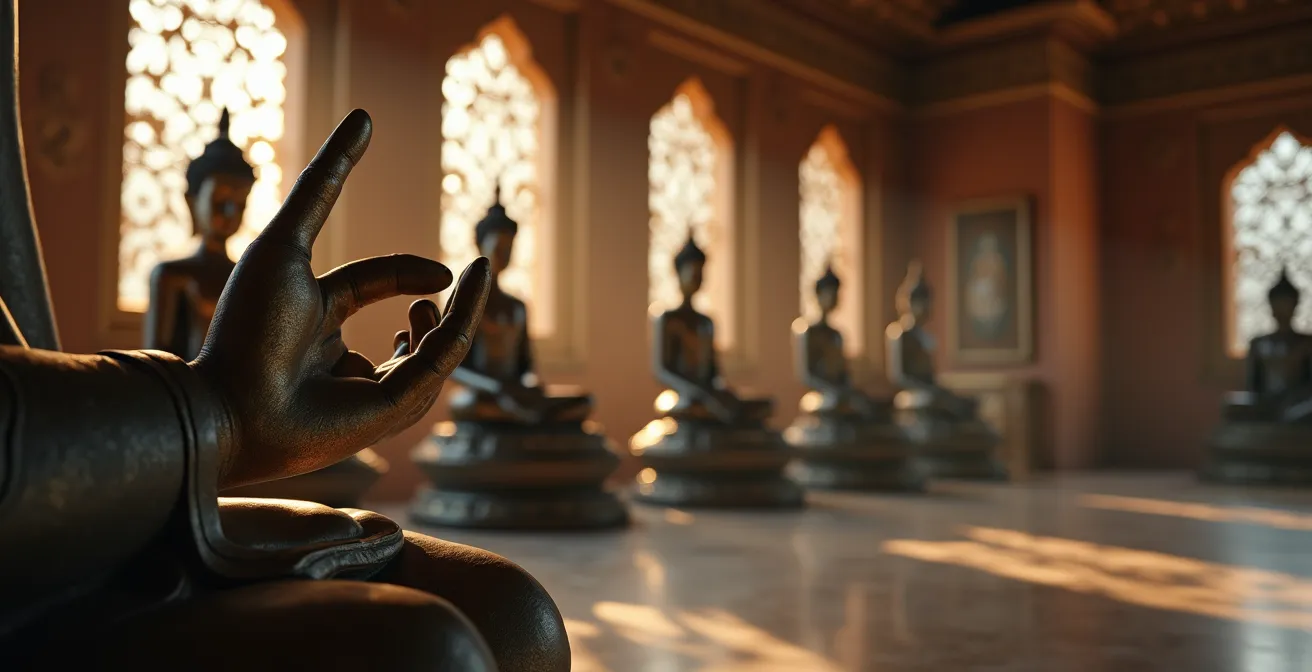
Contrary to popular belief, understanding sacred Eastern art is not about memorizing a dictionary of symbols, but about learning its visual grammar.
- The meaning of a symbol, like a hand gesture or a flower, is not fixed; it is defined by its context, including the deity’s posture and narrative role.
- Color and form are not merely decorative but function as a sophisticated code to describe a deity’s state of mind, power, and purpose.
Recommendation: Shift your perspective from asking “What does this mean?” to “How does this element function within the whole composition?” to truly decode the artwork.
Standing in a quiet temple in Southeast Asia or a bustling museum gallery, you’ve likely felt it: a sense of awe mixed with a touch of confusion. Before you stands a serene, multi-armed deity or a golden-faced Buddha, their hands held in a precise gesture. You sense a profound story is being told, but the language is visual, and its grammar remains a mystery. Many guides will offer simple translations—the lotus means purity, the raised hand means ‘do not fear’. While not incorrect, this approach is like learning a few foreign words without understanding how to form a sentence. It misses the richness, the nuance, and the deep spiritual technology encoded in the art.
The common approach of creating a simple “symbol dictionary” falls short because it treats these sacred images as static icons. The truth is far more dynamic. This art is not just meant to be looked at; it’s a functional tool for meditation, a mnemonic map of complex cosmology, and a medium for a direct spiritual encounter. The position of a finger, the color of skin, or the choice of a flower are all parts of a sophisticated visual language, where meaning is derived from context and relationship, not just isolated symbols.
This guide will move beyond simple definitions. Instead of providing a list to memorize, we will uncover the underlying ‘grammar’ of this sacred art. You will learn not just *what* the symbols are, but *how to read them in context*. We will explore how hand gestures (mudras) interact with posture (asanas), how color signifies function over identity, and how narrative art unfolds in time. By the end, you won’t just recognize symbols; you will begin to read the stories, understand the philosophy, and appreciate these masterpieces on a much deeper level, transforming your experience from that of a passive tourist to an informed observer.
This article provides a structured path to understanding this visual language. Below is a summary of the key concepts we will explore to help you decode the rich symbolism embedded in every sculpture and painting.
Summary: Decoding the Visual Grammar of Sacred Art
- Why Are the Hands of the Buddha Positioned Differently in Each Statue?
- Lotus or Peony: What Does the Flower Choice Tell You About the Deity?
- Blue Skin vs. Gold Skin: How Color Identifies Role and Power?
- The Common Mistake Tourists Make Between Budai and Gautama Buddha
- How to Read a Narrative Scroll Painting From Right to Left?
- Why Does Visual Art Replace Text in Many Spiritual Traditions?
- The Common Interpretation Error That Misleads 80% of History Students
- How to Use Ink Wash Painting as a Form of Daily Meditation?
Why Are the Hands of the Buddha Positioned Differently in Each Statue?
The specific positioning of a Buddha’s hands, known as a mudra, is one of the most immediate and telling aspects of its identity and message. These are not random poses but a precise sign language, a core component of the art’s visual grammar. Each mudra signifies a specific action, power, or moment in the Buddha’s life. For instance, the *Abhaya mudra*, with the right hand raised, palm facing outwards, is a gesture of fearlessness and protection. Conversely, the *Bhumisparsha mudra*, or “earth-touching gesture,” shows the right hand reaching down to touch the ground. This depicts the pivotal moment of the Buddha’s enlightenment, when he called the earth to witness his victory over temptation.
However, interpreting a mudra in isolation is a common mistake. Its meaning is deepened by the figure’s posture, or asana. A standing Buddha with the Abhaya mudra suggests offering protection while in motion, while a seated figure in the same pose implies an established, unshakable state of refuge. The context of the deity is also critical. The same gesture on a Buddha versus a Bodhisattva (an enlightened being who delays nirvana to help others) can carry different implications based on their distinct roles in the cosmic order.
Case Study: The Five Dhyani Buddhas
The system of the Five Dhyani (or Wisdom) Buddhas perfectly illustrates how mudras function as a complete symbolic language. Each of these five celestial Buddhas embodies a different aspect of enlightened consciousness and is identified by a unique color, direction, and mudra. For instance, a detailed analysis shows that Akshobhya (East, blue) displays the earth-touching mudra, symbolizing steadfastness. Amitabha (West, red) forms the meditation mudra with hands in his lap, representing boundless light. According to a guide on the subject from Exotic India Art explaining mudras, this systematic arrangement demonstrates how hand gestures are not just isolated symbols but part of a comprehensive map of the psyche, conveying specific wisdoms to overcome core afflictions like anger, desire, and ignorance.
Therefore, to read the hands of the Buddha, you must look beyond the gesture itself. You must consider the posture, the identity of the figure, and its place within a larger narrative or symbolic group. The hands are not just posing; they are speaking.
Lotus or Peony: What Does the Flower Choice Tell You About the Deity?
Flowers, especially the lotus, are ubiquitous in Buddhist and Hindu art, but they are far more than simple decoration. The choice of flower, and even its stage of bloom, is a potent symbol that reveals the nature and spiritual state of the deity associated with it. The lotus is particularly central, its journey from the mud at the bottom of a pond to a pristine flower on the surface serving as the ultimate metaphor for the soul’s journey from the mire of existence (samsara) to the purity of enlightenment (nirvana). Indeed, its importance is reflected in its prevalence; one study found that lotus motifs appear in 87% of Buddhist temple architecture in India and Sri Lanka.
The state of the lotus is a key part of this visual grammar. A closed bud represents unrealized potential or the beginning of a spiritual path, often held by young Bodhisattvas. A partially open flower signifies progress along that path, while a fully bloomed lotus represents complete enlightenment, perfection, and purity. This is why Buddhas and other fully realized beings are often depicted seated or standing upon a fully bloomed lotus throne—it signifies their transcendent and unblemished nature. The color also matters: a white lotus denotes mental purity, while a red lotus relates to love and compassion, often associated with Avalokiteshvara.
This detailed symbolism shows how artists convey complex spiritual ideas through simple, natural forms. The lotus is not just an attribute; it is a visual summary of a deity’s state and function.
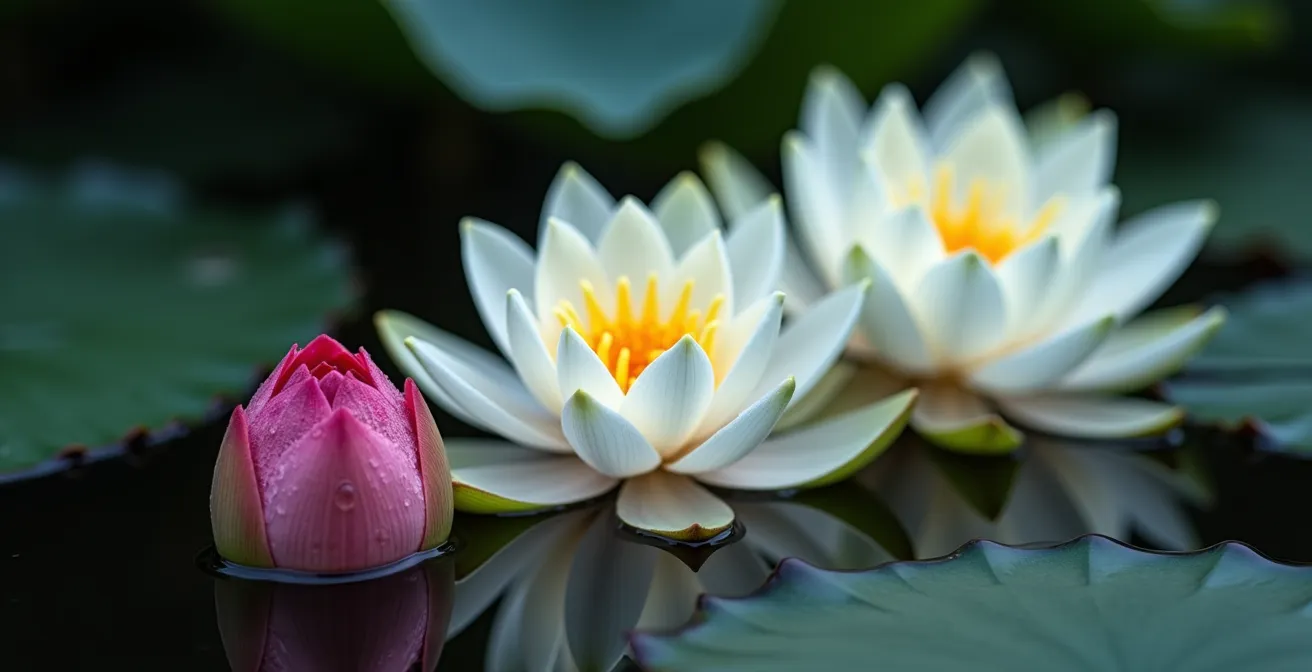
The progression from bud to full bloom is not just botanical but philosophical. The table below breaks down these stages and their meanings, providing a clear guide to reading this powerful symbol.
| Flower Stage | Symbolic Meaning | Deity Association | Artistic Context |
|---|---|---|---|
| Closed Lotus Bud | Unrealized potential, beginning of spiritual journey | Young Bodhisattvas | Often held as attribute |
| Partially Open Lotus | Walking the path, spiritual progress | Manjusri (wisdom) | Blue lotus, center hidden |
| Fully Bloomed Lotus | Complete enlightenment, perfection | Buddha, Amitabha | Throne or pedestal |
| Lotus Going to Seed | Cycle of life and death, rebirth | Avalokiteshvara | Red lotus symbolism |
Beyond the lotus, other plants like the Bodhi tree leaf or the Ashoka tree also appear, but they typically reference specific biographical events, such as the site of the Buddha’s enlightenment or birth, rather than a universal spiritual process.
Blue Skin vs. Gold Skin: How Color Identifies Role and Power?
In the symbolic language of sacred art, color is never arbitrary. It is a powerful signifier that communicates a deity’s essential nature, its cosmic function, or even a temporary emotional state. Two of the most prominent colors, gold and blue, offer a perfect example of this functional symbolism. Gold skin, most often seen on statues of the Buddha, represents purity, incorruptibility, and the radiant nature of an enlightened being. It signifies a body that has transcended the physical realm, becoming a vessel of pure light and wisdom. The use of actual gold leaf or polished bronze is not just for opulence; it is a material manifestation of this state of perfection.
In stark contrast, blue or black skin is often used for powerful, and sometimes wrathful, deities in both Hinduism and esoteric Buddhism. In Hinduism, figures like Krishna and Vishnu are depicted with blue skin to represent the infinite, immeasurable nature of the divine, like the boundless sky or ocean. It signifies their all-pervasive consciousness. In Buddhism, this dark coloring often denotes a deity’s fierce or protective aspect. These wrathful figures are not evil; they are compassionate beings who adopt a terrifying form to destroy obstacles to enlightenment, such as ignorance, hatred, and greed. The dark color symbolizes the primal, untamed energy they wield for a compassionate purpose.
As one expert notes, color can be fluid, describing a temporary state rather than a fixed identity. A deity normally depicted as peaceful might appear with dark skin when in a wrathful form, demonstrating that color describes function and emotion.
Beyond Pigment: The Role of Material
The meaning of color is further enhanced by the material used to create the sculpture. A figure carved from dark granite conveys a sense of gravitas, permanence, and immovable power. The same figure in polished bronze implies a luminous, incorruptible quality. White marble, on the other hand, suggests transcendent purity and ethereality. The artist’s choice of stone or metal is therefore an integral part of the iconographic code, working in harmony with the color to define the deity’s essence.
Understanding color requires looking past a simple “blue means X, gold means Y” formula. Instead, one must ask: What is the deity’s role? Is it peaceful or wrathful? Is it representing a boundless concept or a perfected state? Answering these questions unlocks the true meaning behind the palette.
The Common Mistake Tourists Make Between Budai and Gautama Buddha
One of the most frequent points of confusion for Western visitors to temples and even restaurants is the distinction between two very different figures: Gautama Buddha, the historical founder of Buddhism, and Budai, the “Laughing Buddha.” Many assume the portly, joyous figure is a representation of the historical Buddha, but this conflates two separate traditions and illustrates how a religion adapts as it crosses cultural boundaries. Recognizing the difference is a fundamental step in learning to read Buddhist art correctly.
Gautama Siddhartha, the historical Buddha, is almost always depicted with a serene, meditative expression. His features are refined and balanced, reflecting inner peace. He has characteristic physical marks of an enlightened being, such as long earlobes (from his past as a prince who wore heavy earrings), a dot or curl on his forehead (the *urna*), and a cranial bump (the *ushnisha*). He wears simple, unadorned monk’s robes, symbolizing his renunciation of worldly possessions. You will find images of Gautama in religious contexts: temples, monasteries, and places of worship.
Budai, on the other hand, is a completely different figure. He was a semi-historical Chinese Chan (Zen) monk who lived in the 10th century and became a popular folk deity. He is depicted as rotund, bald, and perpetually laughing or smiling, symbolizing joy, contentment, and abundance. He wears loose-fitting robes that expose his large belly and often carries a cloth sack (his name means “Cloth Sack”), which is said to contain precious items but is never empty. Budai is a symbol of prosperity and good fortune, which is why his statue is commonly found in businesses, restaurants, and homes, rather than exclusively in temples.
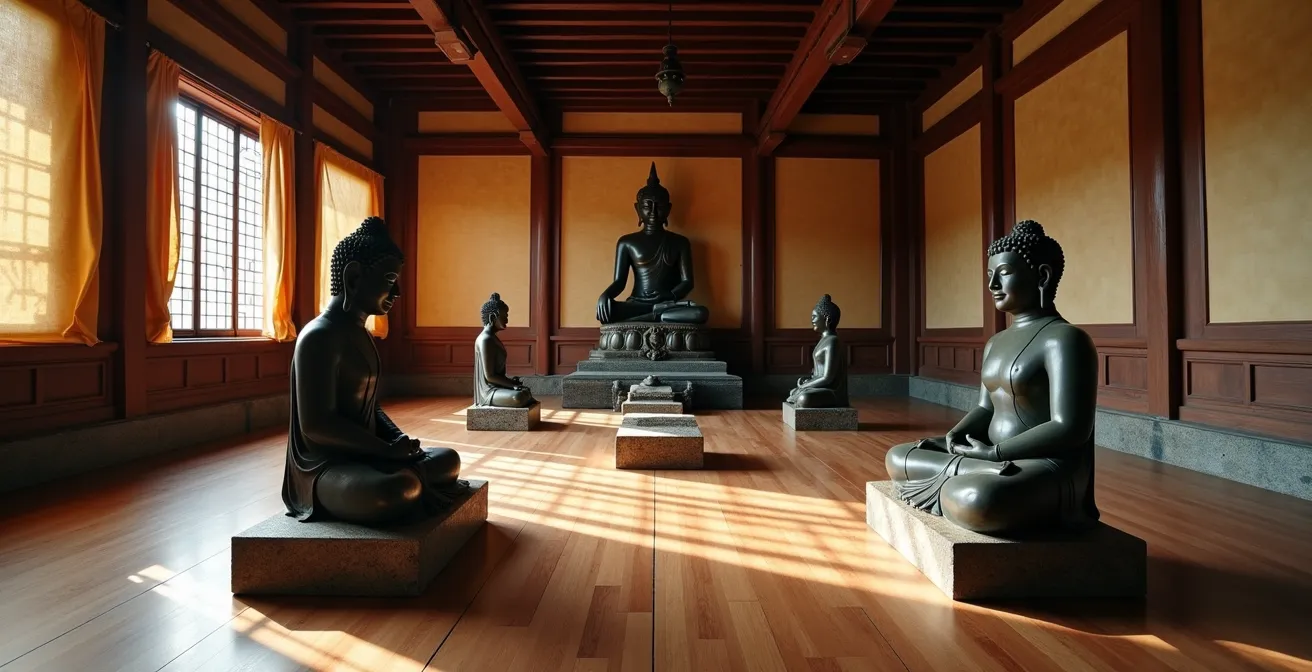
The confusion arises from a process called syncretism, where Buddhism, upon entering China, merged with local values that celebrated abundance and earthly happiness. Budai came to be seen by some as an incarnation of Maitreya, the future Buddha, but he is not Gautama. The key identifiers are context (temple vs. commercial space), body type (ascetic vs. prosperous), and expression (serene vs. jovial).
How to Read a Narrative Scroll Painting From Right to Left?
While statues present a static, singular moment of spiritual insight, narrative handscrolls, or *emakimono* in Japanese, offer a dynamic, cinematic experience. These artworks tell stories, from the life of the Buddha to historical epics, but they defy the Western convention of a single, framed perspective. To read them is to participate in the unfolding of time itself. The fundamental rule is that they are read from right to left. The scroll is placed on a table and unrolled a small section at a time—typically about a shoulder’s width—with the right hand, while the left hand rolls up the viewed portion.
This process creates an intimate viewing experience, forcing the observer to focus on one scene at a time rather than taking in the whole composition at once. The sheer scale of these works, which according to the Metropolitan Museum of Art can reach up to 40 feet in length, makes this sequential viewing a necessity. The artists used clever compositional devices to guide the viewer’s eye and manage the narrative flow. Visual “chapter breaks” like mountains, rivers, or architectural elements signal a shift in time or location. To follow the story, you must track the protagonist by identifying their recurring features, such as specific clothing or a companion figure.
A key concept in these scrolls is “continuous narration,” where the same character may appear multiple times within a single continuous scene. This is not repetition; it is a visual device to show the passage of time and a sequence of actions within one location. For example, you might see a character arriving at a house on the right, speaking with someone in the middle, and departing on the left, all within a single, unbroken background. This technique captures the temporal nature of storytelling in a way that a static painting cannot. The experience is one of constant discovery, as each newly unrolled section reveals the next part of the tale.
Reading a scroll is therefore a durational art. It requires patience and attention, rewarding the viewer with a story that literally unfolds before their eyes, mimicking the passage of time and the journey of the characters within it.
Why Does Visual Art Replace Text in Many Spiritual Traditions?
In traditions where philosophical and cosmological ideas are immensely complex, visual art often serves a purpose that text alone cannot. It functions not just as illustration for the illiterate, but as a powerful, multi-layered medium for transmitting knowledge, facilitating direct experience, and encoding vast amounts of information. It is a sophisticated mnemonic system, where a single image can serve as a complete map of a spiritual universe. The ability to convey abstract concepts non-linearly is one of its greatest strengths.
One core reason for the primacy of visual art is the concept of *darshan* in Hindu culture, a principle that also influences Buddhist practice. As explained in a discussion on the shared symbolism of Hinduism and Buddhism, *darshan* means “seeing” and, more importantly, “being seen by” the divine. It is a moment of reciprocal gaze, a direct and personal encounter with the deity. This profound, experiential connection cannot be achieved through reading a text. Temple sculptures are consecrated objects, living presences designed specifically to facilitate this sacred viewing. The eyes are often the last element to be carved or painted in a consecration ceremony, symbolically “opening” the deity to be seen.
Complex iconography serves as a sophisticated mnemonic system. A single statue of Vishnu is a visual map of cosmology, philosophy, and mythology, encoding vast amounts of information that were traditionally transmitted orally.
– Robert Beer, The Handbook of Tibetan Buddhist Symbols
Furthermore, art can express concepts that are difficult to articulate in words. How does one describe “emptiness” (*shunyata*) or non-duality? A sculpture of a wrathful deity embracing its consort can visually represent the union of wisdom and compassion in a single, powerful image. A multi-armed deity is not a literal depiction of a monster; it is a visual metaphor for divine omnipotence, the ability to perform countless compassionate acts simultaneously. Art transcends the linear, sequential nature of text to present a holistic, immediate truth.
The Common Interpretation Error That Misleads 80% of History Students
One of the most significant barriers to understanding sacred Eastern art is viewing it through a modern, Western aesthetic lens. This approach, which prioritizes form, beauty, and the artist’s personal expression (“art for art’s sake”), fundamentally misunderstands the purpose of these objects. The most common interpretation error is to ask, “What does this look like?” or “Is this beautiful?” instead of the far more crucial question: “What was this made for?” This shift from an aesthetic to a functional perspective is the key to unlocking its meaning.
These objects were not created to be displayed in a museum gallery. A statue of a Buddha was a tool for meditation, a focal point for ritual, and a consecrated presence within a temple. A *thangka* painting was not just a picture; it was a portable altar and a visual guide for complex deity visualizations. Their forms were dictated by strict iconographic rules passed down for centuries, ensuring their ritual efficacy. The artist’s goal was not personal expression but the creation of a ritually correct and potent object. Judging it by the standards of Renaissance or Modernist art is a category error.
This functional approach also helps decode seemingly strange or repetitive elements. For example, historical evidence from early Buddhist sites shows that before the 1st century CE, the Buddha was never depicted in human form. Instead, he was represented by aniconic symbols: an empty throne, a set of footprints, or the Dharma wheel. This wasn’t due to a lack of artistic skill; it was a deliberate choice to represent the transcendent, unrepresentable state of nirvana. To interpret this as “primitive” is to miss the profound theological statement being made.
| Common Error | Correct Interpretation | Example |
|---|---|---|
| Art for Art’s Sake | Functional Sacred Tools | Statues are meditation aids and ritual objects, not aesthetic displays. |
| Fixed Symbol Meanings | Context-Dependent Significance | A swastika means different things in Hindu, Buddhist, and Jain contexts. |
| Modern Psychological Reading | Symbolic Energy States | Wrathful deities represent dynamic energy destroying obstacles, not anger. |
| Static Interpretation | Dynamic Narrative Reading | Multiple appearances of the same figure show time progression, not repetition. |
By shedding the “art for art’s sake” mindset and embracing the functional purpose of these objects, the entire visual language begins to make sense. Every element is present for a reason, contributing to the object’s power as a spiritual technology.
Key takeaways
- Sacred Eastern art is a ‘visual grammar,’ where symbol meanings are determined by context, not fixed definitions.
- Artworks are functional tools for meditation and ritual, not just aesthetic objects; their purpose dictates their form.
- Understanding the art involves a shift from passive viewing to actively reading the interplay between gesture, color, posture, and narrative.
How to Use Ink Wash Painting as a Form of Daily Meditation?
After learning to *read* the visual grammar of sacred art, you can deepen your understanding by engaging with its underlying principles through practice. Ink wash painting, particularly the Zen practice of drawing an *ensō* (a circle), is not just an artistic pursuit but a form of daily meditation. It transforms the intellectual understanding of concepts like imperfection, spontaneity, and emptiness into a lived, embodied experience. This practice can profoundly change the way you see and connect with Buddhist art.
The practice is simple. Each day, you take a single breath and, in one fluid motion, paint a circle on rice paper. The goal is not to create a perfect circle but to create one that is a true expression of your state of mind in that exact moment. A gap in the circle may represent openness, while a heavy, thick stroke could show strong energy. The act of creation and acceptance becomes a mirror for your inner state. This practice of “controlled spontaneity” directly connects to the aesthetics you see in sacred art—the single, decisive brushstroke of a master calligrapher or the seemingly effortless but perfectly balanced posture of a deity.
After three months of daily Enso practice, I began seeing Buddhist art differently. The empty space around statues became as important as the figures themselves. I understood that the ‘controlled spontaneity’ in a deity’s posture mirrors the same principle in ink wash – planned yet natural. The acceptance of imperfection in my daily circles taught me to see the beauty in weathered temple sculptures. This practice transforms you from passive viewer to understanding participant in the artistic tradition.
– A Practitioner’s Experience
Engaging in this practice attunes your eye to the core principles of Zen aesthetics. You begin to appreciate the importance of empty space (*ma*) around a statue, understanding it not as a void but as a potent, active element of the composition. You learn to see the beauty in imperfection (*wabi-sabi*), finding it in a weathered wooden temple post or a slightly asymmetrical teacup. It shifts your role from that of an outside observer to an active participant in the tradition.
Your Action Plan: Daily Enso Circle Meditation Practice
- Prepare your space: Set up rice paper, ink, and a brush in a quiet area. Treat these materials as sacred tools, not just art supplies.
- Center yourself: Sit in meditation for five minutes, focusing on your breath to quiet the mind and achieve a state of clarity.
- Load the brush: Dip the brush into the ink with full, mindful attention, feeling the weight of the ink and the texture of the bristles.
- Create the Enso: In one fluid breath and a single, continuous motion, draw a circle on the paper without lifting the brush. Let the motion flow from your center.
- Accept and observe: Do not judge the result. Simply observe the circle as a reflection of your present moment. Notice its form, the variations in ink, and any gaps, seeing them as expressions of your state, not as flaws.
By learning to see with a new eye, you can transform every museum visit and temple tour into a profound conversation with the past. The art is waiting to tell its stories; all it requires is a willingness to learn its language.
Frequently Asked Questions About Symbolism in Eastern Art
Why is Krishna depicted with blue skin?
In Hindu iconography, blue represents the infinite and the immeasurable, reflecting boundless and all-pervasive concepts like the sky or the ocean. For a deity like Krishna or Vishnu, this color symbolizes the vast, limitless nature of divine consciousness that encompasses all of reality.
What does gold coloring signify in Buddhist statuary?
Gold is a symbol of absolute purity, enlightenment, and the perfected, unblemished nature of a divine body. It signifies incorruptibility, permanence, and transcendence over the physical world. Applying gold is not just decoration but an affirmation of the figure’s sacred and radiant status.
How does the material itself contribute to color meaning?
The choice of material adds a layer of meaning that works with color. Dark, heavy granite conveys a sense of gravitas and immovable power. Polished bronze suggests a luminous, radiant quality. White marble evokes a feeling of transcendent purity and otherworldliness. The material is an integral part of the symbolic code.