
The Western obsession with realism wasn’t a simple aesthetic choice; it was the product of a powerful socio-technological system, a “Mimetic Engine,” that made realistic depiction the dominant cultural currency for over 400 years.
- Scientific advancements and institutionalized training (academies) created a self-reinforcing loop where technical skill in representation was prized above all else.
- This system made non-mimetic art not just an alternative style, but a structural and economic impossibility until its collapse in the 20th century.
Recommendation: To understand global art history, analyze the underlying economic, technological, and institutional forces that shape a culture’s aesthetic values, rather than just comparing styles.
An art student walking through a major Western museum might observe a curious pattern. Gallery after gallery presents a relentless pursuit of reality: lifelike portraits, meticulously detailed landscapes, and historical scenes rendered with photographic precision. Yet, in wings dedicated to non-Western or ancient art, the priorities are clearly different—symbolism, spiritual expression, and decorative patterns take precedence over faithful representation. The conventional explanation points to the ancient Greeks’ fascination with the human form and the Renaissance masters’ rediscovery of their techniques. This narrative, while true, only scratches the surface. It presents the Western path toward mimesis—the imitation of reality—as a natural, almost inevitable, philosophical evolution.
This perspective, however, fails to explain the sheer dominance and longevity of this single aesthetic goal. Why did Western art lock itself into this mimetic trajectory for centuries, effectively stifling other forms of expression? The answer lies not in philosophy alone, but in the construction of a powerful, self-perpetuating system. This “Mimetic Engine” was a feedback loop composed of scientific discovery, technological innovation, and rigid academic institutions. For centuries, this engine made verisimilitude a form of cultural and economic currency, rewarding technical accuracy and marginalizing abstraction. The divergence in global art history is therefore not a simple matter of taste, but a story of two different operating systems—one culturally hardwired for realism, and others free to explore the vast territories of the non-representational.
This article will deconstruct the components of this Western “Mimetic Engine.” We will explore how science demanded a new kind of artistic precision, how institutions codified it into a strict curriculum, and how the entire system eventually faced a crisis that led to its collapse, finally paving the way for the explosive arrival of modern abstraction. By understanding this framework, the historical divergence ceases to be a mystery and becomes a clear lesson in how technology, power, and culture intertwine to define what is seen as “good” art.
Summary: Deconstructing the Western Fixation on Realism
- How Did the Scientific Revolution Push Art Toward Hyper-Realism?
- Photography or Painting: Which Capture Reality “Better” in the 19th Century?
- How Did the Quest for Perfect Naturalism Stifle Creativity for Centuries?
- The “If It Looks Real, It’s Good” Fallacy That Limits Appreciation
- What Events Triggered the Collapse of Naturalism After World War I?
- How to Spot the Use of Linear Perspective in Early Renaissance Works?
- Why Do Academies Force Students to Copy Old Masters for Years?
- Self-Taught vs. Art School: Which Technical Approach Builds Better Skills?
How Did the Scientific Revolution Push Art Toward Hyper-Realism?
The dawn of the Scientific Revolution in the 16th and 17th centuries fundamentally altered the role of the artist. As inquiry shifted from theological dogma to empirical observation, a new demand arose for images that could function as data. Art was no longer just for devotion or aristocratic portraiture; it became an indispensable tool for scientific documentation. Fields like botany, anatomy, and entomology required a level of visual accuracy that pushed artists toward an unprecedented standard of hyper-realism. The goal was not merely to represent a flower, but to render its anatomy with such precision that it could be studied and classified. This transformed the artist’s studio into a laboratory, a space where verisimilitude was a scientific necessity, not just an aesthetic preference.
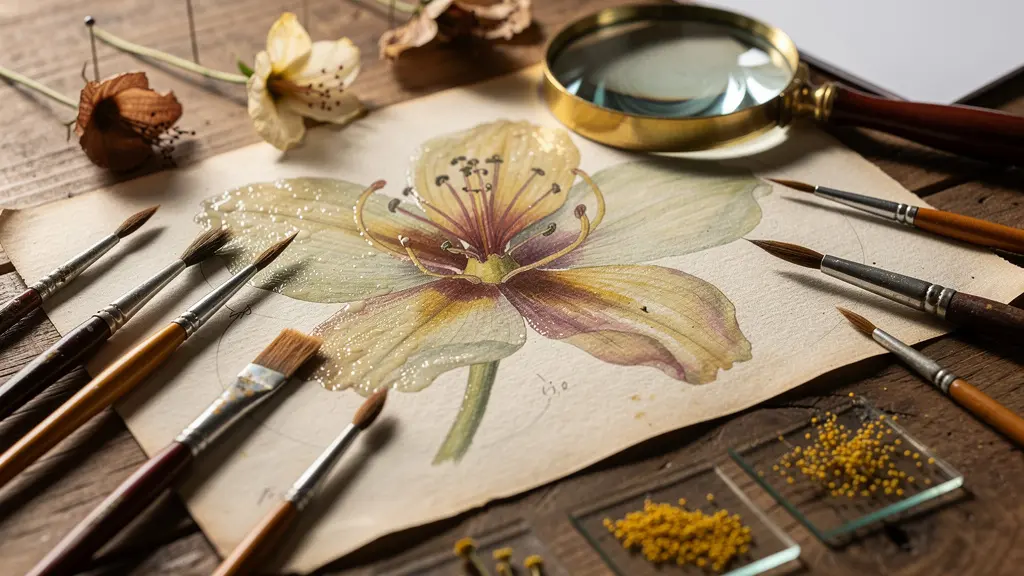
This intersection of art and science is perfectly embodied in the work of figures like Maria Sibylla Merian. At a time when insects were still believed to arise from “spontaneous generation,” Merian embarked on a purely scientific expedition to Suriname. Her groundbreaking work, meticulously documenting the full metamorphosis of insects, was both a scientific and artistic triumph. According to an analysis of her work, the pioneering work by Maria Sibylla Merian documented the life cycles of numerous species with an accuracy that was revolutionary. This was not art about insects; it was science performed through the medium of drawing and painting. The “Mimetic Engine” was thus fueled by this need for objective, transferable knowledge, establishing a direct link between realistic representation and intellectual progress.
Photography or Painting: Which Capture Reality “Better” in the 19th Century?
The invention of photography in the 19th century is often cited as the event that “killed” realistic painting. This narrative, however, is an oversimplification. Rather than being an external threat, photography was the logical culmination of the West’s centuries-long obsession with mimesis—the ultimate tool of the “Mimetic Engine.” For the first time, a perfect, mechanically produced likeness was possible. Yet, this new technology did not immediately render painting obsolete. Instead, it triggered a complex debate about what “capturing reality” truly meant, forcing painters and photographers to contend with the strengths and weaknesses of their respective media. As the literary critic Erich Auerbach explored in his seminal work, the concept of mimesis itself is complex.
Mimesis: The Representation of Reality in Western Literature
– Erich Auerbach, Mimesis study on representation in Western art
Early photography was a blunt instrument. While it excelled at capturing static detail with unerring accuracy, it had significant limitations. The Impressionists, in direct response, focused on precisely those aspects of reality that the camera could not grasp: the fleeting effects of light, the nuance of color, and the sensation of movement. They weren’t abandoning reality; they were claiming a different, more subjective part of it. A comparison of the two mediums reveals this divergence in capabilities.
| Aspect | Early Photography (1850s-1890s) | Impressionist Painting |
|---|---|---|
| Exposure Time | Several seconds to minutes | Instantaneous capture of fleeting moments |
| Color | Black and white only | Full spectrum of colors |
| Movement | Blurred or impossible to capture | Successfully conveyed through brushwork |
| Atmospheric Effects | Limited tonal range | Superior rendering of light and atmosphere |
| Cost | Increasingly affordable | Expensive commissioned work |
This table illustrates that photography’s “realism” was mechanical and limited, while painting could capture a more perceptual and atmospheric truth. The crisis triggered by photography was not about realism’s relevance, but about its definition. This forced a schism that would eventually lead some artists to abandon the mimetic quest altogether, seeking a reality beyond surface appearance.
How Did the Quest for Perfect Naturalism Stifle Creativity for Centuries?
While the Renaissance and Scientific Revolution ignited the quest for realism, it was the academic system that codified it into dogma, creating a powerful force of institutional inertia. From the 17th century onwards, art academies across Europe, most famously the Académie des Beaux-Arts in Paris, established a rigid hierarchy of genres and a standardized curriculum. The goal was to produce artists capable of achieving perfect naturalism. This system, which prized technical skill above originality, effectively controlled artistic production and patronage for centuries. The Western art’s commitment to mimesis lasted from the Renaissance to the mid-19th century—a span of roughly 400 years where deviation from the representational norm was not just discouraged, but often meant career suicide.
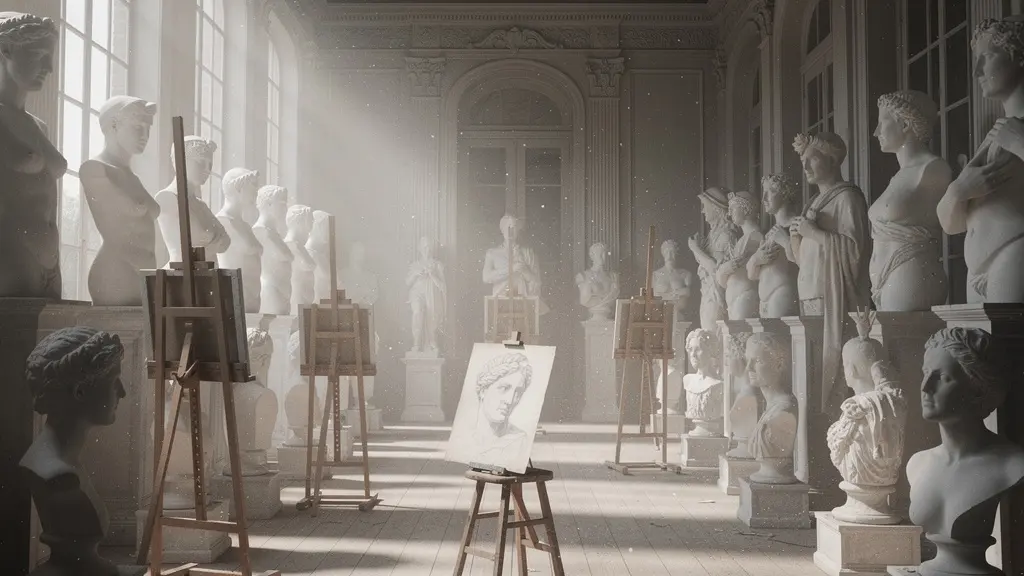
The training was grueling and methodical, focused on years of drawing from plaster casts of classical sculptures before a student was even allowed to work from a live model. This process drilled the principles of anatomy, light, and form into generations of artists, but it also cultivated a deep-seated conservatism. Innovation was seen as a threat to the established order. As one analysis of the era notes, this figural tradition, with its academies and wealthy patrons, held absolute sway. Creativity was channeled into refining existing formulas, not inventing new ones. The “Mimetic Engine” had become so efficient and entrenched that it left little room for the symbolic, the emotional, or the abstract, which were dismissed as primitive or unskilled.
The Academic System’s Control Over Artistic Expression
This figural and representational tradition with its apprenticeships, academies, and wealthy patronage ruled from the Renaissance through the mid-nineteenth century. Then, as intellectual and social history shows, the Western mind changed, and art changed with it. The system’s very success in perfecting naturalism created the conditions for its own eventual overthrow by the avant-garde, who sought to reclaim art from what they saw as sterile imitation.
The “If It Looks Real, It’s Good” Fallacy That Limits Appreciation
The long dominance of the “Mimetic Engine” left a powerful and persistent legacy: a widespread public bias that equates technical realism with artistic quality. This “if it looks real, it’s good” fallacy is a direct cultural byproduct of centuries of academic training and patronage that valued verisimilitude above all else. For many viewers, a work of abstract art is met with suspicion or dismissal because it lacks a recognizable subject, a failing by the standards of the old system. This deeply ingrained prejudice overlooks the fact that art can serve many purposes beyond mere imitation—it can express emotion, explore formal relationships of color and shape, or engage with spiritual or philosophical ideas. The debate itself is ancient, rooted in the very foundations of Western philosophy.
For Plato, it was art’s deception; for Aristotle, a natural act of learning and catharsis
– Analysis of Greek philosophy on mimesis
Plato famously distrusted art as a mere copy of a copy, twice removed from the “true” world of Forms. Aristotle, his student, took a more favorable view, seeing imitation as a natural human instinct for learning. The Western tradition largely followed Aristotle, building an entire aesthetic system on the virtues of skillful imitation. The problem arises when this single criterion is used to judge all art. It creates an inability to appreciate the sophisticated visual language of non-representational art or the stylistic choices of cultures that prioritized symbolism over naturalism. To counter this, museums are increasingly implementing interactive displays and educational programs to help audiences develop a new kind of visual literacy, one that is not solely dependent on recognizing a subject. This effort is a conscious attempt to dismantle the remnants of the old mimetic hierarchy and open viewers’ eyes to art’s broader expressive potential.
How to Spot the Use of Linear Perspective in Early Renaissance Works?
Linear perspective was one of the key technological components of the “Mimetic Engine.” Codified by artists and architects like Filippo Brunelleschi and Leon Battista Alberti in the early 15th century, it was a revolutionary system for creating a convincing illusion of three-dimensional space on a two-dimensional surface. It provided a mathematical, rational, and replicable method for organizing a picture, making it the bedrock of Western representational painting for 500 years. For an art student, learning to identify the mechanics of linear perspective is like learning to see the hidden scaffolding that holds a Renaissance masterpiece together. It reveals the work not as a magical illusion, but as a carefully constructed intellectual exercise.
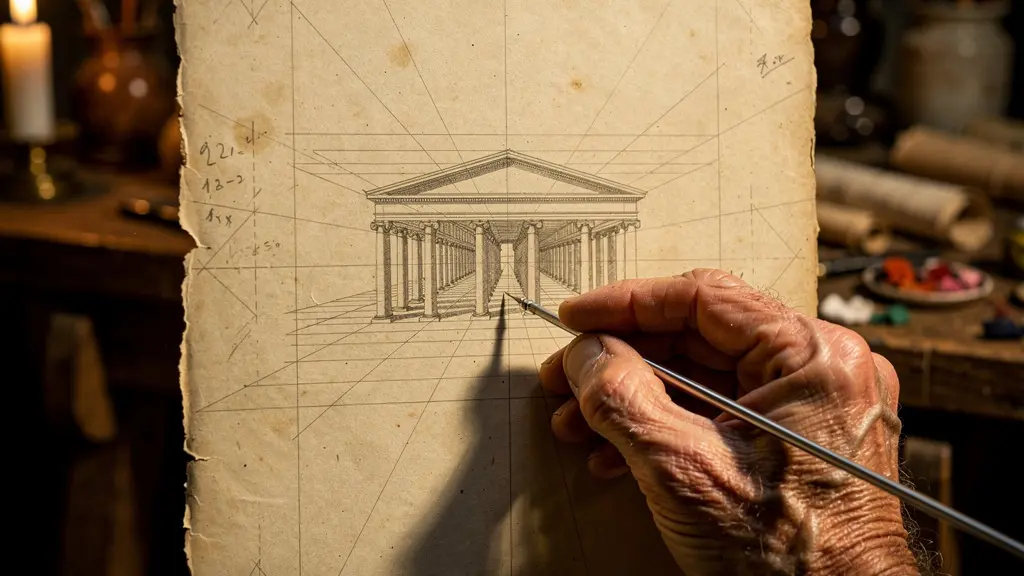
Spotting its use involves looking for a set of specific visual cues that, once understood, become readily apparent in works from the Early Renaissance onward. The most crucial element is the vanishing point, a single point on the horizon line where all parallel lines (known as orthogonals) appear to converge. This simple but powerful device organizes the entire composition, dictating the proportional recession of objects into the distance. By mastering this technique, artists could create spaces that felt rational, ordered, and, most importantly, “real” to the viewer. To train your eye, you can use a systematic checklist to analyze paintings.
Your Checklist for Identifying Linear Perspective
- Find the Vanishing Point: Look for a single point, often near the center of the painting, where all parallel lines (like floor tiles or building edges) seem to converge.
- Identify the Horizon Line: Trace the implied horizontal line that runs through the vanishing point; this represents the viewer’s eye level.
- Observe Diminution: Notice how objects and figures get systematically smaller as they recede toward the vanishing point.
- Check for Atmospheric Perspective: Look for how distant objects become hazier, less detailed, and bluer in color to enhance the illusion of depth.
- Locate the Implied Viewer: The entire construction is built for a single, static viewpoint. Try to determine where the artist intended the viewer to stand.
Why Do Academies Force Students to Copy Old Masters for Years?
The practice of forcing students to spend years copying plaster casts and Old Master paintings can seem, to a modern observer, like a tedious exercise designed to stifle originality. However, from within the logic of the “Mimetic Engine,” it was the only conceivable way to transmit the highly complex and nuanced language of naturalism. Before the avant-garde movements of the late 19th century, the goal of art was not radical self-expression but the mastery of a shared, traditional craft. Copying was the apprenticeship. It was how one learned the subtleties of anatomy, the behavior of light on form, and the proven compositional strategies developed over generations.
This system was a direct descendant of the Renaissance workshop, where apprentices would grind pigments and copy the master’s drawings for years before being allowed to contribute to a final painting. In fact, historical evidence shows that artistic apprenticeships could last 7-10 years, a testament to the depth of skill required. The academies simply institutionalized and scaled this model. By copying, students weren’t just learning to draw a hand; they were internalizing an entire visual syntax. They were learning the “language” of Western art, and as with any language, fluency requires immense practice and immersion before one can compose original “poetry.”
Mimesis is the traditional language of fine art
– Academic study on artistic tradition, Comparative Study of Abstraction in Art
This approach assumes that creativity emerges from mastery, not from a vacuum. An artist could only “break the rules” meaningfully after they had completely mastered them. The academic curriculum was therefore seen as a necessary foundation, providing the technical arsenal required to achieve the highest levels of illusionism. For the academies, teaching art without this rigorous, copy-based training would be like trying to teach literature to someone who hasn’t yet learned the alphabet.
Key Takeaways
- The Western focus on mimesis was not just a style but a self-reinforcing system—a “Mimetic Engine”—driven by science, technology, and institutions.
- Tools like linear perspective and institutions like the art academy codified realism into a rigid, teachable curriculum that dominated for centuries.
- The rise of abstraction was not merely a change in taste but a “Representational Collapse”—the breakdown of this entire system’s worldview after WWI.
What Events Triggered the Collapse of Naturalism After World War I?
For centuries, the “Mimetic Engine” ran at full steam, but by the early 20th century, it began to sputter and seize. A series of profound cultural, technological, and psychological shocks converged to trigger a “Representational Collapse.” The horrors of World War I, with its mechanized slaughter and shattered landscapes, rendered the polished, orderly world of academic naturalism obsolete and even offensive. How could an artist paint a heroic battle scene in the face of mustard gas and trench warfare? Realism seemed utterly inadequate to express the trauma and disillusionment of a generation. Artists like the German Expressionists and Dadaists rejected it, seeking a more raw, direct, and often brutal visual language to convey their inner reality.
This psychological crisis was compounded by intellectual and spiritual shifts. The theories of Freud suggested that true reality lay not in the visible world but in the subconscious mind. Simultaneously, many artists felt a profound spiritual void as the cultural influence of traditional religion waned. This led to a deliberate quest for new transcendental truths, a search for the universal spiritual essence hidden beneath the “mere appearance” of things. The rise of abstraction was a direct result of this quest.
The Quest for New Spiritual Foundations in Abstract Art
Of all the historical and cultural forces working to generate abstract art, none was more powerful than the quest for new ideological and spiritual foundations. The desire to find and portray a hidden universal spirituality drove the diverse art of modernist giants like Kandinsky, Malevich, and Mondrian, who believed that pure form and color could communicate profound truths more directly than any representational image. This quest effectively dismantled the old mimetic system from within, replacing it with a new focus on inner vision.
The final blow came from the art world itself. The avant-garde, once a fringe movement, gained critical and commercial traction. When the critic Robert Coates first labeled a group of New York painters, the movement was formally recognized when they were dubbed “Abstract Expressionists” in 1946. This marked the moment when the alternative paradigm became the new establishment. The “Mimetic Engine” had finally broken down, freeing Western art to explore the vast, non-representational territories it had ignored for so long.
Self-Taught vs. Art School: Which Technical Approach Builds Better Skills?
The historical schism between Western mimesis and global abstraction sets the stage for a contemporary debate: in an era after the collapse of the academy’s dominance, what is the best way to acquire artistic skill? The old binary of the rigid, academy-trained artist versus the “naïve” self-taught visionary is a relic of the “Mimetic Engine.” Today, the lines are blurred. The fundamental question is no longer about adhering to a single tradition but about which approach best equips an artist to realize their unique vision, whether it be representational, abstract, or a hybrid of the two. Art school offers a structured environment, access to resources, and a critical community, but can sometimes still carry the DNA of academic dogma.
The self-taught path, empowered by the internet, offers infinite freedom and access to a global library of techniques, but it lacks the focused mentorship and critical feedback that can accelerate growth. There is no single “better” approach; rather, the effectiveness of each depends on the artist’s goals and temperament. However, the influence of mimesis has not disappeared. Even in contemporary art, representation remains a powerful tool. Many artists continue to use imitation and realism not as an end in itself, but as a strategy to explore and critique social norms, identity, and the nature of reality itself. The skill of mimesis is now one tool among many, rather than the only tool in the box.
This new landscape has given rise to hybrid models of learning, where artists combine formal education with online tutorials, workshops, and peer networks. This reflects a broader shift in understanding artistic skill. It is no longer seen as the mere ability to copy what the eye sees, but as the ability to develop a personal visual language and deploy the right techniques—whether learned in a school or a studio—to articulate a compelling vision. The ultimate measure of skill is not the “how” of its acquisition, but the “what” of its final expression.
Understanding this long and complex history empowers you, the art student, to look at any work of art with a more critical eye. By deconstructing the forces that shaped its creation, you can move beyond simple appreciation and engage in a deeper, more meaningful analysis of its place in the grand, divergent narrative of global art.